Kensuke Ogawa
Kensuke's KingdomKensuke Ogawa is a Japanese doctor, castaway, and guardian of an island community of orangutans whose history of war and loss shapes his wary welcome of Michael. First encountered as an authority who bans fire, marks off territory, and forbids swimming, Kensuke is later revealed as the boy’s rescuer and daily provider. His transformation from isolation to affection does not end in a conventional return: when Michael can go home, Kensuke remains in the island he calls his kingdom, accepting the separation while binding the two through promises and memory.
Identity and Background
Born and raised in Nagasaki, Kensuke studied medicine in Tokyo and became a doctor who cared for mothers and newborn babies. He later studied at Guy’s Hospital in London, where he learned some English, before returning to Nagasaki. He married Kimi and had a son, Michiya; he remembers this earlier period as a happy family life. When the war began, he joined the Japanese Navy as a doctor aboard a warship, staying with his patients during an American air attack even as the ship was bombed and its crew and patients died.
Kensuke survived aboard the damaged ship, which continued moving after its engine was left running. Listening to the radio, he learned that an atomic bomb had fallen on Nagasaki. He believed Kimi, Michiya, his mother, and the rest of his family had died. When Japan surrendered, his grief was so great that he says he wanted to die. A storm carried the ship to the island, where he survived despite expecting that he would not. He salvaged food, clothing, sheets, pots, bottles, a knife, binoculars, medicine, and tools before another storm drove the ship onto rocks and sank it. The wreck remained on the island as a physical trace of the life that had brought him there.
Survival and Self-Imposed Isolation
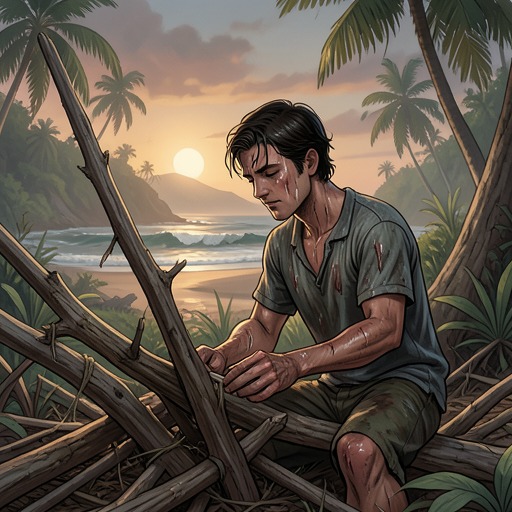
Alone on the island, Kensuke initially lived like a beggar and struggled with the belief that he had survived while his friends and family had not. His encounter with the orangutans changed his sense of the place: he found them kind and the island beautiful and peaceful, and came to regard survival there as a reason to stay. By observing what the orangutans ate and how they moved, he learned to find food, climb, and interpret their warnings. Over time, he built their trust and became part of their community.
Kensuke’s solitude hardened after hunters arrived with guns. He concealed the orangutans in his cave by calling them with a song, but the hunters shot gibbons, killing mothers and taking their babies. Kensuke came to think of people as killers and wanted no human company. That fear governs his first response to Michael: he does not want anyone to discover the island, harm its animals, or find and remove him. His isolation is therefore not simply a preference for solitude; it is also a protective strategy rooted in war, presumed bereavement, and the hunters’ violence.
Michael’s Arrival and the Island’s Rules
Kensuke first enters Michael’s account as the man who forbids fire. When Michael tries to explain that smoke could bring his parents to the island, Kensuke draws a map in the sand, divides it with a line, and assigns Michael to the smaller end. He identifies himself as the island’s owner and orders Michael away. He also smothers the boy’s fire. The boundary, which Kensuke renews as needed from the forest to the sea, makes his terms visible: Michael must stay on his side and not light fires.
The prohibition conceals both fear and care. Kensuke had already brought Michael food and water, and he continues replenishing the boy’s supplies, as well as Stella’s water bowl. He explains later that he had found Michael, Stella, and the ball at sea and brought them back to the island. He left food and water because he did not want Michael to die, even though he wanted him gone. Once Michael recognizes that the provisions are deliberate, he understands that Kensuke will keep them alive only so long as they follow his rules. Dependence makes the boundary difficult to challenge: Michael has limited success finding fruit or fishing for himself and still needs Kensuke’s daily food and water.
Kensuke also forbids Michael to swim after a storm has filled the sea with dangerous jellyfish. When Michael enters the water anyway, Kensuke wades out, takes him by the arm, and leads him back to shore, making clear that the warning is a command. Michael resents the restrictions but initially gives in because he depends on Kensuke. After Michael crosses the boundary and swims in defiance, a jellyfish stings him. Kensuke brings him to the cave, treats him with vinegar made from berries, and helps him recover. The episode exposes the double nature of Kensuke’s authority: it is controlling, but it also responds to dangers Michael does not understand.
From Conflict to Shared Life
The deeper history of their relationship comes out during a fishing trip in Kensuke’s outrigger boat. He tells Michael that he had been swept away from the island while fishing, and that he heard a voice and saw a light before finding Michael, Stella, and the ball in the sea. Michael had nearly died; Kensuke had saved them. He also recounts why he initially treated the boy harshly: he wanted to remain alone, feared discovery, and believed people would endanger the orangutans and gibbons. The account reframes the early hostility without erasing its effect on Michael, who had felt frightened, abandoned, and bewildered.
Trust takes shape through repeated practical acts and shared routines. After the rescue and Michael’s recovery, Kensuke and the boy fish together, gather fruit, and live according to a steady daily pattern. They wash at a stream, share meals, and sit together at the cave entrance to watch the sun set; at the end of the day they bow to each other without speaking. Kensuke, who wastes nothing, uses the fish and gathered ingredients to prepare their food. In time he also teaches Michael to paint shells, showing him how careful observation and a picture formed in the mind guide the brush. Their friendship develops through this quiet instruction and work as much as through speech.
The annual emergence of the sea-turtle hatchlings gives their shared life a common purpose. Kensuke explains that mother turtles lay their eggs on the island and that the young make their way to the sea on a night when the moon is high. Many are at risk from birds or become stranded. He and Michael patrol the beach, turn over hatchlings trapped on their backs, and carry weak ones to the water. At dawn they drive the birds away, though some turtles are still taken. The vigil brings them together in a form of care that extends beyond their own survival, and it shows Kensuke’s long-standing commitment to the island’s animal life.
Family, Separation, and the Kingdom
Kensuke eventually tells Michael that the boy has become like a son to him. He connects Michael’s separation from his mother with his own lasting memories of Kimi and Michiya: even though he believes his family dead, they remain present in his thoughts. He admits that he hated Michael at first, then grew attached to him, and says he wants him to stay. At the same time, Kensuke recognizes that Michael wants to return home and that this is right for the boy. His care changes from keeping Michael safe on the island to accepting a choice that means losing his daily company.
When the Peggy Sue returns, Kensuke explains why he will not leave. He believes that, even if Kimi and Michiya survived, they would have long thought him dead; he would return as a stranger to a changed family and would no longer be the person they remembered. He also regards the orangutans as his family and fears the hunters may come again. Calling the island his kingdom, he describes remaining there to care for its people as a matter of honour and responsibility. The decision resolves the story’s central conflict without making the two men’s desires identical: Michael goes home, while Kensuke chooses the island and the life he has built there.
Before they part, Kensuke asks Michael for three promises: to paint every day and become a great artist, to remember him when he is home in England, and to keep Kensuke’s existence and the island secret for ten years. He gives Michael the ball and tells him that he is a better painter than a footballer. They bow to each other; Kensuke calls their acquaintance an honour, and Michael leaves in tears before rejoining his parents aboard the Peggy Sue. The ball, recovered and returned by Kensuke, accompanies Michael home, while the promises preserve a connection that neither shared residence nor a return to the past can provide.
Narrative Significance
Kensuke’s arc is organized around the shifting meanings of boundaries and care. At first, the line in the sand and the bans on fire and swimming make the island a territory under his control. As Michael learns what lies behind those rules, the same acts can be read alongside Kensuke’s provision of food, rescue at sea, and treatment of the jellyfish sting. Protection does not excuse the fear and restriction Michael experiences, but the later account makes clear that Kensuke’s rules arise from his effort to prevent another encounter with human violence.
The story also sets two forms of survival beside one another. Michael’s terror in the sea is followed by the discovery that Kensuke, himself adrift and frightened, had heard him and come to help. Kensuke survives war and loss by withdrawing from people and attaching himself to the island’s animal life; his friendship with Michael opens that isolation without persuading him to abandon his chosen home. The ending preserves both the bond and the separation: Kensuke stays to care for the orangutans, while the boy carries his lessons, the ball, and the promise to remember him back to England.