Kensuke’s island
Kensuke's KingdomKensuke’s island is both a remote refuge and a place of enforced separation: Michael arrives there alone after being swept away from the Peggy Sue, while Kensuke has made it his home after years of isolation. The island’s beauty contrasts with its hazards and with the history of violence that has led Kensuke to keep other people away. As Michael and Kensuke build a relationship there, the place shifts from an apparent prison into a shared home—and, for Kensuke, a kingdom he will not abandon.
Setting and first impression
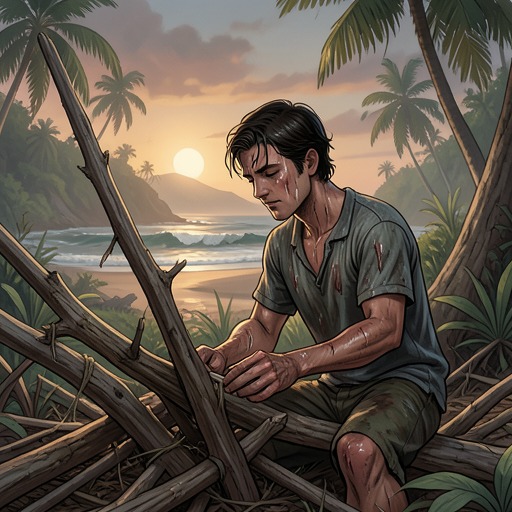
From a hilltop, Michael sees sea on every side and understands that he is on an island with no visible sign of human life. He estimates it to be two or three miles long, shaped like an elongated peanut, with white beaches, two hills, and forest covering nearly all the ground between them. The view is at once isolating and beautiful: Michael recognizes the danger of being stranded, yet the green island framed by beach and sea leaves him unexpectedly elated that he and Stella Artois have survived.
The island’s apparently empty coastline conceals a human presence. Kensuke has already brought Michael food and water, but after Michael lights a fire, he marks a boundary in the sand map and assigns the boy to the smaller end of the island, near his cave. Kensuke’s rule is explicit: Michael must stay on his side, and there must be no fire. The island is therefore not simply uninhabited wilderness; it is a territory whose access and use Kensuke controls.
From voyage to island refuge
The island stands at the far end of a journey begun when the Peggy Sue set sail from Southampton on September 10, 1987. Michael later describes the voyage through selected entries from his ship’s log. The family’s route makes landfall and open water part of his growing sense of home: on April 3, off Perth, he records their excitement at reaching Australia after crossing the ocean from England. Months later, after storms in the Coral Sea, the family’s navigation becomes uncertain and Michael is left at the wheel while his parents sleep.
On the dark night before his twelfth birthday, Michael falls overboard while trying to bring Stella Artois back aboard. The Peggy Sue’s lights disappear, and he fears he is alone in the water with no hope of rescue. He finds Eddie’s soccer ball and clings to it for buoyancy, but the island is not reached by a planned voyage or a visible rescue vessel. Kensuke later explains that he had gone fishing in a boat, was carried away by the wind and sea, and heard a shout and saw a light. He found Michael, Stella Artois, and the ball, brought them back near the island, and left the boy on the beach with provisions.
A lived-in landscape and contested refuge
Kensuke’s long residence has made the island a place of learned survival rather than mere isolation. He tells Michael that he learned what was safe to eat by watching the orangutans, imitated their climbing, and came to understand their warning signals. Over time, he built trust with them and became part of their world. The island’s forest thus provides both sustenance and a community that Kensuke values, even as the beach, cave, and hills mark the limits of his contact with people.
That refuge is shadowed by hunters. Kensuke says that armed men came to the island, hunted, and killed gibbons, including mothers whose babies they took. He hid the orangutans in his cave when they were frightened, singing to draw them to safety. The episode helps explain why he fears that people will find the island and harm its wildlife. His prohibition on fire and his division of the island are not arbitrary rules in his account: they are measures meant to keep outsiders from discovering his refuge and the animals he protects.
Separation, friendship, and belonging
At first, Michael experiences the island as confinement. He stays in his cave after Kensuke drives him away, feeling abandoned and bewildered; he can see no way to leave except to attract a passing ship. The cave begins to feel like home because he has no other, even though he believes that the island may contain only himself, Kensuke, and the animals. His isolation is sharpened by the contrast between Kensuke’s earlier kindness in leaving food and water and his refusal to meet or speak with him.
The distance between them changes through shared life on the island. Kensuke eventually explains that he had feared people because of the hunters and had wanted to be alone, but that after Michael survived the dangers of the sea and the jellyfish, the two became friends. They fish, paint, and live together; Kensuke comes to regard Michael as a son and says that he is now part of his family. The island that once separated them into opposing territories becomes the setting for care, explanation, and chosen belonging.
Kensuke’s kingdom and its meaning
When the Peggy Sue returns, Kensuke declines to leave. He says that Japan belongs to an earlier life, that he would be a stranger to Kimi and Michiya if they were alive, and that his orangutan family needs someone to protect them. He calls the island Kensuke’s Kingdom and describes his responsibility as that of an emperor who must not run away from his people. The title gives a name to a home defined not by ownership alone but by care, memory, and duty.
Michael leaves the island with his parents, while Kensuke remains. Their separation does not cancel their bond: Kensuke asks Michael to paint, remember him, and keep the island and Kensuke’s presence secret for ten years so that no one will come looking for him. Michael runs toward the Peggy Sue and is reunited with his mother and father, but he first watches the yacht arrive from the trees and says goodbye to Kensuke. The island is therefore both the place Michael must leave to return to his family and the home Kensuke chooses to preserve, holding together the story’s contrasting meanings of rescue, refuge, and belonging.