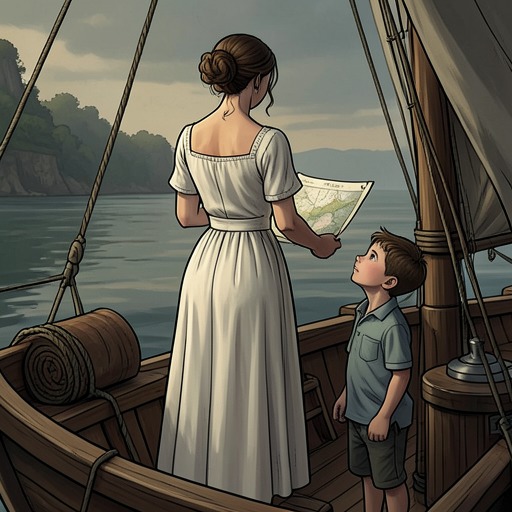
Michael's parents
Kensuke's KingdomMichael’s parents are a partnership reshaped by hardship, sailing, and separation. The brickworks’ closure first strains their family life and leaves them without work; a voyage they undertake together restores their shared purpose, while the search for Michael tests that bond in a different way. His mother persists in believing he is alive, and his father eventually joins her in sailing from island to island until they find him.
Hardship and a divided household
The closure of the brickworks and the parents’ layoffs bring a sudden end to the household’s earlier ease. After the news, the family sits in silence at breakfast, and Sunday sailing stops. Both parents seek work without success, and the house becomes marked by arguments over small matters and long stretches when they do not speak. Michael’s father, formerly someone who fixed things around the house, is scarcely home; when he is there, he sits quietly with yachting magazines. The change is visible not only in the family’s finances but in the routines and shared pleasures that disappear with them.
The parents respond differently when Michael’s father proposes a move south. He sells the car and says he will find the family a place, but does not explain his full plan. Michael’s mother refuses to leave the house where she was born, citing the house, Grandma, and school. The family’s disagreement reaches a painful point when Michael’s father observes that the only wage coming in is the money his eleven-year-old son earns on his paper route. A week or so later, a phone call changes the mood: Michael’s mother hears that her husband sounds like his old self. He has found a place in Fareham, near Southampton and the sea, and is ready for his family to join him. When they arrive, he is bright-eyed and laughing, has planned the move, and greets Michael warmly. The return of energy and confidence foreshadows a new life built around sailing.
A family made into a sailing crew
Aboard the Peggy Sue, the parents’ relationship with Michael becomes more companionable and cooperative. Michael describes his father as a friend and shipmate, someone on whom he can rely. His mother takes the lead as skipper: she studies books and charts until she has mastered what the voyage requires, and the family trusts her to take them around the world and back. Though she can be strict about keeping the boat shipshape, the others accept her authority; the three of them work as a team at the winches, at the helm, and in the galley.
The voyage begins on September 10, 1987, with the boat loaded with stores and provisions. Grandma and friends come to see them off, and the parents’ new undertaking turns family plans into a shared expedition. The log format preserves the voyage as a succession of dated passages and discoveries, while also showing the parents making decisions together. Ten days after leaving Southampton, they take turns keeping watch in the Channel and do not yet allow Michael to stand watch alone. As they sail down Africa’s west coast, his mother explains the route on the chart: the wind will carry them south before they cross the Atlantic, while drifting off course could leave them becalmed in the Doldrums.
The parents’ happiness is especially apparent at Cape Town. They tell Michael they can afford to stop for a couple of weeks, perhaps longer, and visit the wildlife he has hoped to see. They had delayed telling him because they were unsure whether the stop was financially possible. When they share the news, they laugh like children; Michael notices that they smile at each other more than they did at home. On another evening, the parents’ competitive ease appears in their chess games: his mother leads his father twenty-one games to twenty, while he jokes that he let her win for Christmas. These moments contrast with the silence and friction of the earlier household, without suggesting that the voyage has removed every difficulty.
Shared achievement and mounting strain
When the Peggy Sue reaches Australia, the family’s response combines delight in the landfall with affection for the time spent at sea. After the long stretch of empty ocean from Africa, they hug and jump up and down at the sight of Perth. They recognize that they have sailed from England to Australia, halfway around the world, under their own power. Michael says that they all value the solitude of being at sea together, even though each sighting of land brings a fresh burst of excitement. Their shared achievement gives concrete form to the confidence the family had placed in the voyage and in their roles as a crew.
The journey also carries a problem the parents cannot simply master through seamanship. Michael’s mother has recurring stomach cramps, first noted around the Cape Town stop and still troubling her by the time the family reaches Australia. She promises to see a doctor there. After leaving Sydney, however, the family encounters successive storms in the Coral Sea. The rudder cable snaps, the self-steering fails, and someone must remain at the wheel. Because his mother is ill, the burden falls on Michael’s father and Michael; they navigate together while she cannot consult the charts. His father wants to send a Mayday call, but his mother refuses, seeing it as giving in. On the dark night before Michael’s twelfth birthday, she is too sick to eat and the family is unsure of its position. The scene exposes the limits of the parents’ control: their voyage has made them a capable team, but illness and damage place them in danger despite their efforts.
Separation and the search
Michael is swept from the Peggy Sue in the darkness after going forward to retrieve Stella Artois. His parents’ boat disappears from his view, and he concludes that his cries cannot reach them. On the island, he comes to feel abandoned and alone, with the cave beginning to seem like the only home he has. The account initially leaves the parents’ knowledge and response outside his immediate perspective; their absence is part of the uncertainty that shapes his isolation.
The later account establishes the scale and duration of their response. For almost a year, Michael’s parents search for him, sailing from island to island. Other people do not believe he could still be alive, and his father later admits that he had given Michael up for dead. His mother does not: she holds to the belief that he is alive and that they must find him. Their persistence culminates when the Peggy Sue reaches the island. Stella Artois runs onto the beach barking at the boat, and Michael sees his parents aboard. His mother cries and embraces him, repeating that she had said they would find him; his father’s first words are the familiar greeting, “Hello, monkey face.”
Reunion and significance
The reunion restores the family, but it does not erase the separation that preceded it. Michael has lived through an ordeal his parents could not witness, while they have spent months searching amid widespread disbelief. The contrast between his father’s eventual acceptance of the possibility that Michael was dead and his mother’s continued conviction makes their different responses explicit. The search is presented not as a miraculous certainty but as an act sustained by faith: his parents keep sailing until they reach the place where he is.
Across the story, Michael’s parents’ relationship is associated with both practical cooperation and emotional renewal. Unemployment divides their household and dismantles familiar routines; the voyage gives them a common undertaking in which his mother’s preparation, his father’s participation, and Michael’s growing work as crew can reinforce one another. Their search then turns that shared mobility toward a single purpose: bringing their missing son home. In the end, the parents are not merely the family Michael has lost sight of; they are the people who continue looking for him until the Peggy Sue returns to his horizon.