Nagasaki
Kensuke's KingdomNagasaki is the Japanese coastal city that frames Kensuke Ogawa’s life before and after the war. It is where he grows up, returns as a doctor, and builds a family; after hearing that an atomic bomb has fallen there, he believes his wife, Kimi, his son, Michiya Ogawa, and the rest of his family have died. That mistaken certainty helps explain his decision to remain alone on an island for decades, and the eventual correction gives his history a second ending.
Home and Family
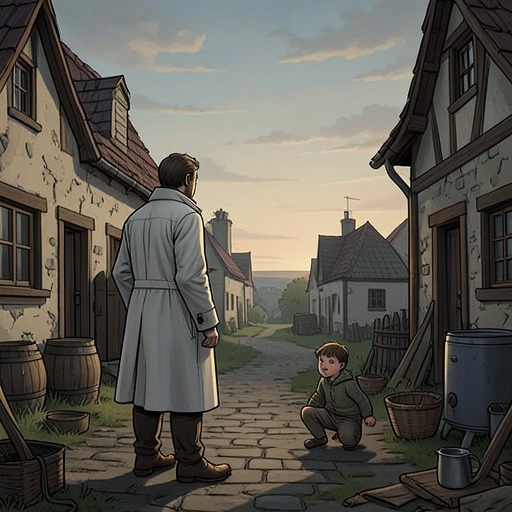
Kensuke describes Nagasaki as a large town by the sea. After studying medicine in Tokyo and at Guy’s Hospital in London, he returns to the city as a doctor, proud of caring for mothers and newborn babies. He marries Kimi and has a son, Michiya. In his account, these are years of family happiness: he often returns home while serving in the Japanese Navy and watches his son grow.
Nagasaki is more than a point of origin in Kensuke’s story. It is the home he repeatedly imagines when he remembers Kimi and Michiya, and the place whose reported destruction makes return seem pointless. His attachment to the city is bound up with his identity as a physician, husband, and father before wartime loss reshapes those roles.
The Atomic Bombing and Kensuke’s Belief
During the war, Kensuke serves as a doctor aboard a large warship. After American aircraft bomb the ship, he remains with his patients; he later finds that they and the other sailors have died, while he alone has survived aboard a vessel still moving without his control. Listening to the radio, he hears that an atomic bomb has fallen on Nagasaki. He concludes that Kimi, Michiya, his mother, and his whole family must have been killed.
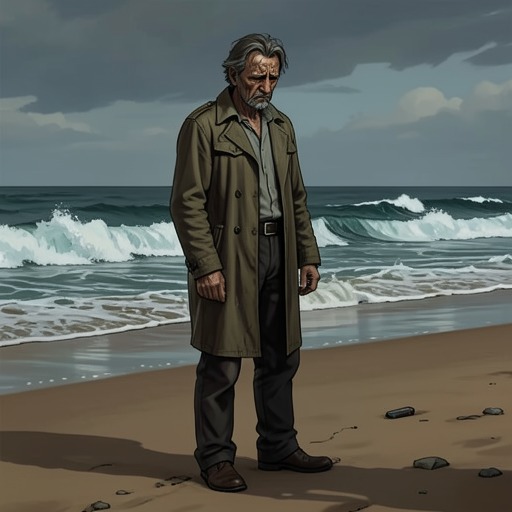
The novel presents this conclusion as Kensuke’s understanding at the time, not as a confirmed account of what happened to his family. He later hears American soldiers say that everyone in Nagasaki is dead, and takes their words as further proof. Believing there is no family left to return to, and unwilling to surrender, he hides from the soldiers when they come to the island. Their departure leaves him alone with a conviction formed from incomplete information.
From Nagasaki to the Island
After Japan’s surrender, Kensuke says he wants to die. Instead, a storm and the sea carry his damaged ship to the island. He salvages supplies and tools before another storm drives the ship onto the rocks; its rusting remains, partly buried in sand, later help Michael understand the connection between Kensuke and the wreck.
Kensuke survives by finding food and water and gradually learns from the island’s orangutans. He comes to see the island as peaceful and decides to stay. The choice is shaped by the belief that his family has died, but it also becomes bound to his fear of people: after hunters arrive and kill gibbons, he generalizes from violence to a distrust of humanity. His isolation is therefore both a refuge from the war’s aftermath and a life organized around a loss he cannot verify.
The Late Correction
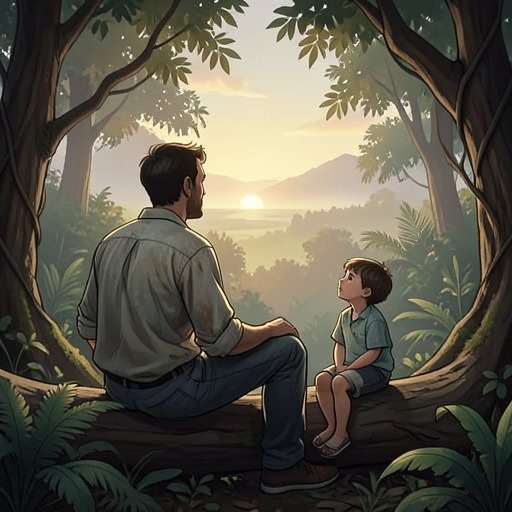
Years later, Kensuke tells Michael that he has never forgotten Kimi or Michiya, even though he believes them dead. He compares this continuing presence in memory with Michael’s mother’s enduring hope that her missing son is alive. As Kensuke prepares to part from Michael, he acknowledges that the boy is like a son to him, while recognizing that Michael’s proper course is to return home. The parallel makes the separation echo his own family loss without making the two situations identical: Michael’s parents are still searching, while Kensuke has believed his family irretrievable.
The closing letter changes the meaning of Kensuke’s remembered history. Michiya writes that he is Kensuke’s son and that, until reading Michael’s book, he too believed his father had died in the war. He explains that he and his mother survived because they had gone into the countryside to visit his grandmother before the bomb fell; Kimi died only three years before he wrote. Michael later travels to Japan and meets Michiya. Thus Nagasaki’s bombing did not kill the family Kensuke mourned, though the long separation meant that neither father nor son knew the other had survived. The city stands at the center of a painful error that the act of telling, and the later reunion of their stories, finally exposes.