Sea Turtle Hatchling Night and Kensuke’s Decision to Return to Japan
Kensuke's KingdomThe annual sea-turtle hatching becomes a turning point in Kensuke and Michael’s life on the island. Through a night spent protecting hatchlings as they make their way to the sea, Kensuke recognizes in their uncertain departure a courage he has not been able to find in himself; he decides to leave the island with Michael and go home to Japan.
The Night Call to the Beach
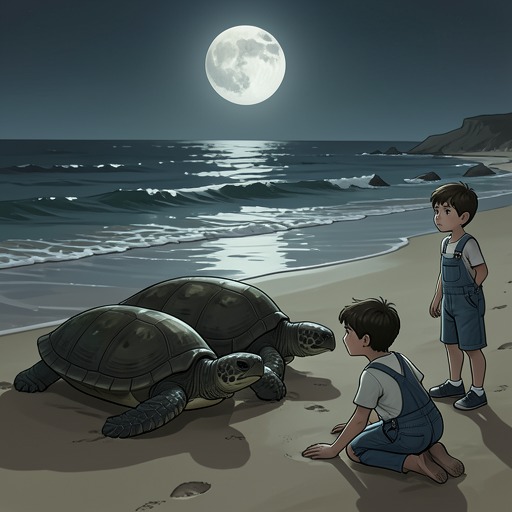
Kensuke wakes Michael from sleep and urges him to come quickly. Michael follows him down the track in the moonlight, with Stella Artois at his heels. At first the beach appears empty. Kensuke kneels in the sand and explains that the tiny animals are sometimes too weak to survive until morning, when birds arrive. Michael then sees hatchlings emerging from holes and heading toward the water: first a few, then dozens and hundreds, perhaps thousands, spread across the beach.
The scene shifts the island’s nighttime stillness into a shared task. Stella Artois noses toward one of the turtles, and Michael warns her away. Kensuke gently turns over a hatchling that has become trapped on its back, setting it upright so it can continue toward the sea. Rather than merely telling Michael about the turtles, Kensuke draws his attention to a particular creature in immediate need; their vigil begins in practical acts of care.
An Annual Migration and Its Risks
Kensuke explains that mother turtles lay their eggs on the beach and that the young emerge one night each year, when the moon is high. The journey from their nests to the sea is long, and many do not survive it. He stays to protect them from birds, which might otherwise eat the hatchlings, and says that the turtles return when grown to lay eggs themselves. Their movement away from the beach is thus part of a recurring cycle: the hatchlings depart, but the adult turtles may later come back to the same place.
Michael and Kensuke keep watch throughout the night. They examine holes for turtles that are stuck or stranded, carry several too-weak hatchlings down to the water, and turn dozens right-side up. At dawn, when birds arrive to scavenge, Stella Artois chases and barks at them while the two humans run, shout, wave, and throw stones to drive them off. Their efforts are not wholly successful: some turtles are taken from the water by birds. By noon, however, most have made it to sea, and Michael and Kensuke watch the last of them swim away while standing ankle-deep in the water.
Kensuke’s Decision
The hatchlings’ passage gives Kensuke a way to reconsider the choice he has made to remain alone. He calls them very brave because they do not know what awaits them, yet go anyway. Their action does not erase the uncertainty he faces, but it offers him a model for meeting it. He tells Michael that when a ship eventually comes and they light their beacon, he will leave with him and return to Japan. He hopes to find Kimi and Michiya Ogawa and learn the truth about what happened to them.
The decision reverses Kensuke’s earlier refusal to return home. He has told Michael that he chose to stay on the island and that returning to Japan would bring him sadness; he also understands that Michael, unlike him, wants to go home. The hatching does not make their desires identical or promise that Kensuke will find his family. Instead, it marks his willingness to face that uncertainty and depart alongside Michael. His phrase, “Like turtles I go,” connects the choice directly to the hatchlings’ journey from the island toward an unknown future.
The Island as Refuge and Threshold
The hatching carries particular weight because both characters have arrived at the island through frightening separations. Michael was lost at sea and, after reaching the island, described his cave as home while feeling abandoned and alone. Kensuke, who rescued Michael, initially wanted people to stay away. His hostility arose in part from the hunters who had come to the island with guns, frightened the orangutans, and killed gibbons; he feared that other people might return, harm the animals, or find and remove him.
As Kensuke later explained, that fear shaped his first treatment of Michael: he left him food and water but drew a line to keep him away and put out the fire that might attract attention. Their relationship changed through subsequent care and shared life, until Kensuke came to regard Michael as a son. The turtle vigil extends that relationship through cooperation: they protect vulnerable lives together, and the work ends with Kensuke placing his arm on Michael’s shoulder before announcing his decision. The island, once a place Kensuke defended against human approach, becomes a temporary refuge from which both can contemplate departure.
From Hatching to Rescue
Kensuke’s decision depends on the future arrival of a ship and the rescue beacon he and Michael have built. The annual hatching does not itself bring rescue, and they remain on the island afterward. Rain later keeps them inside the cave for days, saturates the beacon, and makes Michael worry that it will not dry. Even so, Kensuke’s commitment has changed: leaving is no longer only Michael’s hope, but a course they have agreed to share when the opportunity comes.
The episode therefore links a natural cycle to a personal turning point without suggesting that departure is easy or guaranteed. The hatchlings’ return to the sea supplies the image and lesson through which Kensuke can accept leaving the island he made his home. His promise to go with Michael gives their eventual rescue a consequence beyond Michael’s reunion with his parents: it opens the possibility that Kensuke, too, will face the journey home and discover what became of his family.