Sea turtles
Kensuke's KingdomSea turtles are both inhabitants of the island’s annual cycle and the occasion for one of Michael and Kensuke’s most consequential acts of cooperation. On the night the hatchlings emerge, the two patrol the beach, turn stranded turtles upright, carry the weakest to the water and drive off birds. Watching creatures smaller than themselves set out without knowing what awaits them helps Kensuke recognize a courage he has lacked: he resolves to leave the island when rescue becomes possible and go home to Japan.
The annual emergence
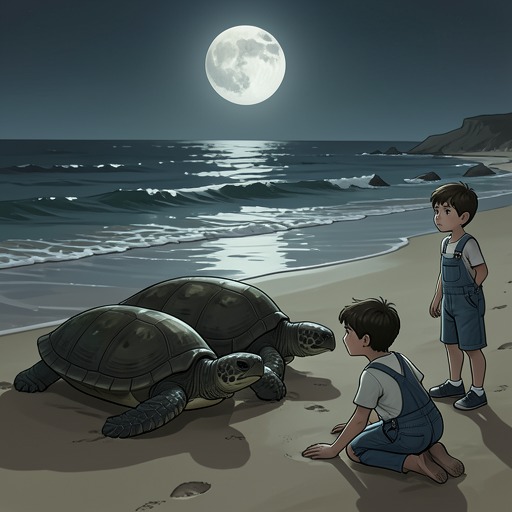
Kensuke explains that mother turtles come ashore to lay their eggs and that, once each year, on a night when the moon is high, the hatchlings emerge. The distance from their nests to the sea is dangerous: many die before reaching it, and birds wait to feed on them. Kensuke therefore stays to protect them, chasing the birds away. His account makes the event more than a remarkable sight for Michael. It is a recurring responsibility, one that gives Kensuke a reason to remain attentive to the island’s animals and their vulnerable passage between land and sea.
The emergence begins with a single tiny turtle climbing out of a hole and heading down the beach. Then Michael sees more—dozens, hundreds, perhaps thousands—scuttling across the moonlit sand. Their numbers transform the shoreline into a place of urgent movement. Stella noses at one hatchling, and Michael warns her away; even a familiar companion could become a danger to such small creatures. The scene asks for attention to individual lives as well as the mass of them: each turtle must make its own way to the water, and some cannot manage alone.
A night of shared protection
Michael and Kensuke keep watch through the night. They search the holes for turtles that have become stuck or stranded, right several that are lying on their backs, and carry some of the weakest down to the sea. The water seems to revive them, and they swim away without needing instruction. Their help is practical rather than symbolic: the humans identify obstacles on the beach and intervene where a hatchling cannot get past one unaided.
At dawn, the threat shifts from the journey across the sand to the birds arriving to scavenge. Stella chases and barks at them while Michael and Kensuke run, shout, wave and throw stones. Their efforts do not save every hatchling. Some are taken from the water by birds despite the group’s attempts to drive them off. By noon the mass emergence is over; the last turtles swim away as Michael and Kensuke stand ankle-deep in the sea. The imperfect outcome matters: their care improves the hatchlings’ chances, but cannot make the island safe or control every loss.
A lesson in departure
Kensuke watches the hatchlings leave and tells Michael that, though they are small, they are brave: they do not know what they will find, but they go anyway. He understands their departure as a lesson for himself. When a ship eventually comes and they light a fire to attract it, he will leave too. He will go with Michael to Japan, hoping to find Kimi and Michiya and learn the truth about them. The turtles’ journey thus changes the meaning of departure for Kensuke: going is not simply an exposure to unknown dangers, but an act that may be necessary to reach home and discover what happened to the people he has not forgotten.
This decision grows out of the island life the two have built together. At first, Kensuke enforced a boundary across the island, required Michael to remain on his end, and forbade fires. Later, they share work and meals, including fish soup cooked over a fire, and sit together at the cave entrance to watch the sun set. Their rescue of the hatchlings is another shared practice, but unlike the repeated evening ritual, it faces outward: they help living creatures make a dangerous passage away from the island. The turtles’ departure anticipates Kensuke’s own, while leaving open whether his hoped-for reunion will succeed.
Ecological and narrative significance
The hatchlings’ survival depends on close attention to the island’s recurring conditions: the nesting place, the high moon, the route across the beach, and the birds that arrive at dawn. Kensuke’s knowledge is expressed through what he does—remaining on the beach, checking holes and protecting the young—rather than through abstract claims of mastery over nature. Michael joins that work, and the episode marks their relationship in action: cooperation here means responding to the needs and limits of other creatures, not merely sharing a shelter.
The turtles also connect the novel’s exploration of boundaries to a natural passage that cannot be secured by drawing a line in the sand. Kensuke’s boundary separates the parts of the island assigned to himself and Michael; the hatchlings must cross from their nest holes to the sea, and their journey exposes them to risks neither human can eliminate. Their eventual swimming away gives Kensuke a model for accepting uncertainty. The episode turns a recurring event in the island’s life into a decisive moment in his own: after years of staying, he makes a conditional promise to leave when a ship offers the chance.