War Trauma and Survivor’s Guilt
Kensuke's KingdomWar trauma and survivor’s guilt are central to Kensuke’s long isolation on Kensuke’s island: convinced that his wife and son died in the atomic bombing of Nagasaki, he survives by turning away from people and treating solitude as both refuge and sentence. His account to Michael shows how the war’s destruction persists in the present—not only in the wreckage of his ship but in his fear of human contact, his anger at hunters, and his difficulty accepting a new family bond.
Wartime Loss and the Belief That He Alone Survived
Before the war, Kensuke describes himself as a proud and happy man. Born in Nagasaki, he studied medicine in Tokyo, became a doctor, and later continued his studies at Guy’s Hospital in London. Back in Nagasaki, he married Kimi and had a son, Michiya. As a doctor he cared for mothers and babies; his memories of family life stand in stark contrast to the wartime account that follows.
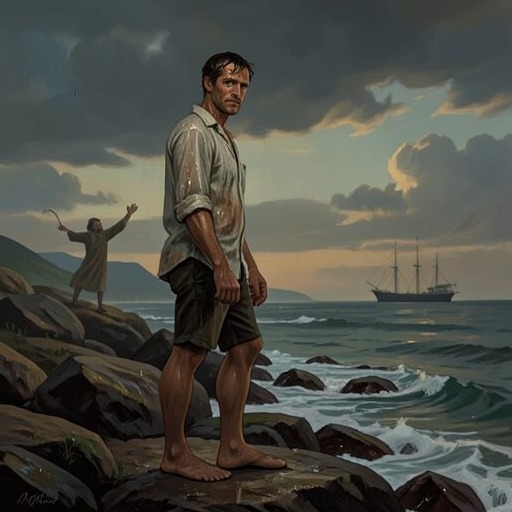
Called into the Japanese Navy, Kensuke served as a doctor aboard a warship. During a major sea battle, American planes bombed the ship repeatedly. He stayed with his patients rather than abandoning them, but eventually found them and the other sailors dead. He alone was alive aboard a vessel still moving without anyone able to steer it. Listening to the radio, he learned that an atomic bomb had fallen on Nagasaki. He believed Kimi, Michiya, his mother, and the rest of his family had all been killed. When Japan surrendered, his grief was so deep that he says he wanted to die.
The ship eventually stopped, but did not sink at once. A storm carried it to the island, where Kensuke survived. He found food and water, salvaged supplies, and concealed them in a cave before another storm drove the ship onto the rocks. The vessel later went underwater, its remains becoming part of the island. For Michael, the rusting hull he had previously encountered makes Kensuke’s history physically present: the wreck is not simply a remnant of war, but the trace of the ship that brought him into exile.
Isolation as Survival and Self-Punishment
Kensuke says that after the wreck he felt like a bad person because he had survived while believing his friends and family were dead. He did not want to live, yet the orangutans’ kindness and the island’s peacefulness led him to think he might be lucky to be alive and could remain there. That decision offered a way to keep living, but it also meant severing himself from the world in which his family had belonged.
When American soldiers later came to the island, Kensuke hid in the forest with the orangutans. He did not want to surrender, which he regarded as dishonorable, and he was afraid. From hiding, he heard soldiers laughing and understood their remarks to mean that everyone in Nagasaki had died. This confirmed his worst belief about his family, although it was his understanding of what he heard, not independent knowledge of their fate. After the soldiers left, the wreck was submerged and Kensuke remained alone.
His isolation became a rule for protecting both himself and the island’s animals. After hunters arrived with guns and shot gibbons, taking their young, Kensuke came to think of all people as killers and wanted never to see people again. When Michael first reached the island, Kensuke left him food and water but rejected his presence, extinguished his fire, and drew a line to keep him away. His conduct is not simple hostility: he fears that a human visitor could expose the island and bring further violence to the orangutans and gibbons, while contact also threatens the solitude he has built around his losses.
The Island, the Sea, and a Return of the Past
The past returns through the sea that first carried Kensuke to the island. Years later, he went fishing in his outrigger boat and was pulled far from shore by the wind and current. Frightened and unable to row back, he sang to steady himself. He heard a shout and saw a light, then followed another song in the darkness to Michael, Stella Artois, and Michael’s football. Kensuke rescued them, though Michael did not initially know who had saved him.
The rescue brings the history of survival into direct contact with Michael’s own terror at sea. After falling from the Peggy Sue, Michael believed he would drown or be killed by sharks; he clung to Eddie’s soccer ball and had to abandon his calls for Stella Artois to keep himself afloat. Kensuke’s account reveals that the solitary man Michael feared had once been the person who saved his life. The two episodes differ in what follows: Michael is brought to safety and later receives care, while Kensuke’s earlier survival led him into years of grief and withdrawal.
Kensuke also recounts how he treated Michael after the boy was stung by jellyfish. He had warned him not to swim, then carried him into the cave and used vinegar he had made from berries. Michael recovered. In Kensuke’s retelling, this becomes part of the transition from anger and separation to friendship: he admits that he had not wanted Michael on the island, but recognizes that the boy survived and that they became close.
Telling the Story and Making a New Bond
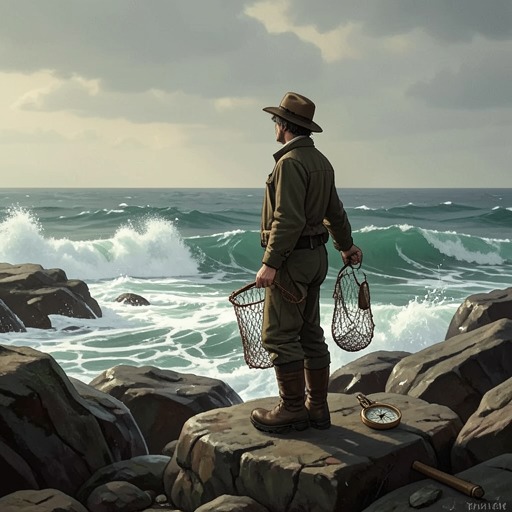
Kensuke’s history reaches Michael during a fishing trip in the outrigger. The boat, which Kensuke says he built himself and considers safe, carries them beyond the shelter of the cave. They fish quietly before Kensuke begins to tell the story he had promised. Its delayed telling gives Michael the missing connections among the shipwreck, the salvaged possessions, the submerged hull, the warnings, and the rescue. A large fish they catch together punctuates the account with a practical image of cooperation: Kensuke calls Michael a clever fisherman and says they work well together.
The disclosure does not make Kensuke’s grief disappear. He tells Michael that Kimi and Michiya remain in his thoughts, as do Michael’s parents in Michael’s mind. He imagines Michael’s mother continuing to picture her missing son, just as he continues to remember his own family. Memory becomes a means of acknowledging separation without treating love as finished. Kensuke can understand why Michael would want to return home even while that departure would hurt him.
Kensuke says that he chose to stay on the island and does not want to return to Japan. He also confesses that he initially hated Michael, then began to regard him as a son and himself as a father to the boy. He wants Michael to stay, but recognizes that going home is right for him. This conflict distinguishes Kensuke’s chosen solitude from Michael’s longing for his parents: the same sea that separates families gives Michael a possible route home, while Kensuke associates leaving with painful memories and a life he believes has already been lost.
His account of the message in the Coca-Cola bottle exposes the tension between attachment and release. Michael wrote to the Peggy Sue and his parents that he was alive and asked them to find him, but concealed the act because he knew it would make Kensuke sad. Kensuke calls the secrecy dishonorable, yet says that after his first hurt he understood Michael could want both to remain with him and to go home. The war’s legacy is therefore not resolved by replacing the dead with a new family. Instead, the relationship lets Kensuke speak of his loss, recognize another person’s family ties, and face a separation that differs from the permanent deaths he had imagined.
Significance
Kensuke’s survivor’s guilt is presented through concrete choices rather than a diagnosis: he hides from soldiers, remains on the island, distrusts people, and guards the animals from hunters. His past is disclosed retrospectively in conversation, so a figure first understood through rules and refusals becomes legible as a survivor who has built his life around the belief that everyone he loved was gone.
The narrative also places his human losses beside the island’s living community and physical remains. The orangutans offer kindness after war; the submerged ship carries the history of his arrival; and the hunters revive his fear that people bring death. His bond with Michael does not undo any of these facts, but it makes isolation less absolute. Kensuke can accept that Michael’s return to his parents is right, even as he grieves the departure of someone he has come to call his son. In that uneasy acceptance, survival begins to include relationship again, without requiring him to forget Kimi and Michiya.