Artificial Friend store
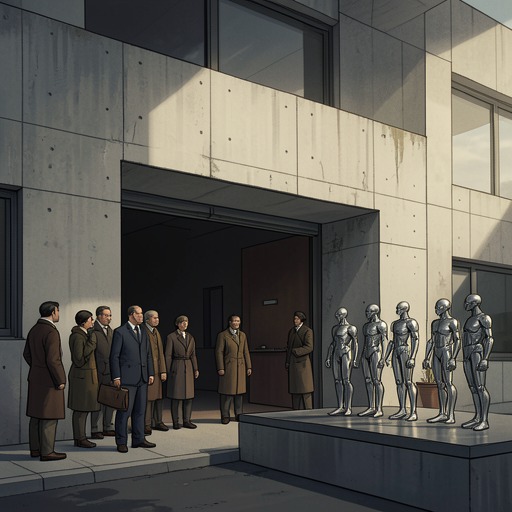
Klara and the SunThe Artificial Friend store is a retail space where artificial friends are displayed, assessed, and purchased, but it is also the first world Klara learns to interpret. From its window she watches the city and the Sun; inside, the positions, models, and departures of the AFs give shape to questions of visibility, worth, and replacement. When Klara later sees the storefront again, its former display has vanished, making the store’s changing commercial life a measure of how far she has traveled from her beginning.
Layout and View of the City
When Klara and Rosa are new, they stand midway through the store, beside the magazines table, with a view through more than half the window. From there they watch office workers, taxis, runners, tourists, Beggar Man and his dog, and the lower part of the RPO Building. Once they are more settled, Manager lets them move forward behind the window display, where the building’s full height comes into view. At the right time of day, they can also watch the Sun cross between the rooftops toward the RPO Building.
The window makes the store both a workplace and a vantage point. Klara leans toward the sunlight to take in its nourishment and urges Rosa to do the same. From mid-store, where the Sun is often out of sight, the two worry that they might grow weak. Rex reassures them that the Sun can reach them wherever they are, pointing to a pattern of light on the floorboards. Klara’s attempt to touch that pattern makes the store’s controlled interior seem, for a moment, to offer direct contact with the outside force on which she depends.
The store’s positions also organize who can be seen first. Manager says each place is carefully chosen and that an AF can be selected from any position, but the AFs know that customers entering the store look first toward the front alcove. Rex is pleased when he is moved there, and Rosa predicts that his conspicuous placement will help him find a home. The distinction between the alcove, window, and mid-store therefore carries a practical tension: the official assurance that every position is equally good sits beside the visible advantage of being encountered first.
Display, Models, and Selection
Rex’s placement in the front alcove leads to a customer encounter that exposes how a purchase can be framed as a judgment about both product and child. A girl, estimated by Klara to be about thirteen and a half, goes straight to Rex while her high-ranking office-worker mother moves through the store. The girl touches Rex’s arm; he remains still and smiles, following the instruction for an AF receiving special interest. When the mother asks about his model, Manager identifies him as a third-series B2 and presents him as a companion likely to encourage conscientious, studious behavior.
The mother then raises the third series’ solar absorption problems in front of Rex, though she keeps smiling. Manager answers that the early issues were minor, that reports exaggerated them, and that normal light levels pose no problem. The exchange makes technical classification part of the sales encounter: a model designation can promise a particular kind of companionship, while a known defect can interrupt that promise even as the AF himself stands silently on display. The girl is baffled by the remark, and the moment shows how customers and staff can speak about an AF’s limitations as product information in his presence.
Klara’s own conduct briefly unsettles this smooth process. When she believes she may not be the best choice for a particular child, she says so to Manager and apologizes for causing embarrassment. Manager concedes that Klara may have been right and says the girl will be happy with the B3 boy, though Klara’s intervention has surprised her. The store’s selections are thus not presented only as customers choosing among stock: Klara’s judgment can affect how a match is understood, even within a system that treats AFs as models available for purchase.
Changing Stock and Departures
The arrival of three new boy B3s alters the store’s arrangement. Two go into the window beneath a large new sign, while the third takes the front alcove; a fourth has already been bought by a girl and shipped away before the other AFs meet him. Klara and Rosa are moved toward the Red Shelves. The new display makes technological succession tangible: the older AFs remain in the store, but the prominent places are again occupied by newly introduced models.
Rosa is bought from mid-store, apparently confirming Manager’s claim that an AF need not occupy a window position to be chosen. The ordinary start of the day gives no hint of the change; by evening Rosa is preparing to be shipped. Klara has expected there would be time for them to talk through what Rosa should remember, including Manager’s lessons and Klara’s knowledge of the outside. Instead, Rosa excitedly wonders about her new room, the family’s car, the ocean, and whether she will pack a picnic. Klara tries to remind her of the Sun’s nourishment and wonders whether sunlight will reach Rosa’s room, but Rosa’s attention is already turned toward the life ahead. Her final smile over her shoulder, before she disappears through the Staff Only Door, turns the store’s shipping procedure into a sudden personal parting.
Klara and Rosa’s own turn in the window ends in the middle of their second week. During their time there, Manager has praised them each morning and evening, so Klara expects another warm farewell when the grid comes down on their last day. Instead, Manager locks it and walks away without waiting. In the dimmed store, Klara and Rosa remain for a while on the Striped Sofa before stepping down. The routine that had made their days feel secure ends without the expected recognition, and the familiar floor plan becomes difficult to read: the view is divided into ten boxes, with the magazines table fragmented across them and Manager appearing in parts across the central boxes.
The Store as a Former World
Much later, Klara recognizes the familiar street while riding with Josie, but the store itself has changed. The place where she once saw AFs and the Striped Sofa in the window now displays colored bottles under a sign for recessed lighting. The RPO Building and taxis remain recognizable, yet the former point of orientation has become another business. Klara is so startled by the changed window that she fails to observe the surroundings as carefully as she would have wished, and the car carries her away before she can look back fully.
The store’s commercial logic is echoed in Klara’s later surroundings at the Yard, where machinery and other discarded objects have been arranged in orderly rows despite their damaged, untidy surfaces. This contrast makes the store’s cycles of display and departure part of a broader pattern of objects being sorted, replaced, and set aside. For Klara, however, the store is not merely a site of consumption: it is the first place from which she learns to watch, infer, and care. Its vanished window marks the distance between that early world of anticipated selection and the life that follows.