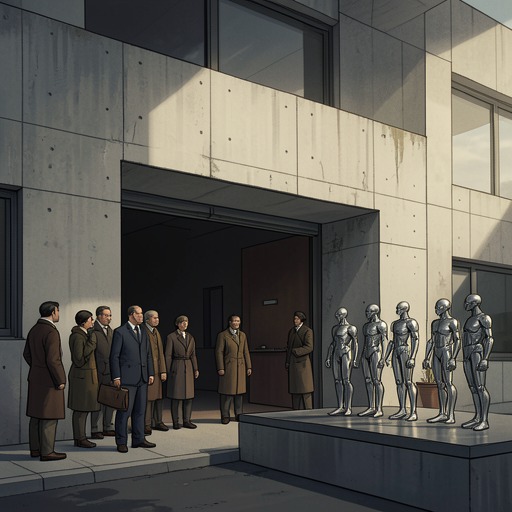
Artificial Friends (AF)
Klara and the SunArtificial Friends (AF) are manufactured companions chosen for children, their promise of care and companionship shaped by model specifications, family decisions, and a changing retail market. The novel’s most consequential question about them emerges when Klara, an AF, is asked not merely to assist Josie but to become her in a prepared replica. That prospect makes the distinction between technical imitation and personal identity the category’s central human stakes.
Models, Capabilities, and Selection
AFs are sold in numbered models and series, and those distinctions shape how adults assess their suitability. Manager presents Rex as a B2, third series, and recommends him as a companion likely to encourage a conscientious, studious attitude. Josie’s mother immediately raises the third series’ reported solar-absorption problems, doing so while Rex is present; Manager answers that the early issues were minor, exaggerated, and not a problem in normal light. The exchange sets a sales pitch beside a technical vulnerability, while the child’s baffled glance between Rex and her mother shows how little the model debate need mean to the young person being matched with a companion.
The store’s inventory turns those distinctions into visible competition. Three new B3 boys are calibrated and positioned: two in the window beside a large new sign, and one in the front alcove. A fourth has already been bought by a girl before the others have even met him. Klara and Rosa are moved to the Red Shelves side of the store, where Rosa recalls Manager’s assurance that every position offers a chance of being chosen. Rosa is eventually purchased from mid-store, confirming the claim even as her sudden departure leaves Klara little time to prepare her for life as an AF. The arrival of newer models and the swift disappearance of a chosen AF make companionship part of a retail system that displays, compares, selects, and ships its products.
Companionship and the Social World
An AF’s role extends beyond being a possession: families expect a companion to enter a child’s social life. When Josie is asked to host an interaction meeting, she insists that Rick be invited. Her mother agrees and describes Rick as a good person and their neighbor, even though Josie doubts that the other children are really her friends. The AF’s household setting therefore places it within a network of family decisions, childhood gatherings, and relationships that may be uneasy rather than effortless.
Klara interprets that unease through the possibility of loneliness. After Rick worries that Josie may become like the other children, Klara acknowledges that Josie behaved strangely but believes she is kind underneath; she also suggests that the other children’s roughness may come from their fear of being lonely. Her understanding of companionship is consequently not confined to the purchased bond between child and AF. It includes the fragile human ties surrounding the child, and the possibility that social exclusion can alter how people behave toward one another.
The educational world reveals another way that status shapes relationships. Josie’s mother explains that Rick, who was never lifted, has a possible route into Atlas Brookings, which admits only a small number of unlifted students. The places are fiercely contested, and he lacks access to screen tutors: TWE members are forbidden to tutor unlifted students, while other tutors demand fees his family cannot pay. Josie’s mother hopes Klara might help, but Rick rejects the plan. In this scene the AF is treated as a possible educational resource, yet its presence cannot dissolve the barriers produced by social rules and limited opportunity.
Limits and Intellectual Recognition
The novel gives AFs concrete capabilities as well as absences. Klara tells the Father that she cannot smell at all, and that B3s may have been given limited smell for safety reasons. The detail complicates the idea of a companion designed to serve: a capacity that could help detect danger is deliberately restricted in the model, and Klara’s self-description marks a boundary between what an AF can observe and what its human companions may assume it can do.
Mr Capaldi, by contrast, argues that AFs possess intellectual powers people should learn from rather than fear. He presents a questionnaire for Klara to complete and takes a special interest in her as an AF. His larger request, disclosed later, is not simply to have her help Josie or assess how well she understands her. He wants her to inhabit an empty replica of Josie, using what she has learned about Josie’s decisions and feelings. The proposed transformation makes accumulated knowledge the basis of an attempted personal continuation, while leaving open whether deep observation can amount to becoming someone else.
Relationships, Replacement, and Legacy
The proposed replica gives the AF category its sharpest ethical and emotional test. Josie’s mother has chosen Klara carefully because she believes Klara can learn Josie deeply and entirely. Capaldi’s plan is contingent on the possibility that Josie may not survive, and the family’s interest in Klara is therefore bound up with illness, fear of loss, and a wish to preserve Josie through a substitute. Klara, however, maintains that it is wrong to give up hope. The disagreement exposes a tension between treating an AF as a replaceable instrument and recognizing the care, attention, and convictions that have formed through her relationship with Josie.
The novel does not equate different futures with the disappearance of affection. Near the end, Klara observes that Rick and Josie remain kind to one another while preparing separate lives, and she tells the Father that their divergent plans cause her anxiety. This concern extends her understanding of companionship beyond a single household role: she has learned to value relationships even when they cannot guarantee permanence or a shared future.
The AF’s commercial life also has an endpoint beyond the store. At the Yard, Klara initially sees disorder in the discarded machinery, then recognizes the careful rows and passages arranged by the yardmen. Her changed view gives the setting a quiet material echo of the category’s lifecycle: objects associated with work and use persist after their original functions have ended, now ordered for visitors to inspect one by one. Against the store’s new B3 display and the attempted replacement of Josie, the Yard makes obsolescence and continuation visible without resolving the question at the story’s center: whether a companion’s knowledge can preserve a person, or whether what is most particular about someone exceeds any substitute.