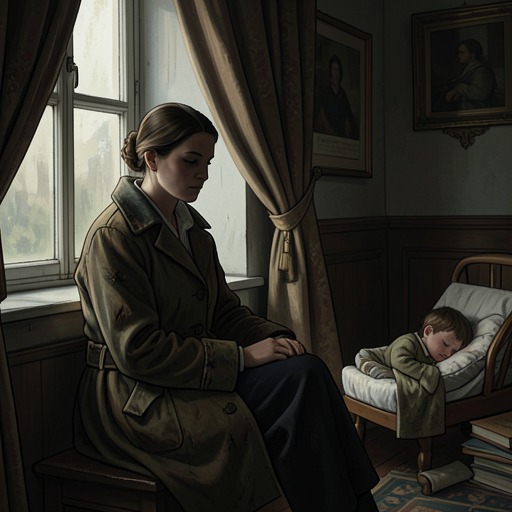
Chrissie–Henry Capaldi relationship
Klara and the SunChrissie–Henry Capaldi relationship centers on a sharp disagreement over Klara’s future: Henry Capaldi wants her to volunteer for research into Artificial Friends, while Chrissie intervenes to protect her from being opened up and studied. Their reunion makes plain that the disagreement is not merely professional. Capaldi believes Chrissie has remained angry with him over what happened with Josie; Chrissie’s refusal, and her insistence that Klara deserves her “slow fade,” give that old conflict a new and intimate consequence.
The Reunion and Its Strain
During a weekend when Josie is away, Chrissie is at home and Capaldi visits after a long absence from the household. Klara, who has spent most of the morning in the Utility Room, hears the voices below and comes onto the top landing. She recognizes Capaldi speaking with Chrissie in the hallway. Their conversation begins in easy tones, but tension enters Chrissie’s voice as it continues; she then looks up three floors and calls Klara down to greet him.
As Klara descends, she hears Chrissie tell Capaldi that their arrangement was not what he had promised. Capaldi answers that he only wants to put something to Klara. That exchange establishes a difference between his stated purpose and Chrissie’s understanding of the visit before he has made his proposal. Capaldi greets Klara warmly and leads her into the Open Plan, while Chrissie follows in silence.
The physical arrangement of the meeting makes their opposition visible. Capaldi settles into the modular sofa and leans back; Chrissie remains standing straight in the middle of the room. When Capaldi invites Klara to sit, Chrissie says she is happier standing and urges him to get on with it. His attempt to ease the atmosphere by addressing Chrissie familiarly and calling the matter nothing to stress about does not dissolve her vigilance.
Capaldi’s Proposal
Capaldi presents himself as a longstanding friend and admirer of Artificial Friends, describing them as a vital source of education and enlightenment. He says that people have grown concerned because AFs seem too clever: their decisions and recommendations are accepted as dependable, often correct, but observers do not understand how they arrive at them. In his account, that opacity has produced fear, resentment, and prejudice.
His proposed answer is reverse-engineering. By opening the “black boxes” and looking inside, he argues, researchers can make AFs less frightening to the public while learning more about how they work. He says that his group has already opened a number of them and wants more volunteers. He has not forgotten Klara, he tells her, and believes she would be uniquely useful.
Klara responds that she would like to assist, provided it does not inconvenience Josie or Chrissie. Her willingness makes Chrissie’s intervention decisive: without it, Capaldi’s appeal might have proceeded as a request Klara could accept. Chrissie swiftly moves around the coffee table to stand beside Klara and objects that this is not what she and Capaldi discussed by phone. Capaldi insists that he only wanted to ask, describing participation as a chance for Klara to make a lasting contribution.
Chrissie’s Refusal and Protection
Chrissie rejects the terms on which Capaldi frames the request. Klara deserves better, she tells him; when he asks whether he may at least ask Klara’s permission now that she is present, Chrissie answers that he may not. She does not treat Klara’s expressed willingness as consent that settles the matter. Instead, she takes responsibility for refusing a proposal she believes would harm or exploit her.
Her alternative is the “slow fade”: Klara should be allowed to decline into obsolescence rather than be opened up for research. When Capaldi returns to the urgency of resisting public backlash against AFs, Chrissie tells him to resist it elsewhere and find other black boxes to open. Her language turns his technical metaphor back against the project: Klara is not a black box available to be prized open, but someone Chrissie considers deserving of a protected ending.
Chrissie’s body reinforces the refusal. She steps in front of Klara as if to shield her from Capaldi, taking her position so quickly that her shoulder nearly touches Klara’s face. The closeness recalls an earlier moment when Chrissie embraced Klara in the car beside the Grind Our Own Beef cafe. In the present scene, that bodily contact is not an embrace, but it again places Chrissie physically between Klara and a threat to her well-being.
The Earlier Dispute and Its Continuing Effects
Capaldi reads Chrissie’s resistance as part of a longer grievance. Leaning back into the sofa after she blocks his request, he says that she has been angry with him for a long time and that this is unfair: she came to him back then, he says, and he did his best to help. He adds that he is glad things worked out well with Josie in the end, but argues that this is no reason for Chrissie to remain angry.
The scene does not resolve their competing interpretations of that history. Capaldi understands his earlier conduct as an effort to help and invokes Josie’s eventual outcome in his defense. Chrissie’s immediate objection concerns Klara and what the two adults had agreed over the phone; her later insistence on leaving Klara alone shows that the stakes now include Klara’s right not to become an object of investigation. The contrast between Capaldi’s language of contribution and Chrissie’s language of deservingness leaves the central dispute unsettled: what he calls useful research, she sees as something Klara should be spared.
Relationship Significance
The encounter links Chrissie and Capaldi through a past they remember differently and a present in which Chrissie actively refuses his plan. Capaldi’s proposal reaches Klara directly, but Chrissie’s intervention prevents his appeal from being treated as the only relevant choice. She is not simply opposed to research in the abstract within this scene: she objects to Capaldi’s approach, invokes the broken or misunderstood agreement, and tells him to seek other subjects rather than Klara.
The reunion also gives “slow fade” a pointed relational meaning. Capaldi’s project promises explanation and discovery through opening AFs; Chrissie insists on an ending that does not require Klara to surrender herself to that scrutiny. Her stance protects Klara in the immediate encounter while exposing how deeply the earlier episode involving Josie still colors Chrissie’s relationship with Capaldi. Neither forgiveness nor reconciliation is shown. Instead, their disagreement sharpens into a boundary: Capaldi may pursue his work elsewhere, but Chrissie will not permit him to make Klara its subject.