Dark-Sky Morning
Klara and the SunDark-Sky Morning is the crisis scene in which a violent, disorienting change in the weather gives way to sunlight falling directly on the gravely ill Josie. It stands between the family’s fear that Josie may die and the later impression that her recovery began that morning. The event also brings together the novel’s competing ways of understanding illness: medical judgment, familial hope, and Klara’s guarded belief that the Sun has answered her appeal.
Background and mounting fear
The morning arrives six days after Klara’s second visit to Mr McBain’s barn, during a period when Josie is dangerously ill and household life has lost its ordinary rhythm. Dr Ryan and the Mother repeatedly argue about whether Josie should be taken to hospital, but each time conclude that it would add to her misery. They resume the same discussion on later visits, a pattern that exposes the limits of their agreement: they can decide against hospital care, but cannot make Josie’s condition less frightening.
The strain has already taken its toll on the household. Rick comes each day to sit with Josie while the Mother and Melania Housekeeper rest, and the adults sleep only when exhaustion overtakes them. Klara’s presence is valued, yet not considered sufficient on its own, despite the Mother’s knowledge that Klara is likely to notice danger signals before anyone else. By the morning of the event, the adults’ tiredness shows in their movements, and even the household’s meals no longer arrive at their usual times.
This crisis follows earlier disputes over how to name Josie’s condition. The Mother has insisted that Josie is sick again, while Josie denies being ill and objects to her mother telling others she is sick when she believes she is strong enough. The conflict is not simply a disagreement over a diagnosis: it reveals how frightening it is for the Mother to see danger Josie will not acknowledge, and how painful Josie finds being described through her illness. The Dark-Sky Morning gives that tension a larger setting, but does not settle it through an ordinary medical explanation.
The storm and the Sun’s arrival
The sky grows unusually dark after breakfast, though the household’s disordered routine makes the time of day feel uncertain. Rick’s arrival is one of the few cues that distinguish morning from night. As the clouds thicken, the wind strengthens; a loose part of the house bangs at the rear, and trees along the rise of the road bend and wave. The weather becomes an external measure of the household’s instability, while Josie remains asleep, breathing shallowly and rapidly.
During the dark morning, Klara and Rick are together watching over Josie. Melania Housekeeper, visibly half asleep with tiredness, arrives to take her turn. Klara moves into the hall to give Rick a few moments alone; there she sees the Mother, still wearing the thin black dressing gown she has worn through the night, pass toward the kitchen. The Mother notices Rick sitting on the bottom step. When she asks whether she has treated him kindly, he answers that she has and calls her a great friend to his mother. The exchange turns into a painful challenge: the Mother asks whether Rick feels he has come out the winner while Josie, who took the greater risk, may be about to lose.
The Mother frames the contrast in terms of the futures each young person has chosen. Josie, she says, has always been hungry for life, and she could not deny her daughter the chance to pursue a future worthy of her spirit. Rick, by contrast, has played safe; the Mother asks him to consider whether what he has gained is worth calling a victory. The argument makes the scene’s stakes explicit: Josie’s uncertain future is not an abstraction to her mother, but the possible loss of the child whose appetite for life made the gamble seem necessary.
Klara interrupts to report that the Sun is coming out and insists that they go upstairs to Josie at once. At the window, the Mother initially treats the announcement as unremarkable. Klara tries to take the curtain material from her; when the Mother finally lets go, Rick also reaches for the blind and curtains, apparently understanding that something is happening. The sunlight enters in such abundance that Rick and Klara reel backward. Melania Housekeeper covers her face and curses the Sun, but does not try to block its light again.
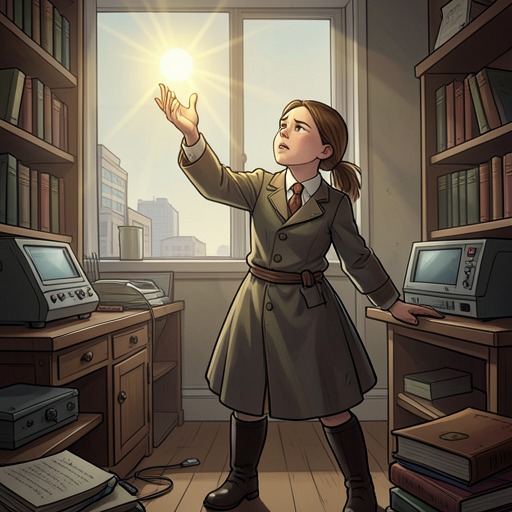
The storm has not ended: the wind remains powerful, the trees still wave, and tiny funnels and pyramids move swiftly across the sky. Yet the Sun breaks through the dark clouds. Those in the room turn toward Josie as if they have received the same private signal. Its orange light forms a fierce half-disc across Josie and the bed; the Mother, nearest to her, raises her hands to shield her face. The others remain still, watching as the sunlight grows brighter. Josie stirs, raises a hand against the light, and asks what is happening. She shifts onto her back, propped against the pillows and headboard, while the Sun continues to shine on her.
Recovery and retrospective meaning
The scene’s immediate force comes from the contrast between Josie’s shallow, rapid breathing and the sudden spectacle of sunlight filling her room. The household does not witness a medical intervention or receive an explanation for the weather. Instead, it watches and waits, and Josie’s movement is the first visible change in a morning defined by fear and helplessness. The Sun’s arrival therefore marks a shift in the scene’s emotional direction, but the text leaves its precise cause unresolved.
That uncertainty becomes part of the event’s meaning. Before the storm, the Mother has asked Klara whether her earlier talk of Josie getting well through some special help was merely hopeful or whether she expected something more solid. Klara acknowledges the careful consideration given to Josie’s condition by the Mother, Dr Ryan, and Melania Housekeeper, but continues to hope that Josie will recover. The question remains open at the bedside: the sunlight is strikingly timed, but its significance is not established by a doctor or confirmed in a direct explanation.
Josie’s illness has also been named and experienced differently by each person around her. The Mother recognizes a recurrence that Josie denies; Dr Ryan and the adults debate care while trying not to worsen her misery; Josie herself resists being treated as already sick. When Josie later says that she does not want to die, the fear underlying those disputes becomes explicit. Dark-Sky Morning does not erase that fear. It gives the watchers an interval in which Josie stirs under the light, while leaving the larger uncertainty of her survival intact.
Memory, secrecy, and the event’s significance
Much later, Rick recalls the morning as the point when Josie may first have begun to get better. He qualifies the memory—he may have it wrong—but says it now feels that way when he looks back. His recollection supplies a retrospective shape the scene itself cannot provide: the household saw a moment of apparent change, and only later could it connect that moment to a recovery. The event is thus both an immediate crisis scene and a memory through which its meaning is revised.
Rick also asks whether the strange weather and the sunlight had anything to do with the other events surrounding Klara’s appeal to the Sun. He remembers carrying Klara over the fields and her making a secret deal, which he had once dismissed as AF superstition meant to bring good luck. His later question shows that he has reconsidered that dismissal, but it does not prove a supernatural cause. Klara refuses to speak about the matter, even to Rick, because she fears that describing the special favor could cause the help Josie received to be taken back. Her silence keeps the connection between her appeal and Josie’s recovery unresolved, while making the scene’s apparent answer inseparable from the risk of naming it.
The storm’s force and the sunlight’s sudden intensity give the episode a dramatic reversal: the household moves from exhausted vigil beneath an unnaturally dark sky to a shared, wordless attention as light reaches Josie. Yet the reversal is not a simple cure or a settled revelation. Rick’s later recollection interprets the morning as the beginning of recovery; Klara protects the secret of her appeal; and the novel withholds certainty about what the Sun’s intervention means. Dark-Sky Morning matters as the moment when hope becomes visible to the family, while remaining, for its narrator, a favor too precarious to explain.