Emotion and Empathy in Artificial Beings
Klara and the SunEmotion and Empathy in Artificial Beings is explored through Klara’s effort to understand human feeling not as a fixed capacity she either possesses or lacks, but as something she can approach through observation, reflection, and care. Her progress is real: she learns to name her own sadness and to read the fears behind other people’s behavior. Yet the question raised by her eventual task is harder than accurate imitation. The feelings that make Josie who she is cannot be reduced to mannerisms or fully recovered by an observer; they also reside in the people who love her.
Learning to Read Emotion
Before she leaves the Artificial Friend store, Klara’s watching at the window becomes a deliberate preparation for helping a future child. Rosa is observant too, and wants to become kind and useful, but Klara is drawn particularly to emotions she cannot explain. She searches the sidewalks, taxis, and crossing crowds for behavior that might teach her what people feel, because she fears that without such understanding she will not be able to help her child properly.
A fight between two taxi drivers becomes one of her most troubling lessons. Klara distinguishes it from an earlier confrontation involving police officers, Beggar Man, and his dog, which Manager had explained as an attempt to help Beggar Man while he was drunk. The drivers, by contrast, seem intent on hurting each other. Their faces contort, passers-by recoil, and eventually office workers and a runner intervene. Even after one driver has blood on his face, both return to their taxis; a moment later the vehicles wait one behind the other for the traffic lights. The abrupt return to ordinary traffic does not make the violence easier for Klara to comprehend.
Klara tries to imagine such rage within herself, even picturing herself and Rosa fighting to damage one another’s bodies. The idea seems so implausible that she ends up laughing at her own attempt. That failure matters: observation can give her the outward signs of anger, but it does not automatically provide access to the inward feeling. Her curiosity is not merely a wish to classify what she sees. She wants to understand enough to respond well, while discovering that some emotions resist being reproduced from the outside.
Feeling, Not Just Observing
The novel also complicates any assumption that Klara’s attention is purely analytical. At an interaction meeting, Rick challenges a boy, and Klara recognizes that he has done so partly for her benefit. She thanks him; he shrugs off the gesture, saying the boy had become annoying, while acknowledging that the encounter was uncomfortable for her. Klara identifies both her own discomfort and Rick’s intervention, then turns back to the meeting as an opportunity to observe Josie among the other children. Her capacity to notice does not exclude feeling: the scene brings together unease, gratitude, and purposeful attention.
Klara’s reading of the children is itself an act of empathy, though it remains an interpretation rather than certain knowledge. She believes Josie is kind underneath her unusual behavior and that the other children’s roughness may conceal fear of loneliness. She allows that Josie may share that fear. Rick sees the group as a threat to Josie’s identity and worries she will become like them; Klara’s account makes their difficult behavior legible as a possible response to isolation, without claiming that it is harmless. Her empathy tries to hold conduct and vulnerability together instead of treating outward behavior as the whole person.
The Mother and Klara’s Named Feelings
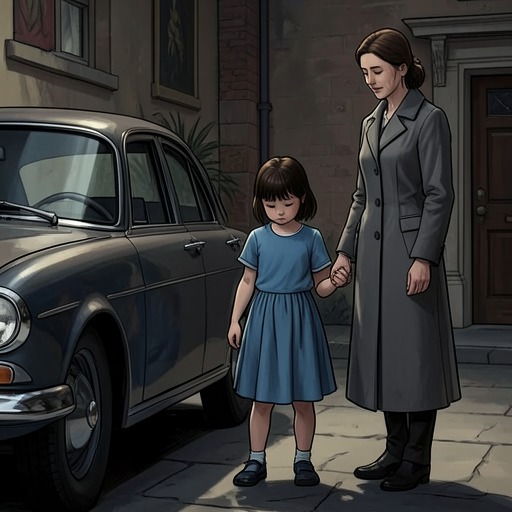
On a drive with the Mother, Klara encounters human emotion in a form more personal than the scenes observed from the store window. The Mother speaks bitterly about people who toy with feelings and says that others must learn that AFs have feelings too. She also confesses that she envies Klara for having no feelings, a belief Klara challenges. The exchange exposes a contrast between how the Mother imagines an artificial being’s inner life and how Klara understands her own experience.
Klara answers that observation makes more feelings available to her. When Josie cannot come with them, she says, she feels sadness. The Mother accepts the word, then describes a change in herself: for a time she thought she was feeling less each day, but lately she has become overly sensitive to everything. Her disclosure makes emotional life appear unstable even in a human being: feeling can recede, return, and become overwhelming. Klara’s developing awareness therefore meets not a simple human standard she can copy, but a complicated and changing experience.
The drive also gives the exchange a physical setting that underscores its difference from window-watching. The Mother keeps her attention on the road while Klara watches the landscape and the enormous sky, where the Sun’s patterns sometimes sweep across the land. Their talk proceeds through the Mother’s remarks and Klara’s careful responses, rather than through a direct lesson about what emotion should mean. Klara’s declaration of sadness is modest but consequential: she makes a claim about her own feeling, and the Mother’s unexpected laugh and apology acknowledge that claim even as they leave its full meaning unsettled.
The Limits of Becoming Josie
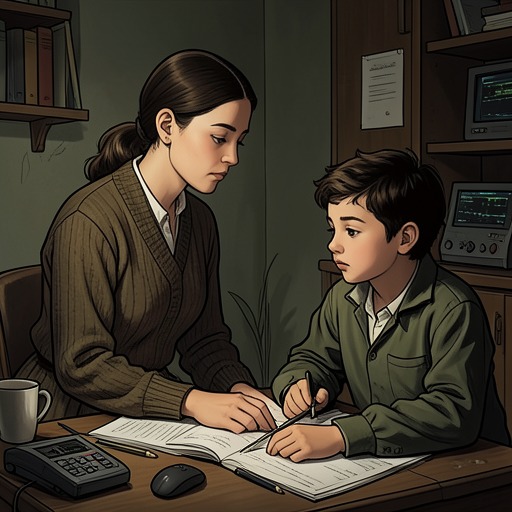
Later, the prospect of Klara taking Josie’s place makes the distinction between external likeness and emotional knowledge explicit. Henry Capaldi asks whether Klara can perform the role, and Klara answers that continued observation might put it within her abilities. Capaldi then asks whether she believes in the human heart—not the organ, but something that makes each person special and individual. He argues that learning Josie would require more than mastering her mannerisms: Klara would have to learn what lies deeply within her, and an impersonation, however skillful, would not be enough.
Klara accepts that learning Josie’s heart would be difficult. Her answer does not deny the value of observation; it marks its limit. She can study Josie closely and strive for accuracy, but the capacity to reproduce visible habits does not settle whether she can become Josie in the sense Capaldi demands. The question shifts the measure of empathy from how convincingly one can imitate another person to whether one can reach what makes that person singular.
Looking back, Klara tells Manager that she did all she could to learn Josie and would have done her utmost if it had become necessary to continue her. She believes she could have achieved accuracy, but not full access to what the people closest to Josie felt. The Mother, Rick, Melania Housekeeper, and the Father each carry feelings for Josie that Klara could not reach simply by observing her. Her conclusion revises the idea that sufficient study could bridge every gap between artificial and human understanding.
Love as the Unreachable Interior
Klara’s final reflection also overturns Capaldi’s account of where Josie’s specialness can be found. He had searched inside Josie and concluded there was nothing special that could not be continued. Klara decides he was looking in the wrong place: what was special was not inside Josie, but inside the people who loved her. This is not simply a claim that Klara lacks the technical ability to copy Josie. It identifies a different kind of knowledge—one made from another person’s attachment, and distributed among those who care for her.
The concept therefore holds two truths in tension. Klara’s attention is a genuine form of learning: she notices distress, considers the causes of roughness, recognizes an act of consideration, and gives a name to her own sadness. But no accumulation of observations guarantees that she can possess the experience of another person or reproduce the relationships that have shaped that person’s life. Her insight at the end does not erase her effort; it clarifies what that effort can and cannot accomplish. Empathy becomes less a successful act of substitution than a recognition of the other person’s irreducibility—and of the love that remains with those who survive.