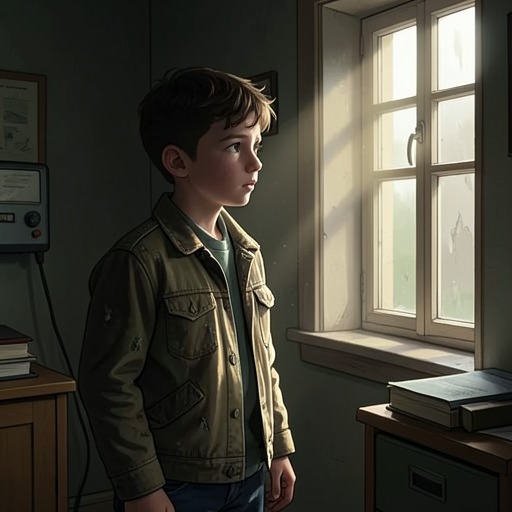
Helen
Klara and the SunHelen, Rick’s mother, is a former actress whose concern for her son’s future is inseparable from the difficulty of letting him act independently. She seeks practical help for his education and emotional support for his choices, but her effort to secure a chance for him at Atlas Brookings leads her to confront Vance, a former partner she had avoided for years. The encounter exposes both her capacity for remorse and the limits of what an apology can repair.
Identity and Background
Helen is introduced through her thoughtfulness about Rick and her uncertain sense of the social rules around asking for help. She has bought him textbooks from the era before children were lifted, but they assume a tutor will be available to explain difficult material. Rick has a genuine ability in physics and engineering, she says, yet when he meets something he cannot understand alone, he becomes discouraged. Helen recognizes that she cannot provide the expert guidance he needs and worries that her request to Klara may be improper; she compares it to borrowing a vacuum cleaner, then immediately acknowledges that the comparison does not fit.
Her own past appears in fragments. She tells Klara that she used to act, including in respectable and dismal theaters, and remembers never forgetting a line even when fellow actors did. Her reflections on fences and hedges similarly turn practical observation into a kind of performance: fences can be pulled down and rearranged like stage design, while hedges seem to set history more firmly into the land. These details establish Helen as someone who narrates her surroundings through theatrical memory, though she is also aware that her own conduct toward people has not always been admirable.
Rick’s Education and Independence
Helen explains that Rick was expected to be home-tutored by screen professors, as other clever children were, but that plan became complicated because he was never lifted. Atlas Brookings is, in her account, the only proper college that still accepts a small number of unlifted students. The places are scarce and competition severe, but she believes Rick is clever enough to have a good chance if he applies himself and receives expert guidance.
That guidance is difficult to find. Helen says potential tutors are either members of TWE, which forbids its members to tutor unlifted students, or people demanding fees the family cannot afford. Klara’s arrival next door suggests a solution. Helen initially presents the request as limited help with textbooks and exams, emphasizing that the material should be easy for Klara and that Atlas Brookings is Rick’s only chance. But Rick objects and returns to the room to stop the conversation. His resistance makes clear that his education cannot simply be arranged on his behalf, even when Helen’s intentions are protective.
Helen also asks Klara to influence Rick indirectly by persuading Josie to encourage him to apply. She believes Josie is the one person who might change his mind, because Rick is stubborn and, she suspects, afraid of the difficult world beyond home. Klara points out that Josie has already pressed him on the issue and that the pressure may have contributed to the rift between them. Helen then asks Klara to make Josie persist, even if Rick reacts angrily, fearing Josie may relent simply to restore their friendship. Her strategy reveals both her conviction that Rick must pursue the opportunity and her willingness to enlist the people closest to him to overcome his refusal.
That concern sits alongside Helen’s awareness of how much Rick depends on her. She tells Klara that the journey to Morgan’s Falls is a day’s drive, yet Rick is convinced he can leave her alone for no more than an hour. Helen wonders how he can grow up and enter the world if he cannot be away from her longer. As she speaks, Rick walks outside slowly, still holding Josie’s drawing against his chest. The scene places Helen’s desire for his independence beside the visible tenderness and attachment that make separation difficult.
Family and Social Relationships
Helen’s relation to Josie and her mother, Chrissie, is part of a broader network of support around Rick. At the interaction meeting, Rick insists that if he must host it, he wants Josie there. Helen agrees, and when he asks whether she thinks inviting Josie is a bad idea, she tells him that Josie is a very good person and their neighbor. Later, Klara understands Rick’s fear that Josie might become like the other children, but insists that Josie is kind underneath and that the group’s roughness may itself be driven by fear of loneliness. Helen’s household concerns therefore unfold amid questions of friendship, social exclusion, and the young people’s need for one another.
Helen is also attached to Chrissie, whom she describes as a good friend. At a gathering supporting Rick, she is glad Chrissie is present and reassured by her company. The warmth matters in the later confrontation with Vance: Helen has people around her, but she does not use that support to conceal the emotional history she has left unresolved. She includes Klara in her gaze as she thanks those assembled, bringing the artificial friend into a gathering otherwise shaped by family and old acquaintances.
Vance and the Request for Help
Before Vance arrives, Helen tells the others that she and he were once passionate for years, not merely for a brief affair. She recalls his fascistic leanings, which she says she had tried not to notice. When Vance learns that Helen has spoken positively about him to Rick, he admits that for years he had assumed otherwise. This small exchange suggests that their separation left each with a distorted understanding of what the other had said or thought.
At first, Vance is impressed by Rick and listens to his case. He explains that Atlas Brookings believes talented young people were denied the benefits of AGE for economic or other reasons, and that society is making a grave mistake by allowing their abilities to go undeveloped. Because the college receives more applications from such students than it can accommodate, he says that once the weakest candidates are removed, selection is effectively a lottery. Then he asks why he is sitting with Rick if Rick is not seeking favoritism.
Helen answers for her son: they are asking Vance for a favor, and she is asking him to give Rick a fighting chance. She insists that the request belongs to her, not Rick. Vance calls this a strange tactic, since favoritism usually works best when it is not acknowledged. He explains that the request changes the encounter: he had thought Rick was asking, but now sees that Helen is asking him personally, after years in which she did not answer his messages. The educational appeal and the old relationship cannot be kept separate once Helen names the favor openly.
Vance asks Helen to be specific about what she wants to apologize for. She recalls the evening at Miles Martin’s house, when she told the group that Vance had not yet read the Jenkins Report, earning a laugh at his expense. Vance says she knew what she was doing. Helen accepts that she behaved badly toward him, but initially frames her awfulness as something distributed among everyone she treated poorly. Vance objects that he was not simply everyone: they had shared a life for five years. Her apology thus moves from general remorse toward a particular wound, but the distinction also shows why broad contrition cannot automatically undo a specific humiliation or years of silence.
Change, Ending, and Narrative Role
Helen tries to keep the meeting focused on Rick, even as Vance insists that the history between them must be acknowledged in front of him. She admits she behaved badly toward Vance and toward others, and imagines lining up all the people she treated shabbily so she could take each by the hand, look each in the eye, and apologize. Yet when Vance asks for specifics, she returns to the immediate request: helping her son. The scene does not resolve whether the apology is enough, or whether the educational favor will be granted.
Vance ultimately decides to leave, saying that none of what is happening is good for Helen. He tells Rick that he likes his drawings and likes him, asks him to take care of himself, and says goodbye to Helen before walking out without looking back. Helen and Rick remain side by side, looking down at the table. Her plea has brought Vance into contact with Rick’s case, but it has not repaired their relationship; the encounter ends with the old lovers separated again and mother and son left together in its wake.
Helen’s arc is shaped by the tension between care and control. She seeks opportunities for Rick because she believes his talent deserves a future, yet she tries to direct him through Klara and Josie when he resists. She recognizes that her closeness may make his independence harder, even as she fears the consequences of his entering an unfriendly world. Her appeal to Vance likewise combines a practical aim with an intimate debt: she wants help for Rick, but the request forces her to face a past she has left unanswered. Later, Klara observes that Rick and Josie remain kind to each other while preparing for different futures. The distance between their plans recalls Helen’s own struggle to support someone she loves without being able to determine what comes next.