Josie and her mother's relationship
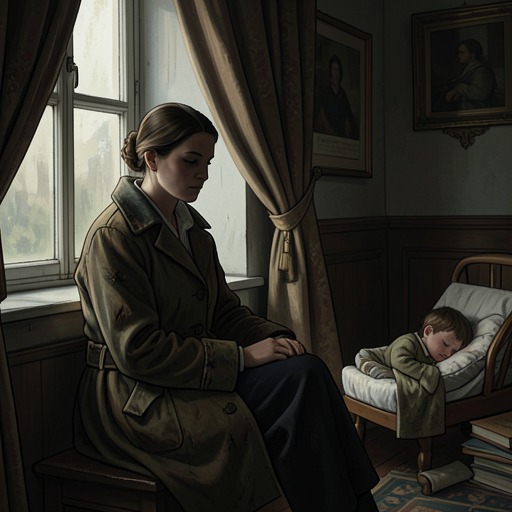
Klara and the SunJosie and her mother's relationship is a bond of daily closeness strained by recurring illness and the fear of losing that closeness. Its clearest measure is the morning coffee: a brief shared routine that Josie fights to preserve, even when she is tired or unwell. As her condition becomes harder to deny, the same intimacy that makes the Mother attentive also makes their conversations tense, as care shifts between listening, reassurance, accusation, and regret.
Daily Rituals and Affection
The Mother's quick coffee is a small interval in a busy day, but it matters profoundly to Josie. The Mother sits at the kitchen Island with her oblong while Melania Housekeeper stands ready to refill her cup; Josie joins her for breakfast before the Mother leaves for work. On mornings when Josie struggles to get up, Klara is tasked with waking her in time. Josie sometimes calls urgently from her en suite bathroom, worried that they will be late, even when Klara is already waiting on the landing.
The importance of the ritual becomes plain when Josie has had a disturbed night. Klara, thinking she needs more rest, lets her sleep after waking her. Josie wakes angry and hurries downstairs, but the Mother's car is already moving away over the loose stones. She does not shout at Klara again; instead, she eats breakfast without smiling. Klara understands that missing the coffee can leave loneliness hanging over Josie's day, regardless of what else happens. The scene establishes that connection is not measured only by the length or ease of conversation: the chance to sit together is itself a form of reassurance.
Affection also appears in the Mother's response to Josie's art. When Josie compares her use of color to her mother's cello playing, the Mother smiles, and her usually tense features soften into an expression strikingly like Josie's own. She praises Josie's unusual eye for color, comparing it to a pond on a summer evening and saying that Josie makes things no one else had thought of. Their exchange is teasing rather than solemn, and the Mother's delight gives their likeness a visible expression: for a moment, the daughter is not a source of worry but an artist whose work her mother admires.
Illness, Fear, and Disagreement
The relationship changes under the pressure of Josie's health. Three weeks after the interaction meeting, Klara notices that Josie's posture and breathing are unlike her usual sleep and raises the alarm. The Mother comes immediately and calls Dr Ryan; Melania Housekeeper later calls again to urge him to hurry. After examining Josie, Dr Ryan says there is nothing to worry about. The Mother is relieved, but quickly turns to a practical warning about Josie's energy drink. Josie, still on her pillow, insists that she is merely tired and tells her mother not to be late for work.
The exchange makes the care running in both directions visible. The Mother tells Josie that worrying about her is her work, and adds that Klara did well to raise the alarm. Then, leaning close to Josie's ear, she asks her to get well for her. Josie answers that she has heard. The moment is tender, but it also reveals how fear has entered their ordinary speech: the Mother's request is not only for recovery but for reassurance that Josie will remain with her.
On the Sunday morning planned for a trip to Morgan’s Falls, anxiety emerges through a conversation about an oblong game. Josie explains that the game involves characters dying in car accidents as players try to get their people onto a superbus and work out its routes. The Mother keeps asking why Josie would play something in which such awful things happen. Josie begins by answering cheerfully and patiently, but her voice loses its smile as the questions continue. Klara recognizes that Sunday conversations can become charged even when they begin with an apparently ordinary topic: the questions are a route into deeper feeling rather than a neutral discussion of the game.
The underlying fear becomes explicit when the Mother tells Josie that she is sick again. Josie denies it and says she is fine; the Mother asks why Josie keeps doing this to her. The argument exposes a painful difference in what each can claim to know. Josie resists being defined by illness, while the Mother sees danger in that resistance and experiences concealment as something done to her as well as a risk to Josie. Their conflict is therefore not a lack of attachment but an effect of attachment under pressure: each speaks from a different position within the same fear.
The Cancelled Trip and Reconciliation
The dispute comes to a head at the car. The Mother challenges Melania Housekeeper's judgment that Josie is well enough to spend the day out at the falls, and asks whether the housekeeper is refusing to help Josie get out. Melania eventually opens the door. Josie pleads with her mother to let them go, but the Mother says that Josie's illness is not her fault while withholding it from everyone and allowing them all to set out for a day together is unfair. Josie replies that it is unfair to call her sick when she is strong enough to go.
Once the door is open, Josie's face turns sad as she looks toward Klara. She apologizes and promises they will go another time. The apology shows how the argument's consequences reach beyond mother and daughter: Josie feels responsible to the others for a plan that has collapsed, even as she is the person whose health is being disputed. Klara answers that they must do what is best for Josie, but the cancelled outing does not resolve the tension between Josie's own assessment and her mother's alarm.
Later, the Mother acknowledges that leaving Josie behind was right because she was unwell, then admits that she misses her. With Josie absent at the falls, she asks Klara to be Josie for a little while, recalling that Klara had done something similar on the day the family brought her home from the store. The request turns absence into an appeal for companionship and briefly places Klara inside the emotional space ordinarily occupied by Josie. It also makes the Mother's longing explicit: even when separation is chosen as protection, she feels the loss of her daughter's presence.
After Klara's account of the day, the Mother apologizes directly to Josie for not bringing her. Josie accepts that her mother was worried and says she is okay. The Mother replies that she wishes Josie had been there and wishes she could stop her from getting sick. The exchange does not erase the earlier argument or settle their different readings of Josie's condition, but it restores tenderness through admission and response: the Mother names her fear and regret, and Josie recognizes the care beneath them.
Care, Independence, and the Wider Family
Their relationship is closely bound to the practical distribution of care. When Josie is in danger, Klara can recognize warning signs and raise an alarm, but her presence is not considered sufficient on its own. During a later period of severe illness, Rick comes each day to sit in Josie's bedroom while the Mother and Melania Housekeeper rest; the adults have abandoned regular hours, sleeping only when exhaustion overwhelms them. The Mother's care thus operates within a household network, but her relationship with Josie remains its emotional center, and the exhausting repetition of watching over her makes the cost of that attachment visible.
The family also tries to create a future for Rick. The Mother explains that although Rick was never lifted, Atlas Brookings admits a small number of unlifted students, with few places and fierce competition. She says that he is clever and could have a good chance with expert guidance, but the family cannot find a suitable screen tutor: TWE members are forbidden to teach unlifted students, while other tutors demand fees they cannot pay. She presents Klara's arrival next door as an opportunity to help. The episode shows the Mother's care extending beyond Josie's immediate illness to the family's future, while also placing Josie and Rick's changing prospects within the same household's anxieties.
At a later family gathering, Josie's father praises Rick's drone work, saying that genuine ability ought to be noticed whether a person has been lifted or not. The remark offers a wider contrast to the Mother's earlier account of the restricted routes open to Rick. For Josie and her mother, however, the decisive fact is that their affection persists even as the young people prepare different futures. Klara observes that Josie and Rick remain kind to each other while moving toward separate plans, and the conversation recalls the earlier reassurance that their love was genuine. The relationship between mother and daughter belongs to this same changing family landscape: closeness does not guarantee that fear, illness, or the future can be controlled, but the novel repeatedly locates their bond in concrete acts of attention, apology, and the wish to remain together.