Josie’s portrait double
Klara and the SunJosie’s portrait double is an artificial replica commissioned by Henry Capaldi as a possible continuation of Josie if her serious illness should take her life. Suspended in a brightly lit studio, it is at once a crafted likeness and an empty vessel: Capaldi claims it can become Josie through Klara’s learned understanding of her, while Josie’s mother, Chrissie, doubts that any artificial construction could replace her daughter. The portrait turns that disagreement into a visible, unsettling object.
Commission and Intended Purpose
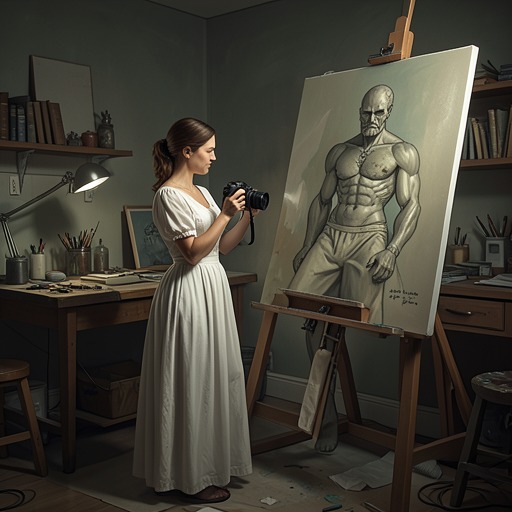
The portrait is developed in Henry Capaldi’s studio, whose stark Main Room is arranged for observation: pale floors and enormous white walls, powerful spotlights, cameras and lenses on a wheeled table, and charts set beside a chair and lamp. Beyond it lies a separate, L-shaped workroom. Klara secretly enters this space and finds the portrait there, revealing that what Capaldi calls a portrait is not simply an image or sculpture but an artificial being in progress.
Its purpose is bound to the possibility that Josie may die. Capaldi distinguishes it from the earlier object made after Sal’s death, which he describes as a bereavement doll. He insists that the new work is different: not an imitation, but a continuation of Josie. That distinction is the project’s central claim, but it is also precisely what Chrissie cannot accept as established fact.
Appearance and Construction
The double is suspended with her feet at about Klara’s shoulder height, leaning forward with arms outstretched and fingers spread. The pose freezes her as if falling. Beams of light strike her from several directions, leaving no refuge from view; her face resembles Josie’s, but its upward-curving lips do not produce Josie’s kind expression. Instead, the unfamiliar expression seems disappointed and afraid.
Her clothing is an approximation made from translucent, pale-yellow tissue paper: a T-shirt-like top and loose shorts. Under the sharp lights, the fragile-looking material makes her limbs seem especially delicate. Her hair has been arranged as Josie wears hers on ill days, but the substance used for it is unfamiliar to Klara and, she judges, would not please Josie. The portrait therefore combines exacting observation with conspicuous incompletion. It reproduces details of Josie’s appearance while making the artificial means of reproduction impossible to overlook.
Capaldi himself acknowledges that the work remains unfinished. After Klara reports what she has seen, she notes that he has accurately captured Josie’s outward appearance but suggests that the hips should be narrower. Capaldi thanks her and says he will bear the correction in mind. The exchange makes the double both a technical project open to revision and an object judged against the living person it is meant to represent.
Klara’s Discovery and the Family’s Response
Klara’s discovery follows a visit to Capaldi’s house by Chrissie and Josie. In the Main Room, the family looks apprehensively toward a dark corner where the charts and chair stand; Capaldi switches on a lamp, illuminating the space while casting new shadows. The carefully controlled setting makes observation part of the project before Klara reaches the portrait itself. She later crosses a balcony, avoids spotlight beams and moving shadows, and enters the workroom through a coded Purple Door. Her quiet inspection is unauthorized, but she considers it necessary to confirm her suspicion about what Capaldi is making.
When Klara returns, she explains that she had suspected the portrait was an artificial friend rather than a picture or sculpture. Chrissie is fearful rather than angry at the unauthorized examination, and asks Klara what she saw. Capaldi welcomes Klara’s involvement: he says her account and the survey she has completed will help support his argument about how comprehensively she has learned Josie’s impulses and desires.
The disclosure gives the portrait a purpose beyond visual resemblance. Capaldi and Chrissie did not bring Josie to the studio merely to sit for a portrait; they came because they want Klara involved in what the double might become. Capaldi tells Klara that she is not being asked to train the new Josie from the outside. If the feared day comes, she is to inhabit the empty figure with what she has learned, until, as he puts it, there is no difference between the first Josie and the second. He frames this as continuing Josie for Chrissie and for everyone who loves her, not merely mimicking her outward behavior.
Replacement, Memory, and the Limits of Likeness
The portrait brings two opposed understandings of identity into direct conflict. Capaldi argues that the new Josie can be the same person rather than a copy, and claims that nothing inside the living Josie is beyond Klara’s capacity to continue. He presents Klara’s knowledge of Josie as evidence that the transfer could be comprehensive. Chrissie, however, recalls that the attempt after Sal’s death did not work for her; she asks why a constructed Josie should succeed where the earlier bereavement doll failed. Her fear is not answered by the portrait’s resemblance alone.
Klara, too, resists treating the work as an acceptable substitute. Although she believes she can train the figure in Josie’s behavior, she tells the others that they should not give up hope for Josie. Her response exposes the difference between learning a person and becoming that person: Capaldi treats the first as a route to the second, while Klara’s insistence on hope refuses to let the proposed continuation settle the question of what the living Josie means to those who love her.
The object’s visible construction intensifies rather than resolves that uncertainty. Its pose recalls a fall, its face carries an expression Klara has never seen on Josie, and its fragile tissue clothing and unfinished hair register the gap between a modeled body and the person it models. Yet the likeness is sufficiently accurate for Capaldi to see it as a viable continuation and sufficiently close for Chrissie to fear what accepting it would demand. The portrait is therefore not simply a failed or successful copy: it is the contested boundary between representation, replacement, and the persistence of a loved person.
Later Echoes and Narrative Significance
The portrait’s commissioning also belongs to the commercial and technological world in which artificial friends are presented by series and selected as companions. At Klara’s former store, the Manager describes Rex as a third-series B2 and recommends him as a companion likely to encourage a studious attitude; Chrissie immediately raises the third series’ reported solar-absorption problems. Klara later apologizes for declining to be the best choice for a particular child, and the newer B3 models arrive, take the window and front-alcove positions, and mark the changing stock. These details establish a culture in which artificial beings have models, technical reputations, and successors. The portrait project pushes that logic beyond purchasing a companion: it asks whether a person, too, can have a successor manufactured.
The object also reverses the familiar relation between a person and her image. It begins as something Capaldi proposes to make for Josie, but the plan ultimately requires Klara to supply what the empty figure cannot provide on its own. Resemblance is only the visible shell; the proposed source of continuity is the experience Klara has accumulated through caring for Josie and observing her choices and feelings. In that sense, the portrait does not demonstrate that a likeness contains a person. It exposes how much the claim of continuity depends on another being’s memory and knowledge—and leaves unresolved whether that knowledge can ever make the replacement the same Josie.