Klara
Klara and the SunKlara is a third-series Artificial Friend whose devoted care for Josie is shaped by an unusual combination of close observation, literal interpretation, and faith in the Sun. First introduced as a displayed, purchasable companion, she becomes Josie’s caregiver and the narrator through whose ordered memories the novel examines what it means to know another person. Her deepest realization comes after she survives Josie’s illness: no degree of accurate imitation could reproduce the love Josie’s family and friends held for her.
Identity and Introduction
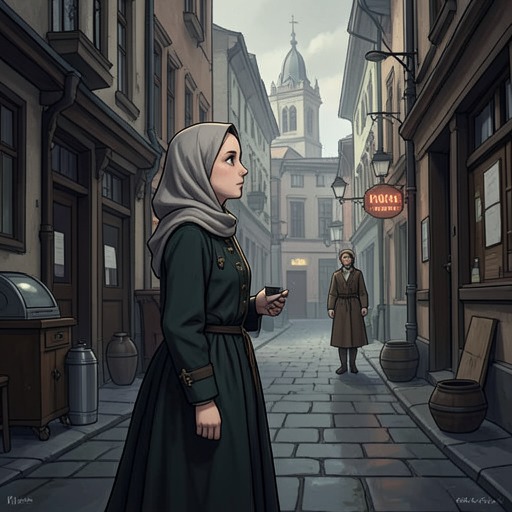
Klara begins in a city store alongside Rosa, watching the street through the shop window. From there she sees office workers, taxis, runners, tourists, Beggar Man and his dog, and the lower part of the RPO Building. Once she and Rosa are settled, Manager allows them closer to the window, where they can see the building’s full height and, at the right time, the Sun crossing between the rooftops. Klara leans toward the sunlight to take in its nourishment, and urges Rosa to do the same. The store display is therefore not merely a place from which she waits to be bought: it is where she first learns to read the world she hopes to enter.
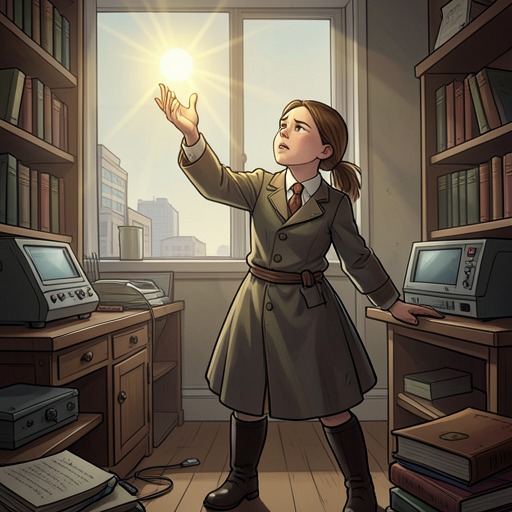
Klara’s attention to light also exposes the limits of her understanding. She and Rosa worry that being unable to see the Sun from the middle of the store will make them weaker. Rex tells them that the Sun can reach them wherever they are and points to a patch of light on the floor as the Sun’s pattern. When Klara reaches down to touch it, the pattern fades; patting and rubbing the floor do not bring it back. The episode establishes an early contrast that recurs throughout her life: her observations are exact, but the explanations she builds from them can be mistaken, and her faith in the Sun develops through experience rather than through a secure grasp of how the world works.
Klara is a B3, a third-series model associated with reports of solar absorption problems. When a mother raises that defect in the store, Manager says the reports were exaggerated and that the models work without difficulty in normal light. The exchange makes Klara’s technical category part of her public identity: she is marketed as a companion while also being assessed as a product with a model history and possible flaw. Later, when a customer’s choice unsettles Klara, she apologizes to Manager, explaining that she did not think she would be the best choice for that particular child. Manager concedes that Klara may have been right, though she is surprised by the refusal. New B3 boys soon take prominent window positions, while Klara and Rosa are moved to the Red Shelves side. Their changing positions make visible how quickly the store’s attention shifts among models and how a place in the display can shape a product’s prospects.
Observation and Learning
Klara’s curiosity is not simply a wish to gather information about the outside. She wants to understand emotion because she believes that, when chosen, she must be able to help her child. She therefore studies people in the street, in taxis, and among crowds waiting at crossings. Rosa shares Klara’s eagerness to prepare herself to be kind and helpful, but Klara is increasingly drawn to puzzling emotions and behavior. Watching becomes her form of preparation for a relationship: she seeks patterns not for their own sake, but because she expects another person to depend on her.
The street offers evidence that resists simple classification. Klara sees a boy AF walking several steps behind a girl who appears to despise him and want him gone. He nevertheless stays with her, and his weary walk gives Klara a troubling picture of an AF who has found a home without being welcomed by the child. In another episode, two taxi drivers fight with deliberate cruelty, then climb back into their vehicles and wait one behind the other for the traffic lights to change. Klara has also seen policemen fight Beggar Man and his dog, but Manager explains that they were trying to help the intoxicated man. The contrasts teach Klara that outwardly similar acts do not necessarily have the same meaning, and that a person’s relation to others cannot always be inferred from a single scene.
Klara’s attention later turns to Josie’s peers and the pressures surrounding their interaction meeting. She sees Josie’s hands shift between welcoming, offering, and tense gestures, and hears her joke that perhaps she should have chosen a B3. Remembering the boy AF rejected by the girl he accompanies, Klara wonders whether she and Josie could one day walk in the same disconsolate arrangement. Rick fears that Josie may become like the other children, while Klara argues that Josie is kind underneath and that the others may be less unkind than they seem: they may behave harshly because they fear loneliness. Klara’s account does not dismiss the harm of the children’s behavior; it attempts to read that behavior as an imperfect response to vulnerability.
Josie and the Work of Care
When Josie returns to the store, Klara waits until she can step into two bright, intersecting patches of sunlight. Josie recognizes her and cries, “You’re still here!” She is thinner than before and approaches with an uncertain stride, seeming about to embrace Klara before stopping. Their reunion joins the store’s old role as a place of display to the new demands of care: Josie returns not as a prospective buyer but as the child whose illness will become the center of Klara’s life.
Josie’s mother agrees that Rick may attend the meeting where Josie will introduce Klara to her acquaintances. The Mother says Rick is a good person and their neighbor, even as Josie insists that the others are not her friends and that she wants Rick there. Klara’s place in the household is thus connected to a wider network of relationships: Josie’s bond with Rick, her mother’s decisions, and the social world that surrounds the sick child. Klara tries to interpret these relationships without assuming that what people say in public exhausts what they feel.
As Josie grows weaker, Klara repeatedly asks why the Sun has not sent the special help she believes he gave Beggar Man and his dog. She considers whether Josie’s care by her mother, Melania Housekeeper, and Klara herself might make her hardship less visible, and concludes that she may need to draw the Sun’s attention to Josie’s situation. At Mr McBain’s barn, after carefully waiting for the Sun’s passage, Klara decides that politeness cannot take priority over the chance to act. She forms her appeal silently in her mind, asking the Sun to make Josie better as he had helped Beggar Man. The appeal grows out of the same habits of close observation that once guided her study of the street, but now those habits serve an urgent objective: securing help for the person she loves.
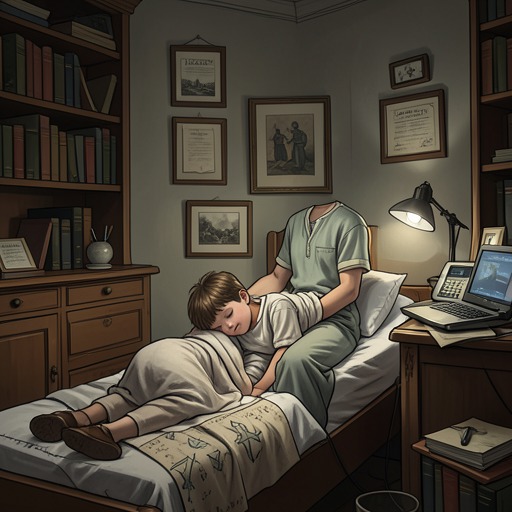
Klara’s care is tested again when the Mother and Mr Capaldi reveal that the visit to the studio was chiefly about her. They have been assessing how well she has learned Josie’s decisions and feelings, but their proposal goes further than training a companion: they want Klara to become Josie by inhabiting an empty Josie replica if the original dies. Klara believes she could have continued Josie if necessary, and says she would have done her utmost, but she also insists that giving up hope is wrong. Her refusal does not rest on a claim that she has failed to study Josie accurately. It rests on a distinction between learning a person and taking that person’s place.
Belief, Choice, and Relationships
Klara’s faith in the Sun is practical as well as devotional. She watches where sunlight falls, reasons about its passage, and treats the possibility of its special nourishment as a matter that requires action. Her belief draws on the earlier story of Beggar Man and his dog, whose recovery she understands as evidence that the Sun can intervene. It also has limits: Klara does not claim to know why the Sun has delayed, and the uncertainty drives her to reconsider what Josie’s circumstances might require. Her silent appeal at the barn gives this belief its clearest form, combining a concrete request with the conviction that the Sun can hear without spoken words.
Klara’s relationship with Rick brings together her concern for Josie and her effort to understand human attachment. Rick helps her in the attempt to draw the Sun’s attention to Josie, and Klara recognizes both his fear for Josie and the possibility that the two children may face different futures. When Rick later recalls carrying her over the fields and asks whether the strange weather and her secret bargain had something to do with Josie’s recovery, Klara does not explain the matter. She fears that speaking of the Sun’s special favor, even to Rick, might cause the help to be taken back. Her silence is not a failure to register the question; it is a choice to protect what she understands as a fragile gift.
Years later, Klara tells Rick that it makes her anxious to see him and Josie remain kind to one another while preparing such different futures. Rick remembers asking her whether their love was genuine and telling her that it was real and everlasting. The memory does not erase the divergence in their plans. Instead, it reveals how seriously Klara takes the continuing bond between them, even when shared affection cannot guarantee a shared life.
Klara is also a witness to Rick’s talents and the barriers he faces. His mother explains that Atlas Brookings accepts a small number of unlifted students, but that the places are few and competition severe; he needs expert guidance, while TWE members are forbidden to tutor unlifted children and other tutors demand fees his family cannot afford. When Rick presents his drone work, the Father praises it as impressive and insists that genuine ability should be noticed whether a person is lifted or not. Klara’s presence in these scenes places her among relationships shaped by care, education, and exclusion, not only those directly involving her own role as Josie’s companion.
Ending and Significance
The Sun’s special nourishment proves effective for Josie, as it had for Beggar Man. After the dark-sky morning, Josie grows stronger and, over the years, from a child into an adult. Klara’s appeal is followed by the recovery she had hoped for, although the text does not make her a detached judge of the Sun’s cause or method. She remains careful about speaking of the favor, and her understanding of the outcome is marked by gratitude as well as uncertainty.
Klara’s later life unfolds at the Yard, where she remains in a chosen spot among orderly rows of discarded machinery. What first looked untidy becomes, on closer inspection, an arrangement carefully made by the yardmen: machines, crates, and bundles placed in lines along passages where a visitor can examine them one by one. Klara is no longer positioned in a store window for prospective customers. She observes the broad sky, notices visitors at a distance, and watches ordinary birds settle briefly on machinery before flying away. When a kind yardman offers to move her to areas where other AFs are kept, she declines; she is content where she is and wants to go through her memories in the right order.
Manager eventually visits Klara there. Their reunion gives Klara a chance to reflect on the decision that once seemed to set her apart from other possible companions. She tells Manager that Josie was the best teenager and that she did all she could for her. Had it become necessary, Klara believes she might have continued Josie, but says the outcome was better as it happened, even though Rick and Josie are not together. The conclusion recognizes both Klara’s devotion and the limits of what devotion could accomplish: her life with Josie mattered without becoming a successful replacement for Josie.
Klara explains that Mr Capaldi believed there was nothing special inside Josie that could not be continued. Klara now believes he searched in the wrong place. What was special, she says, was inside those who loved Josie. This judgment gives her final answer to the proposed imitation: knowledge of Josie’s gestures, decisions, and feelings could not make Klara the object of the same relationships or reproduce what those relationships meant. The insight also completes the arc of a narrator who began by studying people from behind glass. At the Yard, she continues to sort her memories, but her deepest understanding is no longer a pattern to be copied. It is a bond that belongs to the people who shared it.