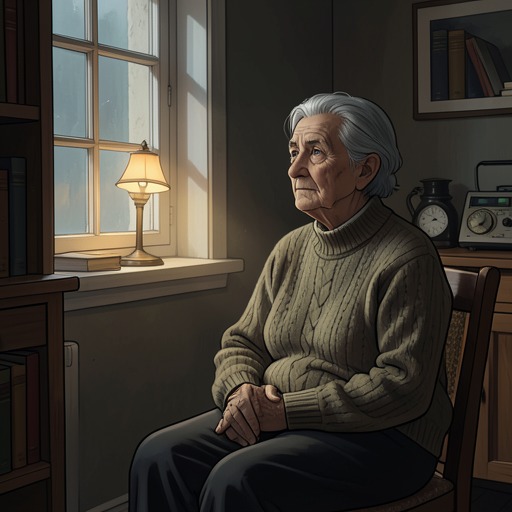
Klara Reunites with the Manager at the Yard
Klara and the SunKlara Reunites with the Manager at the Yard is Klara’s last reunion with the Manager, the former supervisor from the artificial-friend store, and a final reckoning with what Klara could and could not do for Josie. In the scrapyard, the Manager learns that Klara stayed with Josie until college; Klara, in turn, explains why she now believes that no accurate imitation could have continued Josie. Their conversation replaces the hope of duplication with a recognition of what belonged to the people who loved her, then closes with a subdued farewell beneath the open sky.
The Manager Finds Klara
Several days before the account’s final quiet, the Manager returns to the Yard, where Klara has been left among discarded machinery. Klara cannot move from place to place, but she can turn her head and has noticed a long-coated visitor walking behind her. The visitor carries a pouch-like bag on a strap and pauses to examine objects on the ground. Klara loses track of her for a time, then hears a sound and finds her standing in front of her. Even before the woman crouches to look at Klara’s face, Klara recognizes the Manager and feels happiness.
The Manager asks whether she has found Klara. Klara answers yes, and the Manager goes to fetch something to sit on. She drags a small metal crate over the rough ground and places it in front of Klara. The meeting’s makeshift seat and its noisy scrape set the reunion against the Yard’s discarded objects, far from the store where they first knew one another. Yet the Manager’s delight is immediate: she says she has hoped to find Klara there. Almost a year earlier she had found something in the Yard and briefly thought it was Klara; this time, she is certain.
The Manager wonders whether seeing her again after so long must be confusing. Klara answers that she feels only happiness. The exchange establishes their reunion not as a confrontation with the past, but as a return to a relationship in which the Manager’s kindness is still recognizable and Klara can receive it without hesitation.
The Years with Josie
The Manager asks whether Klara stayed with the people who took her from the store. She explains that she no longer has easy access to such information, making the question a measure of how much time and distance have opened between them. Klara tells her that she was with Josie all the time, until Josie went to college. The Manager calls this a successful home, and Klara agrees that she gave good service and prevented Josie from becoming lonely. The Manager replies that Josie must barely have known the meaning of loneliness with Klara there.
Klara’s account gives the reunion its most important confirmation: her work as Josie’s companion lasted through the years at home, but it did not prevent Josie’s eventual departure for college. The measure of success is not that Klara kept Josie permanently beside her. It is that she offered companionship during the time they shared. The Manager’s response recognizes the value of that care while leaving the later separation intact.
The conversation also turns back to Klara’s selection. The Manager remembers the day Josie’s family came to the store and tested Klara by asking her to walk like Josie. She says the test worried her, and that after Klara left she kept thinking about it. Klara assures her there was no need for concern: Josie’s home was the best home for her, and Josie was the best teenager. Her answer links the formal test of resemblance to the life that followed, but it does not suggest that Klara’s place in the household depended on becoming Josie. She learned and served within a home where, she says, everyone was kind to her.
The Unrepeatable Part of Josie
Klara tells the Manager that she did all she could for Josie and has thought many times about what might have happened if it had become necessary to “continue Josie.” The phrase prompts the Manager to ask what Klara means. Klara explains that she tried to learn Josie and would have done her utmost, but now believes the attempt would not have worked, even if she had achieved accuracy. Something would still have remained beyond her reach: what the people closest to Josie felt for her in their hearts.
Her explanation changes the meaning of the possibility she once considered. The obstacle is not simply imperfect copying. Klara distinguishes between reproducing Josie accurately and possessing the relationships that made Josie irreplaceable. The Mother, Rick, Melania Housekeeper, and the Father loved Josie in ways Klara could observe and learn about, but could not acquire as her own. Her conclusion is not that she failed to care for Josie; it is that care and likeness could not make her the person those relationships were about.
Klara identifies Mr Capaldi as having believed that nothing special inside Josie could not be continued. He had searched for such a quality and told the Mother that he had found nothing of the kind. Klara now thinks he was looking in the wrong place: what was special was not inside Josie as an isolatable feature, but inside those who loved her. This is why Klara believes she could not have succeeded, and why she is glad she made the choice she did. The conversation gives her own account of the limits of the proposed continuation: what cannot be copied is not a hidden component, but the web of feeling through which a person is loved.
The Manager accepts Klara’s conclusion and says that she is glad Klara believes things worked out for the best. She adds that this is what she always wants to hear when she meets her former artificial friends again: that they are glad about how things went and have no regrets. She offers to ask the men to move Klara closer to several B3s on the far side of the Yard, in case she wants company. Klara declines. She likes her present spot and has her memories to go through and place in the right order. The choice makes her solitude neither a complaint nor an accidental condition in this scene: Klara prefers to remain where she is, occupied by the work of remembering.
Sunlight and Farewell
Before the Manager leaves, Klara says she must report one more thing: the Sun was kind to her from the beginning and was especially kind once when she was with Josie. She wants the Manager to know. The Manager affirms that the Sun has always been good to Klara, but the exchange remains understated; it does not turn Klara’s report into a new explanation of what happened. Instead, it lets her carry into the reunion a conviction that mattered during her life with Josie.
As she responds, the Manager turns toward the wide sky and raises a hand to her eyes. For a moment, they look at the Sun together. This shared gesture gives the farewell a point of contact beyond their words, but does not undo the distance between their lives. The Manager then says she has to get on and says goodbye. Klara thanks her and says goodbye in return.
The Manager drags the crate back to where it had been, its unpleasant noise echoing the sound it made when she brought it over. She walks away down the long passage between the rows of machinery. Klara notices that she now walks differently from the way she did in the store: every second step, she leans left, and Klara worries that the long coat on that side might touch the dirty ground. At mid-distance, the Manager stops and turns, but she looks toward the far distance, where a construction crane stands on the horizon, rather than back at Klara. Then she continues away. The scene ends not with a second farewell or a last exchanged look, but with Klara watching the Manager’s changed gait and receding figure.
Memory, Care, and Limits
The reunion brings the novel’s final concerns into a single conversation: companionship can matter without lasting forever, and learning another person does not grant possession of the relationships that make that person unique. Klara can say that she served Josie well, recall the kindness of the household, and imagine what she might have attempted. Yet she concludes that the love of Josie’s family and Rick could not have been reproduced by even the most accurate continuation. Her account grants emotional significance to the bonds around Josie rather than locating her specialness in a quality that can be extracted and copied.
The scene also returns Klara to the Manager, who first remembers her through the store’s test and then meets her as someone with a completed history. She asks whether Klara regrets how things turned out; Klara’s answers make clear that she does not. The Manager’s wish to hear that former artificial friends have no regrets meets Klara’s more particular reasons: Josie had a good home, Klara did what she could, and a continuation would not have captured what mattered most. Their parting preserves affection without pretending that reunion can restore the past. Klara remains in the Yard with her memories, while the Manager walks toward the distant crane, carrying the encounter back into a world Klara no longer shares.