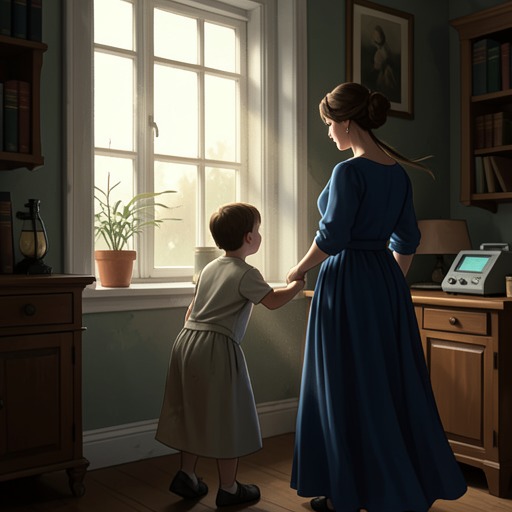
Klara and Josie's relationship
Klara and the SunKlara and Josie's relationship is a bond of chosen companionship and devoted care, formed when Josie singles Klara out in the store and deepened as Klara becomes part of her household. Its tenderness is repeatedly tested by Josie’s illness, her difficult relations with other children, and the diverging futures she and Rick prepare for. The relationship’s final significance lies not in Klara replacing Josie, but in the persistence of her attachment after Josie has moved beyond her care.
Recognition and Choosing
Josie first approaches the store during Klara’s fourth morning in the window. Pale and thin, she walks with a cautious, uncertain rhythm, seeming to check after each step that she remains safe. She stops before Klara, smiles, and asks whether she can be heard through the glass. The encounter establishes a distinction between simply seeing an Artificial Friend and recognizing a particular one: Josie’s attention is fixed on Klara, while her mother evaluates the models on display.
That evaluation is sharpened by the store’s model hierarchy. The Manager presents Rex as a B2, third series, and recommends him as a companion who could encourage a conscientious, studious attitude. Josie’s mother remarks that the third series had solar-absorption problems. Although the Manager minimizes the reports, the exchange makes clear that a family’s choice is also shaped by model reputation and practical anxieties. Klara, in turn, worries that she may not be the best choice for Josie and apologizes to the Manager for causing embarrassment. The Manager eventually agrees that Josie will be happy with the B3 boy, but is surprised by Klara’s hesitation.
Josie’s choice becomes unmistakable when she returns to the store after Klara has been moved to the rear. Her mother says they cannot keep searching forever, and Josie replies that Klara had been there and that they may simply be too late. Klara waits quietly, partly because she expects Josie to find her and partly because she fears the possibility that a child who once made a promise may return only to choose another Artificial Friend. When the Manager leads Josie toward the arch, Klara steps into two intersecting rectangles of sunlight. Josie’s face fills with joy, and she quickens her uncertain stride. Her cry of recognition—“You’re still here!”—turns the earlier window encounter into a deliberate reunion and confirms that Klara, rather than a generic replacement, is the one she has sought.
Companionship and Care
Once Klara is part of Josie’s home, the relationship rests on a particular kind of trust: Josie wants Klara there, and Klara treats being chosen as a responsibility. Josie explains that her mother is watching Klara closely because Josie insisted that it had to be her. The mother’s scrutiny therefore becomes part of the bond’s conditions, not evidence that Josie herself is uncertain. Klara reads Josie’s expression carefully and responds with encouragement, even when uncertainty remains visible in Josie’s face.
Josie also lets Klara see needs and loyalties that complicate her role as companion. Before an interaction meeting, she asks her mother to invite Rick, rejecting the idea that the other children are her friends. Later, lying in bed, she quietly hopes Rick will come to what she calls an awful party. Klara is pleased that Josie has raised the meeting, but unsure how to understand it. The exchange shows that intimacy between Josie and Klara does not isolate Josie from her human attachments: Klara is trusted with Josie’s wishes, including those concerning Rick, while remaining an observer of the social strains around her.
At the meeting, Josie behaves in ways that can appear contradictory. Klara recalls her changing gestures—hands that welcome, offer, or tense—and the laugh with which Josie answers a question about not choosing a B3 by saying, “Now I’m starting to think I should have.” Rick fears that Josie may become like the other children. Klara counters that Josie is kind underneath, and interprets the children’s roughness as a response to loneliness rather than simple unkindness. She allows that Josie, too, may fear being alone. Her understanding does not erase the difficulty of the meeting; it gives Klara a way to remain loyal to Josie without reducing either Josie or the other children to their worst behavior.
Strain, Illness, and Misunderstanding
The intimacy is not free of hurt or uncertainty. After the interaction meeting, Klara sees an unfamiliar expression in Josie’s eyes. Remembering Josie’s joke about wishing she had chosen a B3, Klara wonders whether she has done something to upset her and apologizes. Josie says she was not upset, but her voice carries no smile, and she clearly wants to be left alone to draw. Klara leaves her to it. The scene exposes a limit in Klara’s devotion: she can notice a change in Josie and ask about it, but she cannot always know its cause or make closeness welcome on demand.
The Morgan’s Falls trip produces a longer chill. Klara expects its shadows to have passed by the following morning, but Josie remains cold toward her, and Josie’s mother also becomes more distant. This change unsettles Klara because she had thought the trip had gone well and had complied with the wishes of both Josie and her mother. She wonders whether her limitations beside a B3 have become apparent and prompted regret about the family’s choice. Rather than withdraw, she resolves to work harder as Josie’s Artificial Friend. At the same time, she begins to understand that human attempts to escape loneliness can involve complicated maneuvers whose consequences may never have been within her control.
Klara’s care also includes the practical and painful circumstances of Josie’s illness. At Rick’s house, Klara tells the Father that she cannot smell at all; she speculates that B3s may have been given limited smell for safety, but that she has none. Such a limitation marks the difference between attentive companionship and human perception even as she tries to understand what matters in a household. Later, Josie’s mother explains that Rick was not lifted and that Atlas Brookings admits only a small number of unlifted students each year. She wants Klara to help tutor him, but the plan is tangled in TWE’s ban on tutoring unlifted children and the high fees charged by others. Josie objects to the scheme. Klara’s place in the family therefore draws her into questions of illness, education, and social exclusion as well as personal comfort; loving attention does not give her the power to settle those conflicts.
Separate Futures and Lasting Attachment
By the time Klara revisits these relationships, Josie and Rick are preparing different futures while remaining kind to one another. Klara tells the Father that this contrast makes her anxious. The Father recognizes the concern as connected to an earlier conversation, when Klara asked whether his love for Josie was genuine; he had answered that it was real and everlasting. Klara’s anxiety shows how seriously she has taken the permanence of human attachment, even as the lives around her move in separate directions. Her bond with Josie has included the hope of being needed, but cannot make Josie’s future stand still.
The physical distance between the pair becomes visible when Josie later passes the old store with Klara. Klara knows the street and expects the familiar setting, but the window no longer displays Artificial Friends or the Striped Sofa. Colored bottles and a sign for recessed lighting have replaced them. The storefront’s conversion makes the end of Klara’s original life as a displayed companion concrete: the place where Josie first saw her has become an ordinary retail space, no longer organized around the possibility of their meeting.
Klara’s later existence is set against that changed world. At the Yard, she occupies a special place beneath a wide sky, with the distant construction crane as the only tall object in view. She first takes the machinery, crates, and bundles for disorder, then recognizes the yardmen’s work in the carefully arranged rows and passages. The setting is not Josie’s home, and the relationship no longer unfolds through daily care. Yet Klara’s memories of Josie remain active within this later life, sometimes compositing people and places so vividly that she momentarily forgets she is sitting on the hard ground of the Yard. Josie’s importance persists not as a claim that Klara can become her, but as a presence Klara continues to carry in memory.
Meaning of the Bond
The relationship brings together choice, care, and the limits of understanding. Josie’s insistence that Klara is the one she wants gives Klara a defined place in a world where Artificial Friends are displayed, compared by model, moved between store positions, and eventually replaced. Klara answers that choice with sustained attention: she watches Josie’s gestures, tries to interpret her silences, considers her fear of loneliness, and keeps working to be a good companion when Josie grows distant.
But the bond is not a promise of perfect mutual comprehension or an unchanging future. Josie can welcome Klara and still need privacy; she can be kind to Rick while moving toward a different life; and her illness and family’s educational concerns create stakes that Klara cannot resolve. The relationship’s emotional force comes from that gap between fidelity and control. Klara remains devoted without being able to govern Josie’s choices, and her memories preserve the attachment without turning it into a substitute for Josie’s continuing life.