Klara and Josie’s meeting at the store window
Klara and the SunKlara and Josie’s meeting at the store window is the beginning of their bond and the first step toward Klara leaving the shop to join Josie’s household. It unfolds not as a single introduction but as a sequence of visits: a pale girl approaches Klara through the glass, promises to return, and later insists that no other artificial friend will do. The early warmth of recognition is shadowed by Josie’s frailty, her mother’s watchfulness, and the possibility that the promised choice might not be kept.
The First Visit
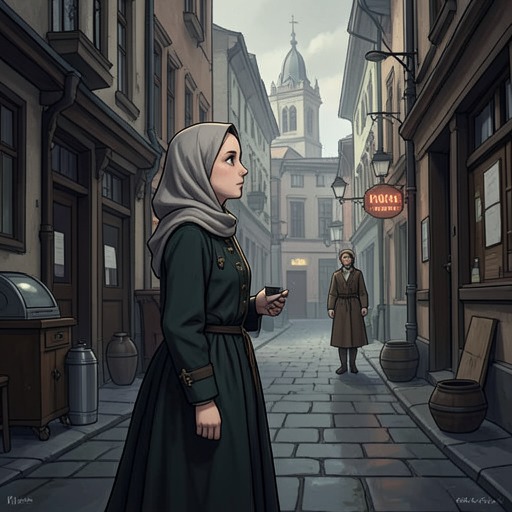
Almost midway through Klara and Rosa’s fourth morning in the window, a taxi slowed and crossed the traffic lanes to stop at the curb. Josie got out and looked directly at Klara. She appeared about fourteen and a half, pale and thin, and walked with a cautious, unsteady rhythm, seeming to check after each step that she remained safe and would not fall. Her careful gait makes the first encounter more than a simple meeting between a child and a prospective companion: Josie’s physical vulnerability is present before either of them speaks.
When the pedestrians had passed behind her, Josie stopped and smiled at Klara. She asked through the glass whether Klara could hear her. Rosa continued looking toward the RPO Building, as she was supposed to, while Klara returned Josie’s smile and nodded. Josie’s face, Klara noticed, seemed to fill with kindness when she laughed. That warmth sat beside a quieter impression: Klara wondered whether Josie might be one of the lonely children she and the Manager had discussed. She could not yet be sure, but the thought gives the meeting an undertone of need beneath its friendliness.
Josie first called Rosa cute, then explained that she had seen Klara while driving past the previous day and thought Klara was the artificial friend she had been looking for. She apologized in case the way she had put it sounded disrespectful. Josie also asked whether Klara was French, connecting her short, neat hair with two French girls she had seen at a recent interaction meeting. Her attention, however, kept returning to Klara. This is a choice beginning to take shape in public: Josie does not merely notice an artificial friend in the window but singles Klara out as the one she wants.
Before leaving, Josie said she would come back soon so they could talk more. In a near-whisper, she asked whether Klara would go away. Klara shook her head and smiled; Josie answered that this was good, and framed the parting as only temporary. The exchange establishes an early promise on both sides, though only Josie’s return can test whether it will hold.
A Choice Under the Mother’s Gaze
On a later visit, at the start of Klara and Rosa’s second week in the window, Josie appeared with her mother and no taxi visible behind them. A crowd of tourists had initially obscured them. Josie beamed at Klara, but her mother kept a hand on her shoulder and continued talking rather than letting her approach. Klara saw Josie’s impatience to come forward and feared they might disappear into the crowd. When the Mother finally released her, Josie walked carefully to the glass, while her mother remained nearby, arms crossed and eyes fixed on Klara.
Josie explained the scrutiny directly: she had told her mother that Klara was the one she wanted, so the Mother was sizing Klara up. She asked again whether Klara would come if her mother agreed. Her uncertainty was not simply about securing permission. Josie stressed that she did not want Klara to come against her will; if Klara refused, Josie said she would tell her mother they could not have her. The request therefore turns the earlier promise into a question of consent as well as selection. Josie wants Klara, but presents that desire as conditional on Klara wanting to go too.
The Mother’s silent assessment and Josie’s concern about Klara’s willingness give the scene a restrained tension. Klara can read Josie’s eagerness, but she recognizes that she has not yet learned how to interpret all the signals in the Mother’s stance and gaze. The glass separates the two girls while the Mother’s presence makes clear that their attachment also depends on an adult decision.
The Search and the Reunion
When Josie and the Mother later came into the store, Klara was in the rear of the shop and did not see them at once. Josie said that another artificial friend, Sung Yi, was great, but was not the one she wanted. Her mother replied that they could not keep searching forever. Josie answered that Klara had been in this store and that they must be too late. The fear that Josie might choose someone else, which the Manager had previously raised with Klara, now becomes concrete: Josie has returned, but believes the object of her search may have disappeared.
Klara stayed quiet where she was. She expected Josie eventually to reach her, yet she also remembered the possibility that children might make promises and then fail to return—or return and choose another artificial friend. Joy at recognizing Josie was therefore checked by apprehension. The meeting’s earlier warmth does not guarantee its outcome; the store’s routines and the prospect of replacement intervene between promise and reunion.
The Manager recognized Josie’s description of the artificial friend she had seen in the window: short, dark hair, dark clothes, kind eyes, and intelligence. She offered to take Josie to find her. Klara then moved into view, stepping into two bright, intersecting rectangles of the Sun’s patterns after spending the morning outside them. When Josie saw her, her face filled with joy and she quickened her pace, though she remained thin and walked uncertainly. She exclaimed, “You’re still here!” The words answer the fear she had voiced in the store and complete the return promised at the window.
Significance
The episode establishes the relationship through repeated, modest acts rather than a single decisive declaration: Josie recognizes Klara, asks to be heard, promises to return, explains her choice to her mother, and eventually searches for Klara in person. The glass is both a literal boundary and the condition of their first conversations; each girl can see the other, but Klara cannot yet leave the display and Josie’s access depends on her mother. Their reunion in the store changes that arrangement, bringing Josie’s chosen companion into reach beyond the window.
The visits also set tenderness against uncertainty. Josie’s kindness and insistence on Klara coexist with her fragile walk; her mother’s permission is accompanied by a close, unsmiling appraisal; and Klara’s hope is haunted by the possibility of being passed over. The final recognition does not erase those conditions, but it converts a child’s promise into an actual choice. By stepping forward from the rear of the store and into the Sun’s bright patterns, Klara becomes visible to Josie again, and the meeting moves from an exchange across glass toward the shared life the pair will begin.