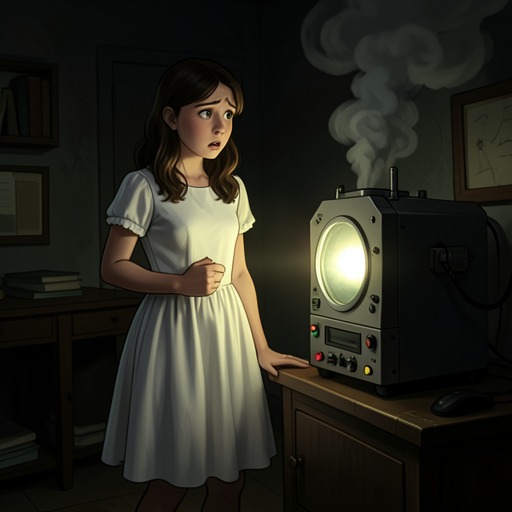
Klara and Paul Plan to Destroy the Cootings Machine
Klara and the SunKlara and Paul Plan to Destroy the Cootings Machine begins as an effort to protect Josie and becomes a wager on Klara’s own body: she asks Paul to help find a machine she believes is obstructing the Sun’s nourishment, then agrees that a substance inside her may be used to disable it. The plan depends on trust where Klara cannot give a full explanation, and its proposed cost makes her devotion to Josie more than a promise.
Cause and Purpose
Earlier that day, Klara and Paul had passed a machine being used by overhaul men. Klara remembered its terrible pollution and asked Paul to drive into the district not simply to visit her old store, but to locate and destroy the machine. She described it as identifiable by the name Cootings on its body and by three funnels emitting pollution. The physical details make her target precise even though her account of why it matters remains incomplete.
Klara connected the proposed destruction to Josie’s health. She told Paul that if they found and destroyed the machine, she believed it would lead to Josie’s full recovery. If that happened, she said, it would no longer matter whether Henry Capaldi made a portrait or how well she could learn Josie. Her assurance gave Paul a reason to take the request seriously, but she admitted that she was unable to explain further and asked him to trust her for Josie’s sake.
Finding the Machine
Paul eventually agreed to try. Their search took them past the RPO Building and the store, then through yards and narrow lanes. Each time Klara failed to see the machine, Paul moved the car on; his sharp turns made her anxious they might hit a fire hydrant or a building. They entered a yard despite a sign reading “Strictly No Admittance,” and searched among vehicles, stacked crates, and a construction crane, but found nothing there. The detours and false leads give the search a practical, improvised character: Paul is acting on Klara’s conviction before he knows what the machine has to do with Josie.
At last, in another yard behind a building marked Floors For Lease and enclosed by wire-mesh fencing, Klara recognized the target. Paul stopped the car abruptly, and she pressed her head against the window to see it more clearly. When Paul checked that it was the machine with the funnels, the sight confirmed that they had found the object she had described. Locating it transformed the request from an abstract act of faith into a decision about whether and how to act.
Proposed Method and Risk
Paul reasoned that the machine would contain a middle-market Sylvester broad generation unit: fuel-efficient and robust, but without real protections. Dust, smoke, and rain would not disable it, he said, whereas a high-acrylamide substance such as P-E-G Nine could rapidly polymerize inside the system and cause terminal damage. He compared the effect to putting gasoline into a diesel engine, but much worse. The plan therefore rests on a technical vulnerability Paul believes he has identified, rather than on an attempt to attack the machine from outside.
Paul then proposed obtaining the solution from Klara herself. He believed she carried a quantity of P-E-G Nine inside her head, perhaps about five hundred milliliters, and estimated that even half might be enough to incapacitate the machine. He stressed that this was only a guess, that extracting it might affect Klara’s cognitive abilities, and that he was not advocating a course that could jeopardize Henry Capaldi’s plan. The exchange places competing risks side by side: the machine might be stopped, but Klara’s abilities could suffer, potentially compromising the possibility of continuing Josie if she died.
The procedure Paul described was specific and unsettling. He suggested making a small incision below either ear, piercing the outer layer to reach a valve, then loosening and retightening it by hand. While searching the Mother’s car glove compartment, he produced a plastic water bottle to catch the liquid and a tiny screwdriver whose edge he considered sharpening. They would then carry the solution to the yard and pour it down one of the funnels, preferably the central one, which he thought likely to connect directly to the generator. His account remained tentative—he acknowledged that this was not his area of expertise—but the everyday objects turned a speculative strategy into an immediate physical possibility.
Agreement and Significance
Klara feared what the extraction might do to her, yet she asked whether Paul believed it could destroy the machine. He confirmed that it was his belief. He also told her that he did not fully understand what she was trying to do, but wanted what was best for Josie and was willing to grasp at any chance. In response, Klara smiled, nodded, and agreed to try. Her consent is the decisive point of the planning episode: she accepts a bodily risk without the certainty of success and without offering Paul a complete explanation of the pollution’s supposed effect.
The plan makes a sharp contrast with the earlier survey at Henry Capaldi’s studio. Klara had completed a questionnaire designed to establish how deeply she understood Josie’s feelings and decisions; Henry then revealed that he and the Mother wanted her not merely to train a new Josie, but to inhabit an empty portrait double and continue Josie if the original died. Paul’s proposed extraction could jeopardize that project, a danger he explicitly recognized. Klara nevertheless treats the machine’s destruction as the more urgent possibility because she hopes it may restore Josie’s health and make the replacement plan unnecessary.
The episode’s tension arises from different kinds of knowledge. Paul can describe an engine, a chemical, and a method of delivery, but cannot verify Klara’s belief that destroying the machine will help Josie. Klara, conversely, insists on the importance of the act while withholding or lacking a fuller explanation. Their agreement is therefore neither a demonstrated scientific solution nor an act of blind obedience: it is a shared decision under uncertainty, grounded in their common concern for Josie and in Paul’s willingness to trust Klara.
Klara later told Rick that the task given to her on the evening he helped her reach Mr McBain’s barn had been completed, and that she had given up something in doing it. She said she could not yet explain, but that they could have hope again. This later report links the planning to a completed sacrifice and renewed hope, while leaving the precise operation and its outcome outside the planning scene itself. The machine becomes the focus of Klara’s attempt to intervene in Josie’s illness, and the cost of that attempt falls, at least in part, on Klara rather than on the person she hopes to save.