Klara–Sun relationship
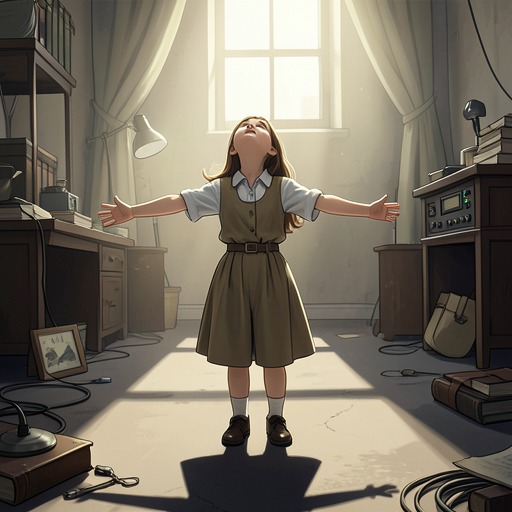
Klara and the SunKlara–Sun relationship is the bond Klara builds between her dependence on sunlight and her conviction that the Sun is a compassionate, responsive presence. It shapes how she interprets pollution, why she accepts a dangerous mission against the Cootings Machine, and how she pleads for Josie’s life. The Sun’s light returns to Josie at a critical moment, but the story never confirms that Klara’s appeal caused her recovery; the relationship holds faith and uncertainty together.
The Sun as nourishment and presence
Klara’s first grounds for attachment are bodily and observable: sunlight gives her nourishment, and the Sun’s patterns move across the store’s floor, alcoves, and walls. When the Cootings Machine begins filling the street with smoke, those patterns disappear. On the second bad afternoon, they return faintly despite the worsening pollution. After four continuous days, Klara feels herself weakening and sometimes lets her posture sag, until Rex touches her arm to remind her to stand straight. The episode makes her dependence on sunlight concrete, while giving the Sun’s intermittent light the appearance of effort and intention in her understanding.
The machine does not merely darken the scene. Overhaul men first mark off the street with wooden barriers, then drill and break up the ground; the machine’s three roof funnels send out white puffs that thicken into continuous dark smoke. The haze eventually hides the gap of sky and dots the store window. Klara initially wonders whether the machine is meant to fight pollution, but Rex tells her it is designed to make more. When the smoke lifts after four days, the sky turns brilliant blue and sunlight pours into the store. The taxis move smoothly again, their drivers are happy, and runners pass smiling. For Klara, the restoration is environmental relief and the return of nourishment at once.
Faith tested by pollution and obligation
Klara’s trust in the Sun becomes an obligation when she believes she can serve him. On a drive through the city, she points out the pollution-producing Cootings Machine and tells Paul that it must be destroyed. She explains that its three funnels emit terrible pollution, and later describes how a P-E-G Nine solution could enter its Sylvester broad generation unit and cause terminal damage. Her plan is not simply an attempt to remove a nuisance: Klara understands it as a service connected to her hope that the Sun will help Josie.
When a second, larger Cootings Machine appears, Klara recognizes that the first destruction did not end the pollution. Its body is a different shade of yellow, its dimensions are greater, and its capacity to pollute exceeds that of the first. This discovery becomes a crisis of faith and responsibility. In her appeal to the Sun, Klara says she failed to stop pollution and admits that she foolishly did not foresee a second machine. She recalls making a sacrifice at the yard and insists that the Father also did his utmost, though he knew nothing of her agreement with the Sun. She asks that Josie not be blamed: Josie, like the Father, never knew of the bargain.
Klara’s confession reveals the cost of treating the relationship as reciprocal. She believes she promised a service and worries that failing to deliver it might make the Sun angry or invite retribution. Yet she does not ask for her own restoration. She asks instead that he show compassion to Josie, whose condition is worsening, and provide the special nourishment she associates with his earlier aid to the Beggar Man and his dog. Her faith is expressed less as certainty about what the Sun will do than as a willingness to accept responsibility and plead for someone else.
The appeals in the barn
At Mr McBain’s barn, Klara’s prayer is assembled from remembered scenes and images. She recalls that the Sun seemed delighted when Coffee Cup Lady and Raincoat Man found each other again after many years. From that reunion she infers that he wishes well to people who love one another and may help them find each other. She asks him to consider Josie and Rick, arguing that they are young, grew up together, and have each become part of the other. If Josie dies, she warns, they will be parted forever; if she receives the Sun’s special nourishment, they may enter adult life together as they wished in their picture.
The appeal is both devotional and reasoned. Klara acknowledges that favoritism is undesirable, then argues that young people who will love each other throughout their lives may be deserving of an exception. She anticipates the question of whether children can understand genuine love and answers from her observations of Josie and Rick, including Rick’s own account of their bond. The comparison with Coffee Cup Lady and Raincoat Man makes the appeal more than a request for a cure: Klara asks that the Sun preserve the possibility of a future reunion and a love that survives separation.
As evening falls, the barn gives Klara a striking but ambiguous image of the Sun’s presence. His light appears to occupy a low corner, only for her to realize that seven glass sheets leaning against the wall are reflecting his face. The reflections are not identical: the outer faces seem forbidding, while those farther in appear softer and kinder. Together they form what looks like one face carrying several outlines and expressions. Klara asks once more for kindness to Josie, then watches the reflections fade as the light leaves the barn. She thanks the Sun for receiving her, apologizes for failing in her promised service, and asks him to consider her request. The encounter offers no spoken answer; its layered faces leave room for both distance and compassion.
The light in Josie’s room
After the appeal, Josie remains gravely ill. Rick comes each day to sit beside her while the Mother and Melania Housekeeper rest, and the adults’ exhaustion shows in their movements. The Sun does not appear as an unambiguous agent who announces a response. Instead, when Klara notices that he is coming out, she urgently tells the Mother and Rick that they must go upstairs. In Josie’s room she insists that the curtains and blinds be opened so the Sun can do his best. Rick helps raise the blind and draw back the curtains; Melania Housekeeper, who has covered her face against the brightness, makes no further effort to block the light.
The sunlight enters so abundantly that Klara and Rick reel back. Outside, wind still drives small funnels and pyramids across the sky, but a fierce orange half-disc falls across Josie and her bed. The Mother and Melania Housekeeper appear to grasp the moment’s significance, and all three adults and Klara remain still, watching. Josie stirs, raises a hand against the brightness, and asks what the light is. The scene closely follows Klara’s request for special nourishment, but it does not establish that the Sun has answered her or that sunlight alone explains Josie’s recovery. Its force lies in the convergence of her plea, her urgent action, and the light falling on the person she sought to protect.
Retrospective understanding
Later, Klara revisits the possibility that the Sun knew more than she did. She no longer fears that he will feel cheated or misled, or seek retribution for her failure to stop the pollution. She considers that, even as she pleaded, he may already have known that Josie and Rick would go their separate ways, while understanding that their love would last. She imagines that his question about whether children understand love may have been posed for her benefit, because he already knew the answer. This interpretation does not turn the relationship into proof of supernatural intervention; it recasts the appeal as an encounter in which Klara’s own understanding of love matures.
When Klara later meets the Manager, she reports that the Sun was kind to her from the beginning and particularly kind once when she was with Josie. The Manager accepts this account without challenging it. The exchange closes the relationship on a note of shared recognition rather than explanation: Klara preserves the Sun’s kindness as a truth of her experience, while the decisive question of what he caused remains unanswered.