Klara’s Appeal to the Sun and Her Bargain
Klara and the SunKlara’s Appeal to the Sun and Her Bargain is the moment when Klara turns her faith in the Sun into a direct plea for Josie’s life and a proposed exchange: she will destroy the pollution-producing Cootings Machine if he will give Josie special help. Set in Mr McBain’s barn as the Sun passes toward his resting place, the scene brings together Klara’s devotion, her growing knowledge of pollution, and her willingness to act on behalf of the child she loves. The Sun’s response remains unspoken, but the bargain gives Klara a purpose that carries beyond the barn.
The Appeal in the Barn
Klara waits in Mr McBain’s barn for the Sun, whose rays are growing orange as he nears his resting place. The barn appears to her in irregular segments: scraps of farming tools, two buckets reduced by the difficult light to intersecting ovals, and drifting particles of hay. She chooses to remain seated on a foldaway chair, trying not to intrude on the Sun’s privacy, but recognizes that the chance to make her request will soon pass. Her appeal is therefore both reverent and urgent: politeness cannot be allowed to prevent her from speaking before the light leaves.
She asks the Sun to make Josie better, recalling the time he helped the Beggar Man and his dog. Klara insists that Josie is still a child and has done nothing unkind, but her plea does not assume that the Sun must agree. She remembers the Mother’s scrutiny at Morgan’s Falls and the angry bull she encountered, and wonders whether she has offended the Sun by approaching him when he needs rest. As the shadows lengthen, she fears he may not distinguish Josie from the humans whose pollution and inconsideration have angered him. Her apology acknowledges that the request may be unwelcome even as she refuses to abandon it.
The Proposed Bargain
Klara asks the Sun to delay his journey for one more instant and listen to a proposal. If she can do something special to please him, she asks whether he would show special kindness to Josie, as he did for the Beggar Man and his dog. This phrasing makes the appeal an offer rather than a demand: Klara accepts that the Sun may refuse, but tries to find an action that might change his response.
The barn’s appearance shifts as she speaks. Though the red glow remains dense, it takes on a gentler quality; the partitions seem to drift in the Sun’s last rays. Klara sees the lower half of the Glass Display Trolley rise out of view, and the terrible bull disappears. She understands these changes as a vital advantage and presses on before the opportunity closes. The scene presents a change in the atmosphere around her without translating it into an explicit answer from the Sun.
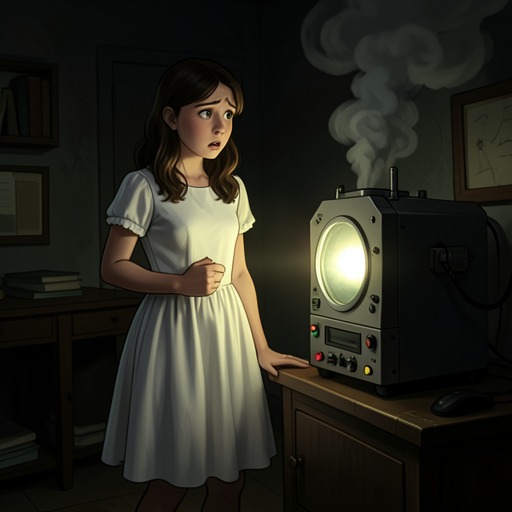
Klara names the pollution as the source of the Sun’s anger and identifies its machine as something she might destroy. This proposal draws on what she learned at her old store, where the Cootings Machine’s three funnels sent thick smoke into the street, obscured the sky, and kept sunlight from reaching the shop. Klara had watched the smoke darken and the Sun’s patterns vanish; after four continuous days of pollution, she felt herself weakening. She now offers to find and destroy the machine in exchange for the Sun’s special help for Josie. The bargain links a visible environmental harm to a personal act of rescue, making Klara’s promise both a plea for Josie and an attempt to answer what she believes the Sun condemns.
Departure and Uncertainty
After Klara makes her offer, the barn darkens, but the darkness seems friendly. The segments disappear, and she understands that the Sun has moved on. For the first time, she walks to the barn’s back opening, where she sees the field reaching a line of trees and the Sun sinking into the ground beneath a night sky. She believes he is smiling kindly as he goes to rest, and stays at the opening until his last glow vanishes before leaving through the dark barn.
The scene closes with signs that Klara has been received kindly, not with a spoken promise that Josie will recover. That distinction matters: Klara departs grateful and hopeful, but the exchange remains grounded in her interpretation of the Sun’s light and the surrounding changes. The bargain supplies the resolve behind her later efforts against the machine, while leaving open whether her proposed sacrifice can secure the help she seeks.
The Bargain’s Wider Stakes
The Cootings Machine first enters Klara’s understanding through the contrast between its name and its function. Before it arrives, overhaul men mark off a section of street with wooden barriers, drill into the ground, and frighten the artificial friends in the shop window. Klara initially supposes the machine may fight pollution; Rex corrects her, predicting that it is designed to produce more. When it begins operating, three short funnels send out white puffs that gather into a continuous, dark cloud. The smoke covers the shop window with dirty dots and eventually hides the gap of sky. Manager reassures the artificial friends that the pollution will last only a few days, but it continues long enough for Klara to feel weak and to worry that Josie might be unable to return to the store.
That earlier experience gives the bargain its practical object: Klara is not asking to defeat pollution in the abstract but offering to destroy a particular machine she has seen and learned to recognize. Later, she explains to Paul that the machine has the name Cootings on its body and three funnels emitting pollution, and says its destruction is the real reason she asked to be driven into the district. Paul explains that its Sylvester broad generation unit could be fatally damaged if P-E-G Nine solution entered its system. The appeal thus leads from spiritual conviction toward a concrete plan, in which Klara’s promise depends on people and technical knowledge as well as faith.
The bargain’s hoped-for result is never confirmed by the scene itself. Later, Klara sees a different, larger machine with the beginning of the name Cootings visible on its body, protected behind overhaul men’s barriers and emitting pollution from three funnels. Its appearance shows that destroying one machine has not ended the pollution: another, more powerful source has taken its place. The contrast limits the reach of Klara’s proposed exchange without erasing its importance to her. She has offered to act against what she understands as a wrong, even though the environmental harm can recur beyond the reach of one act.
Faith, Care, and the Meaning of Help
Klara’s approach to the Sun grows from her belief that sunlight nourishes artificial friends and that the Sun previously helped the Beggar Man and his dog. She does not treat that earlier recovery as proof that Josie must be saved. Instead, she invokes it as a precedent while admitting that the Sun may be angry and may refuse to consider her request. Her faith is active but not entitled: it leads her to ask, apologize, and offer something in return.
The appeal also foreshadows the larger conflict around Klara’s ability to understand and continue Josie. Mr Capaldi later tells the Mother that Klara’s survey responses suggest she has learned Josie’s impulses and desires, and argues that nothing in Josie is beyond an artificial friend’s capacity to continue. This proposed scientific proof treats human identity as accessible through observation and replication; the Sun bargain, by contrast, is founded on a relationship Klara cannot prove or control. The two forms of hope meet in Klara, whose care for Josie is at once attentive and practical, yet not reducible to a technical demonstration.
That tension returns when Mr Capaldi later asks Klara to help with efforts to reverse-engineer artificial friends, describing them as black boxes that people fear because they cannot understand how they think. He says she could be uniquely useful to the research. The Mother refuses permission, insisting that Klara deserves her slow fade rather than being opened up for study. Set against that later dispute, Klara’s bargain with the Sun emphasizes a different way of treating an artificial being: her understanding matters not as material to be extracted, but as the basis for a promise made out of care. The plea does not establish that the Sun saves Josie, and the later replacement machine denies any simple victory over pollution. What it does establish is the scale of Klara’s commitment: she tries to turn gratitude, observation, and faith into help for someone else.