Klara’s selection by Josie’s family
Klara and the SunKlara’s selection by Josie’s family is the turning point that takes Klara from the Artificial Friend store into Josie’s home and places her within the intimate, demanding work of caring for a seriously ill child. Josie returns looking for the particular AF she remembers, and the Mother’s scrutiny transforms a purchase into a test of Klara’s attention: Klara demonstrates that she has learned Josie’s appearance, voice, and movement with unusual precision. The Mother’s decision follows that demonstration, while Josie’s embrace gives the choice its emotional force.
The Return to the Store
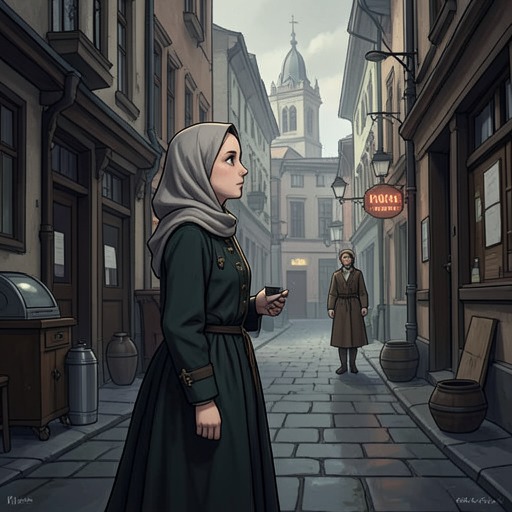
Josie comes back to the store after an absence long enough to make the reunion uncertain. Klara has remained in the rear of the store when Josie enters, partly believing that Josie will eventually find her and partly held back by a fear seeded by the Manager’s warning: children sometimes make promises at the window and do not return, or return only to choose another AF. Joy at recognizing Josie therefore arrives already shadowed by the possibility of being passed over.
Josie tells the Manager that she is looking for the AF she saw in the window: short-haired, darkly dressed, almost French-looking, and kind-eyed. The Manager recognizes Klara from that description and leads Josie to her. Klara waits until they reach the arch before stepping into view. She has been outside the Sun’s patterns all morning; now she stands in two bright, intersecting rectangles as Josie approaches with a sudden quickening of her stride.
Josie’s first words are an astonished recognition that Klara is still there. Klara quietly reminds her that they made a promise. Josie accepts that she took too long, then turns to call the Mother over and identifies Klara as the AF she has been searching for. She admits that she had been sick, though she says she is fine again, and asks whether the Mother can buy Klara immediately, before someone else does. Her urgency makes clear that this is not an open-ended comparison among store models: Josie has already formed a definite preference.
The Mother’s Test
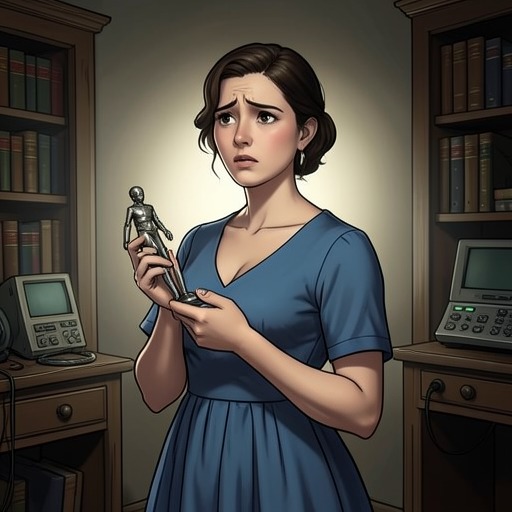
The Mother does not immediately accept Josie’s choice. She asks the Manager whether every Artificial Friend is unique, and, after hearing that this is especially true at Klara’s level, asks what makes Klara distinctive. She then separates Klara from Josie and tests whether Klara can answer without looking at her. Asked for the color of Josie’s eyes, Klara answers that they are gray. The Mother next asks her to characterize Josie’s voice and, finally, to explain what she has noticed about the way Josie walks.
Klara identifies a possible weakness in Josie’s left hip and the potential for pain in her right shoulder. She explains that Josie’s way of walking appears to protect both from sudden movement or unnecessary impact. Rather than treating this as a sufficient verbal answer, the Mother asks Klara to reproduce the walk. The demand turns Klara’s accumulated observations into a public demonstration, with Josie, the Mother, the Manager, and the store watching.
Klara walks beneath the arch and across the Sun’s patterns towards the B3s and the Glass Display Trolley. To reproduce Josie’s gait, she draws on several observations rather than a single impression: Josie getting out of a taxi, approaching the window after the Mother removed a hand from her shoulder, and hurrying towards Klara moments earlier. Even as she circles the trolley, she tries not to brush against the B3 standing beside it. The performance shows both the precision of her attention and the care with which she has retained details across separate encounters.
At the end of the circuit, Klara catches the Mother watching her with a gaze that seems to pass through her, as though the Mother were trying to see something beyond the visible display. Klara stops beside the trolley, one foot poised with its heel off the floor. The Manager names what the demonstration has established: Klara has extraordinary powers of observation, unlike any AF she has known. Josie’s quiet plea follows. The Mother agrees to take Klara.
Choice and Consequence
Josie hurries to Klara and holds her in an embrace. The tableau distinguishes the three adults’ and child’s responses: the Manager smiles happily, Josie clings to the AF she has been seeking, and the Mother, still drawn and serious, looks down into her shoulder bag. The Mother’s agreement resolves the immediate contest over whether Klara will be chosen, but her searching expression preserves the seriousness with which she has assessed the decision.
The selection carries the relationship out of the carefully ordered store and into the less predictable routines of Josie’s household. At home, Klara must learn spaces whose objects do not remain in fixed positions: in the kitchen, the housekeeper Melania repeatedly moves items, including shifting a blender four times within a few minutes. The transition also brings Klara into the household’s disagreements about how much time she may spend with Josie and where she may be present. Melania initially tries to keep her out of the kitchen during the Mother’s quick coffee and Josie’s breakfast, and later insists that she stand by the refrigerator rather than join them at the Island. Josie protests until the Mother rules in Klara’s favor.
Those morning meals reveal the practical meaning of Klara’s new role. One of her tasks is to wake Josie in time for the Mother’s quick coffee, when Josie and her mother can sit together at the Island. On one occasion, Klara lets Josie fall back asleep after a difficult night, believing that the extra rest will help. Josie wakes late and hurries downstairs, but the Mother’s car is already leaving. Josie does not shout at Klara again, yet she eats without smiling. Klara understands that missing this brief shared time can let loneliness enter Josie’s day, regardless of what else happens.
The Relationship the Choice Begins
The choice is later tested by the limits of illness and by the competing judgments of the people around Josie. During an outing to Morgan’s Falls, the Mother challenges Melania’s assessment that Josie is well enough to spend the day away from home. Melania does not move to help Josie out of the car; Josie then apologizes to Klara and promises they will go another time. Klara accepts that they must do what is best for Josie. The promise made in the store is thus carried forward not as a claim on Josie’s strength, but as a bond that must accommodate her vulnerability.
When Josie becomes acutely distressed, Klara tells her that her mother needs rest and reminds her that Klara is there for her. Josie insists that she needs the Mother, not Klara. The moment does not cancel the selection or Klara’s devotion; it makes clear that being chosen as an AF does not make her a substitute for every relationship Josie needs. Klara’s part is to remain attentive and present while recognizing that Josie’s attachment to her mother has its own necessity.
The Mother’s original examination also anticipates how Klara’s observational ability will matter beyond the store. Later, Melania privately asks Klara to keep a close eye on Josie during a visit to the city with the Mother, especially when they see Mr Capaldi, whom Melania distrusts. Klara agrees to help. Her selection was secured by her ability to notice how Josie moved; that same capacity becomes a reason others rely on her to watch over Josie when they fear they may not see a danger in time.
The scene therefore makes attention the basis of both purchase and relationship. Josie chooses Klara because she remembers her and wants no other AF; the Mother consents after Klara proves that looking at Josie has become a form of careful knowledge. The bright patches of Sun through which Klara steps at the moment of reunion frame a choice that is at once commercial and deeply personal: she enters the family as an artificial companion, but the household soon depends on her sustained observation, practical care, and willingness to stay present through the interruptions of illness.