P-E-G Nine Solution
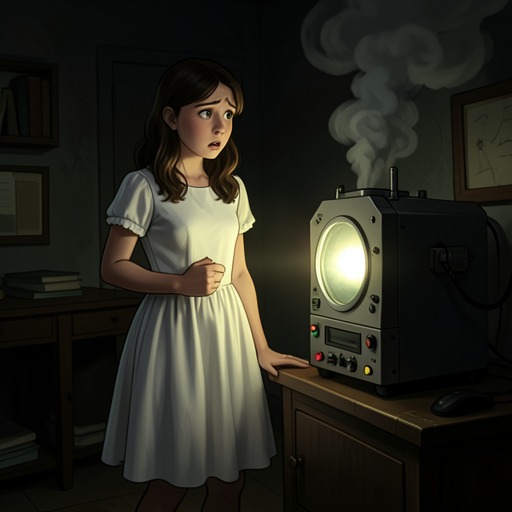
Klara and the SunP-E-G Nine solution is a chemical substance that, in Paul’s account, could irreparably damage the pollution-producing Cootings Machine. His plan depends on the possibility that some of it is carried inside Klara’s head: extracting the substance would turn her body into the means of attacking a machine whose smoke had obscured the Sun. The plan makes the solution more than a technical detail. It draws together the novel’s industrial pollution, Klara’s dependence on solar nourishment, and the physical exposure involved in treating an artificial being as something whose interior can be accessed and used.
Identification and Proposed Use
Paul explains that the Cootings Machine contains a middle-market Sylvester broad generation unit, designed to withstand dust, smoke, and rain but not a substance with a high acrylamide content. P-E-G Nine solution, he says, would rapidly polymerize inside the unit, causing damage likely to be terminal. His comparison is to putting gasoline into a diesel engine, but with a much worse result. The proposed mechanism is therefore specific: rather than damage the machine from outside, the solution would enter its system and incapacitate it from within.
The plan follows Klara’s insistence that the machine must be destroyed. When she and Paul pass a machine operated by overhaul men near her old store, she identifies it by the name Cootings on its body, its three funnels, and the terrible Pollution they emit. The threat is not abstract. Earlier, the machine’s smoke had darkened the daytime, hidden the gap of sky, and blocked the Sun’s patterns from the store. After four continuous days of Pollution, Klara felt herself weakening, despite Manager’s reassurance that the store’s AFs had endured the machine’s previous appearances without suffering. Her proposed intervention grows out of this earlier encounter with smoke as both a visible environmental hazard and a disruption of the nourishment on which AFs depend.
Klara as the Source
Paul tells Klara that she may carry P-E-G Nine inside her head, in a small cavity where the head meets the neck. He stresses that this is only his guess and not his area of expertise, but estimates that the quantity might be approximately five hundred milliliters. In his view, even half that amount could disable a middle-market machine. The substance’s possible presence in Klara’s body is thus presented as a technical possibility, not a certainty established by examination.
The extraction proposal makes that uncertainty consequential. Paul says a small incision below either ear could expose a valve, which he believes he could loosen and then tighten again. The substance would be caught in a plastic water bottle, and a sharpened tiny screwdriver would serve as the tool. They would then walk to the machine and pour the solution into one of its nozzles, preferably the central one, which Paul thinks likely to connect directly to the Sylvester unit. These ordinary items—the bottle and screwdriver—give the plan a makeshift character, while the proposed incision reveals its personal cost: the route to disabling the machine passes through Klara’s own body.
Risk and Decision
Paul does not present the procedure as safe. He warns that losing some P-E-G Nine might affect Klara’s cognitive abilities, although he expects her overall performance not to be greatly impaired. He reasons that her essential energy source is solar, so the loss should not affect her significantly; at the same time, he emphasizes that the matter lies outside his expertise and that jeopardizing her abilities could jeopardize Capaldi’s plan. The warning sets the plan against the purpose for which Klara had been selected: to learn Josie deeply enough to become her, should the original Josie die.
Klara recognizes that Paul’s suggestion might itself be dangerous to her, but his willingness to consider it comes from his desire to help Josie. He says he wants what is best for her and is willing to grasp at any chance. Klara responds by smiling and agreeing to try. The decision is made without certainty that the substance is present in the proposed amount or that the extraction would leave her unharmed. In this way, the chemical’s practical usefulness is inseparable from a choice to risk the capacities that make Klara valuable to the people who hope she can continue Josie.
Pollution, Recurrence, and Artificial Interiors
The Cootings Machine first appears as an imposing street presence: overhaul men prepare a special section behind wooden barriers, drill and break up the ground, and then operate a machine whose three roof funnels send up white puffs that thicken into continuous dark smoke. Klara names it from the word Cootings printed on its side. Its Pollution reaches the store, where the Sun’s patterns disappear and Klara’s strength falters. The later plan to use P-E-G Nine reverses the relation between machine and body: the machine had imposed its smoke on the surrounding environment, but now Klara’s possible internal contents are imagined as a means of entering and disabling the machine.
The pollution threat recurs after the first machine has been destroyed. From the Mother’s car, Klara sees another machine protected by overhaul men’s barriers, pumping Pollution from three funnels. Its different shade of yellow and somewhat larger dimensions establish that it is not the machine she and the Father destroyed in the yard; it is more capable of producing Pollution than the first. This recurrence prevents the earlier plan from resolving the larger environmental problem. The solution’s proposed power remains targeted at an individual machine, while the return of the machinery shows that the source of danger can be replaced.
The substance also resonates with the later dispute over the interiors of Artificial Friends. Henry Capaldi argues that AFs should be opened and reverse-engineered because people fear what they cannot understand inside them; he describes them as black boxes whose mechanisms might yield new knowledge. The Mother refuses to let him recruit Klara, insisting that she deserves a slow fade rather than being opened for research. P-E-G Nine belongs to a different proposed intervention, not the later reverse-engineering campaign, but both episodes make the artificial body’s hidden interior a site of practical claims. In one, an uncertain chemical reserve might be extracted to damage a machine; in the other, internal mechanisms are sought as knowledge. The story leaves those interiors consequential without making access to them seem neutral or cost-free.