Rick's drone birds
Klara and the SunRick's drone birds are the self-developed technology through which Rick makes his abilities visible to others and begins to imagine a future beyond the limits placed on unlifted students. The birds are not merely a hobby: they gather data, carry substantial surveillance capabilities, and become the centerpiece of Rick's appeal for a chance at Atlas Brookings. Their promise is inseparable from the ethical questions that attend observation, privacy, and the authority to regulate technological use.
Development and Technical Ambition
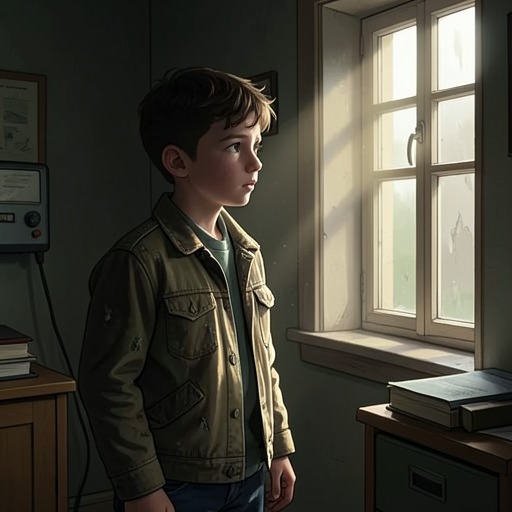
Rick describes his interest in drone technology as a passion and says he has developed his own system and assembled a team of drone birds. When Mr Vance asks whether this means he has gone beyond anyone else, Rick is briefly panicked and looks toward Klara. Her encouraging smile, offered on Josie's behalf as well as her own, helps him continue. He quickly clarifies that he is not claiming genius or a breakthrough; his claim is more measured, and in some ways more persuasive: he has worked out the system himself, without tutors.
Rick explains that he has used information he found online and that his mother has supported him by ordering expensive books. He has brought drawings to show how the system works, while acknowledging that he is unlikely to make a major advance without expert guidance. The distinction matters. The birds demonstrate initiative and technical understanding, but Rick does not present them as proof that he has already surpassed specialists. He presents them as the work of someone ready to learn more.
The system has moved beyond the page: Rick says that he has already realized some of the designs in his notebook. The account gives no detailed specifications for the birds' construction or operation, but Mr Vance's inspection of the drawings leads him to identify their high surveillance capabilities. Rick confirms that the birds gather data. Their technical significance therefore lies not just in their being functional creations, but in the kind of access and observation their function makes possible.
Uses and Ethical Questions
Rick resists treating data gathering as automatically equivalent to privacy invasion. He identifies security and babysitting as possible applications, then adds that there may be people society needs to watch, including criminals, paramilitaries, or cults. The range of examples makes the system's purpose appear open-ended: the same capacity to observe could be framed as care, protection, or scrutiny of suspected threats.
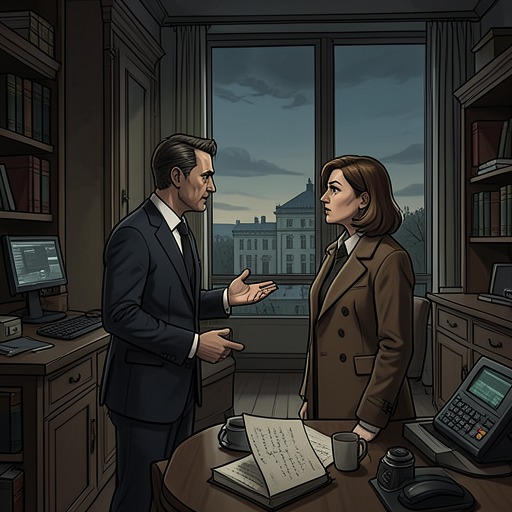
Mr Vance asks whether Rick sees ethical problems in this potential. Rick says that he is sure such problems exist, but argues that legislators, rather than someone in his position, should decide how these technologies are regulated. For the present, he says, he wants to learn enough to take his understanding to the next level. Mr Vance approves of this answer and continues through the notebook. The exchange does not resolve who should control the birds or how their use should be bounded; instead, it makes regulation part of the system's significance. Rick's technical ambition is presented alongside an acknowledged ethical burden, even as he places the responsibility for formal rules elsewhere.
Education and Opportunity
The drone birds become central to Rick's attempt to pursue a place at Atlas Brookings. He and his mother hope that the college's liberal reputation might make it willing to consider him, despite the institution's intake of unlifted students being less than two percent. Rick calls his prospect theoretical, not assured. The system gives him concrete work to discuss when he asks Mr Vance to take his application seriously, but it cannot by itself remove the institutional limit he faces.
In the meeting, Rick explains that he wants a good college in order to do justice to his talent. The drawings and the designs he has already realized let him speak about that talent without claiming that he is already an exceptional inventor. The birds thus function both as an engineering project and as an argument for access to further education: they show what Rick has pursued without tutors, while also making plain what he believes expert guidance could enable.
Changing Circumstances and Significance
The birds belong to a period when Rick is still trying to imagine his future in relation to Josie and her family. When Josie's illness worsens, their agreed study sessions lose their original purpose: Rick stops concentrating on lessons and waits in the hall for permission to see her, sometimes receiving only a few minutes at the bedroom doorway. The technical project does not erase this attachment, but it exists alongside the strain of watching Josie become less available to him.
Later, as Josie increasingly leaves home to prepare for college, Rick also becomes occupied with projects and new friends. He buys a car, names it the Wreck, and drives to the city; the car increasingly, rather than Josie herself, is what brings him to the house. The account does not state that the birds directly produce this changed life, but their place among Rick's projects connects his earlier bid for educational recognition to a widening independence. Their most lasting narrative function is therefore double: they make his technical ability legible within a system that sharply restricts unlifted admissions, and they expose the ethical uncertainty that accompanies the power to watch.