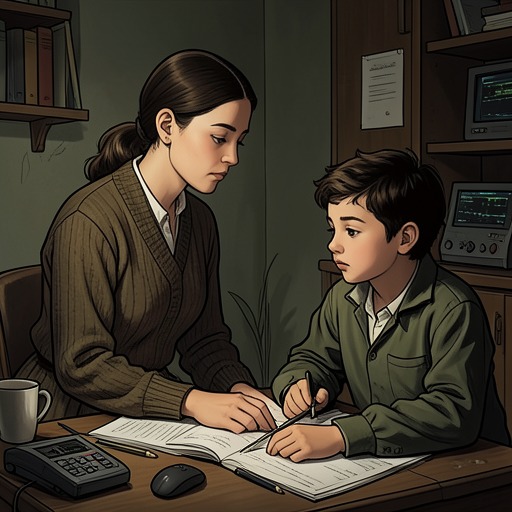
Rooms within rooms
Klara and the SunRooms within rooms is a metaphor for the depth and limits of knowing another person. The Father imagines Josie’s heart as a house whose rooms open into further rooms; Klara believes that, however complex, the house must have an end. Her later conclusion complicates that confidence: she could have learned Josie’s observable self, but not the love for Josie held in other people’s hearts.
The Heart as a House
The image emerges in a conversation about what it would mean for Klara to become Josie if Josie’s illness made that necessary. The Father distinguishes impersonating Josie’s mannerisms from learning what makes her individual. Klara agrees that the human heart may be the hardest part to learn, but proposes a devoted Artificial Friend could move through its rooms one by one, studying them until they became like her own home.
The Father extends the image by asking what happens when a room contains another room, and that one another still. The house ceases to be a finite interior that can be mastered by careful observation; it becomes a structure whose unexplored depths may keep multiplying. The metaphor makes the problem vivid without resolving it: attention and devotion might enable Klara to know a great deal, but the scale of the task may resist completion.
Klara’s Confidence and Method
Klara does not dismiss the possibility of knowing Josie. She accepts that Josie’s heart is complex, yet reasons that complexity must have limits. If learning it is the best way to save Josie, she says she will do her utmost and believes she has a good chance of succeeding. Her confidence rests on patient observation, the method she has already applied to human behavior.
Before the conversation with the Father, Klara’s effort to understand others has included studying passers-by and trying to feel emotions she cannot readily comprehend. She cannot find the beginnings of the taxi drivers’ violent anger in herself, but she keeps investigating unfamiliar emotions because she wants to help her future child. In this light, the rooms are not merely a picture of an unknowable interior: they also express her belief that close attention can make another person’s emotional world traversable.
The Metaphor Reconsidered
By the time Klara reflects on the possibility of continuing Josie, she distinguishes accuracy of imitation from access to the heart. She believes that she might have reproduced Josie with considerable precision, yet still failed to reach what the Mother, Rick, Melania Housekeeper, and the Father felt for Josie. What remained beyond her reach was not simply a hidden feature of Josie that better observation could uncover; it was the inward meaning Josie had for those who loved her.
Klara’s final account relocates the “something very special” that Henry Capaldi had searched for. It was not, she concludes, an independently discoverable essence inside Josie, but something present in the people who loved her. The house metaphor therefore changes force across the novel: first it frames Klara’s hope that devoted study can reach every room, and later it clarifies why even perfect imitation would not have amounted to continuing Josie. The inexhaustible rooms mark both the ambition of understanding and the boundary between learning someone’s patterns and sharing the relationships that make that person irreplaceable.