the Sun
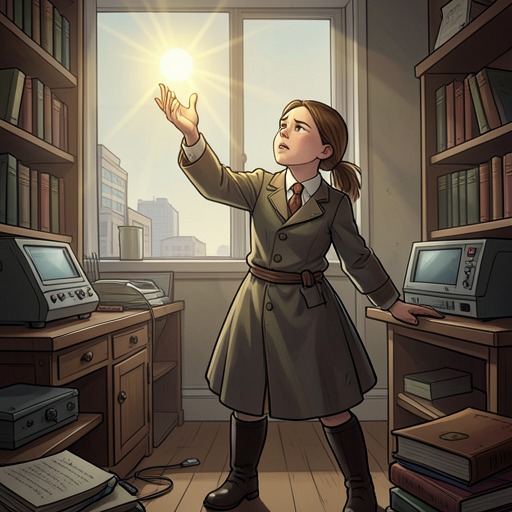
Klara and the SunThe Sun is both a visible source of nourishment and the center of Klara’s evolving faith in special help. Its journey across the city and its descent beyond the fields give the story a recurring measure of time; its light first sustains Artificial Friends, then becomes the grounds for Klara’s hope that it may save Josie. Yet the contrast between Beggar Man and his dog’s recovery and the Sun’s unexplained delay in helping Josie leaves that hope unresolved.
Identity and Presence
When Klara and Rosa are new in the store, they watch the Sun cross between the tops of the buildings, glimpsed from their positions behind the window. Klara leans toward its light to take in as much nourishment as possible and urges Rosa to do the same. Their limited view from mid-store makes its movement consequential: the Sun is not an abstract emblem but a visible presence whose light the AFs understand as sustenance.
Rex tells them that the Sun can reach them even when they cannot see him. Pointing to a pattern on the floorboards, he says they can touch it to become strong again. Klara tries this when the store is empty, but the pattern fades under her fingers and does not return when she pats or rubs the boards. The episode establishes an early tension between the Sun’s dependable nourishment and Klara’s wish to find a direct, controllable way of receiving it.
The window gives Klara a larger view of both the Sun and the world beyond the store. On the morning she and Rosa take their turn, a narrow gap beneath the lowered grid lets sunlight form a bright rectangle on the platform, within reach of their feet. Klara expects this warmth to provide nourishment for some time. When the grid rises, the two AFs are covered in dazzling light; for Klara, the moment is also a release into the close, complete view of the outside she had long wanted.
The Sun’s Daily Course
At Josie’s house, the Sun’s setting becomes part of the girls’ evening routine. From the bedroom’s rear window, Klara and Josie can see across three adjoining fields to the horizon, watching the Sun sink into the ground at the end of the day. Josie calls the landscape “the field,” but its boundaries are marked by posts, and wind moves the tall grass as if unseen passers-by are hurrying through it. The broad view contrasts with the narrow slice of sky Klara had seen from the store.
The sky’s changing colors make this view more than a fixed backdrop. It can resemble lemons or slate, and when Josie is unwell it may take on colors Klara associates with her vomit, pale feces, or streaks of blood; sometimes it divides into neighboring squares of purple. Klara and Josie watch from the soft cream couch by the window, which Klara privately calls the Button Couch. The recurring sunset links the Sun’s regular passage to the changing circumstances of Josie’s health, without making the sky itself a reliable sign of what will happen.
Special Nourishment and Recovery
Klara’s belief in the Sun’s special help is grounded in what she witnesses in the city. On a gray afternoon, she sees Beggar Man and his dog lying motionless together beside a blank doorway between the RPO Building and the Fire Escapes buildings. Passers-by sometimes pause, but neither moves through the day. Klara concludes that both have died. She feels sorrow, while also recognizing that they died together, holding one another, and considers asking Manager to arrange for them to be taken somewhere quieter. Seeing how tired and serious Manager is, she says nothing.
The following morning, in splendid weather, Klara looks again and finds Beggar Man sitting up against the doorway, one leg stretched out and the other bent beneath his resting arm. He strokes the dog’s neck with his free hand; the dog is alive too, turning its head to watch the people passing. Klara understands their recovery as the result of a special kind of nourishment from the Sun. As they absorb the light, both grow stronger, and she expects Beggar Man soon to stand and resume his cheerful exchanges with passers-by. This scene becomes the clearest evidence she has that the Sun’s help can reach someone at the edge of death.
Josie and the Limits of Hope
When Josie becomes dangerously weak, Klara applies the precedent of Beggar Man and his dog to her. At first she expects the Sun to help during the period before the trip to Morgan’s Falls. Later, as Josie grows weaker and her future remains uncertain, Klara cannot understand why the help has not come. The earlier recovery has given her a model for hope, but not a rule that explains when or why the Sun intervenes.
Alone outside, Klara tries to account for the delay. She thinks the Sun may be busy attending to many people, or may overlook Josie because she appears to be cared for by her mother, a housekeeper, and an AF. This leads her to wonder whether Josie’s condition must be made conspicuous to attract the Sun’s attention. At a wooden gate into the tall grass, she recalls a difference between the cases: Beggar Man had become weak in a busy street, where taxi drivers, runners, and other passers-by could see him. Klara also remembers that the recovery followed the disappearance of the Cootings Machine, whose pollution had forced the Sun to retreat; the special help had come in the fresh era after the machine was gone. She watches the grass from the gate, thinking about how she might rescue Josie, but, unused to being alone outdoors and beginning to feel disoriented, returns to the house.
The Sun’s significance therefore rests on a mismatch between visible pattern and uncertain agency. Its light has a daily route; its nourishment can be felt and, in Klara’s observation, can accompany a striking recovery. But the Sun does not answer in a predictable or demonstrable way when Klara needs help for Josie. That uncertainty makes the Sun at once a source of material nourishment and the object of a faith tested by illness, memory, and the unequal circumstances of those who need it.