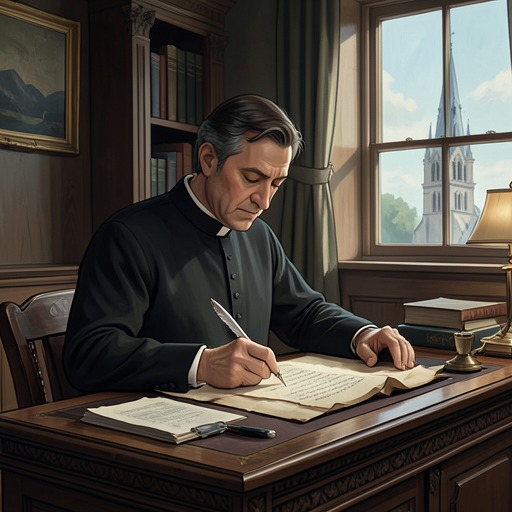
Archbishopric of Seville
La piel del tamborThe Archbishopric of Seville is the local ecclesiastical authority at the center of the conflict over Nuestra Señora de las Lágrimas: it pursues the church’s secularization and redevelopment, yet cannot readily overcome the privilege protecting the building while Mass is celebrated for its founder. Under Archbishop Aquilino Corvo, the archdiocesan administration must balance diocesan discipline, Roman oversight, and a proposed financial arrangement with Banco Cartujano. Its predicament shows how formal authority can be checked by inherited obligations and the stubborn persistence of local practice.
Authority and the Rome Investigation
The Archbishopric enters the story as both an institution with local responsibility and a body subject to intervention from above. After a hacker’s letter draws the Pope’s attention, the Institute for External Works is assigned to investigate its author and maintain prudent contact with the local ecclesiastical authority. The investigation is deliberately kept discreet and reasonable, but the prospect of escalation to the Congregation for the Doctrine of the Faith gives the inquiry a disciplinary edge. The Archbishopric is therefore not simply the investigator’s setting: it is one of the institutions whose actions and internal dealings may come under scrutiny.
That scrutiny also becomes a piece in the Roman Curia’s internal maneuvering. Archbishop Paolo Spada tells Lorenzo Quart that the hacking incident is, in itself, a minor matter; the Pope’s interest has transformed it into an opportunity for a larger institutional contest. Spada wants information and a substantial report to demonstrate that his office is acting, satisfy the Pope, and keep Cardinal Jerzy Iwaszkiewicz at bay. The local archdiocese’s affairs thus acquire significance beyond Seville, as competing priorities in Rome shape how its problems are investigated.
Corvo, Ferro, and the Limits of Discipline
Aquilino Corvo presents the church’s demolition as dependent on secularization, but explains that this prerequisite has become difficult because of an old privilege. Granted in 1687 with papal sanction, the privilege provides that Nuestra Señora de las Lágrimas retains its rights so long as a Thursday Mass is said for the soul of its benefactor, Gaspar Bruner de Lebrija. The condition binds the fate of a valuable site to a recurring religious act, converting an inherited obligation into a practical obstacle to redevelopment.
Father Príamo Ferro more than satisfies the condition: he celebrates Mass every day at eight in the morning, and twice on Sundays and holy days. Corvo cannot simply use his office to stop a priest from saying Mass. The archbishop describes the conflict instead as one of discipline: Ferro disregards his pastorals and calls to order, and holds personal positions that Corvo cannot easily bring into line. Corvo has asked Rome to suspend Ferro ab officio, but the process is slow. The Vatican computer intrusion further complicates matters, since officials appear to be waiting for Quart’s report before acting. Until that procedure runs its course, the matter remains unresolved.
The Thursday observance is protected not just by a document but by vigilance around its performance. Macarena Bruner explains that a representative of the archbishop and a notary paid by Pencho Gavira attend the service, each watching for an irregularity or lapse that might invalidate the condition. The presence of both observers makes the Mass a contested, monitored event: its words and timing have consequences for the church’s survival. Macarena fears that, once Father Óscar is removed from the parish, someone may try something against Ferro, whose continued observance is crucial to preventing demolition.
The Redevelopment Bargain
The Archbishopric has a material stake in the church site, although Corvo acknowledges that the diocese has no claim to the land beyond a moral one grounded in three centuries of worship. Banco Cartujano offers generous compensation and undertakes to finance a church in one of Seville’s poorer neighborhoods, as well as a foundation supporting the Church’s social work among the Roma community. Corvo presents these provisions as persuasive in a period when parish collections are meager. The offer frames redevelopment as a way to exchange a threatened old church for resources and new social provision.
The bargain is tied to Banco Cartujano’s broader financial exposure. Its internal report warns that failure of the Puerto Targa transaction would leave the bank in serious difficulty; public knowledge of the bank’s dealings around Nuestra Señora de las Lágrimas could also damage its standing with conservative, often Catholic, clients. The church project is consequently not an isolated diocesan matter. It forms part of a high-stakes commercial strategy, while the Archbishopric’s proposed benefits make the ecclesiastical institution a participant in a transaction that could carry reputational as well as financial consequences.
Corvo’s language reveals a measure of institutional caution. He first speaks of the prospective benefit to his diocese, then corrects himself to say the diocese, as though reconsidering the possessive claim. He also emphasizes that the archdiocese has only a moral right to the land, even as it considers the compensation on offer. The correction does not settle the ethical or legal question; it makes visible the gap between the institution’s historical presence, its limited claim to ownership, and its willingness to negotiate over the site.
Parish Practice and Institutional Contrast
The Archbishopric’s administrative rooms embody a world of records, hierarchy, and official procedure. When Quart meets Corvo, he sits opposite the archbishop amid volumes of Church Fathers and papal encyclicals bound with the archiepiscopal arms. A separate, more comfortable receiving area is reserved for those Corvo favors, and Quart is plainly not among them. The office’s furnishings establish an unequal relationship before the discussion of authority even begins; the encounter is formal, guarded, and shaped by Corvo’s distrust of the investigator.
The parish’s daily worship offers a sharp contrast to that bureaucratic setting. At the eight o’clock Mass, Ferro wears an old amice and an outdated guitar-shaped chasuble, garments associated with a pre-Vatican II style. He celebrates certain portions of the service in Latin, although Church rules since Paul VI prescribe local languages to encourage understanding and participation. These practices are not presented as the same sort of violation: Latin is not a grave offense, and some churches enjoy special privileges. Together, however, Ferro’s dress and liturgical choices mark his partial resistance to ecclesiastical modernization, a resistance that parallels his refusal to yield to Corvo’s pastoral instructions.
Quart’s response to the Mass complicates the institutional conflict. He is moved by Ferro’s solemn handling of the ritual and recognizes that, for the modest congregation gathered among scaffolding and darkened paintings, the service provides consolation. The Archbishopric’s case treats the Mass as a condition to be satisfied, a disciplinary problem, and an obstacle to the development deal; in the nave, the repeated gestures and words are also a source of warmth and companionship for people burdened by age and ordinary life. The same ritual therefore has legal, administrative, and human force, none of which can be reduced to the others.
A Power That Cannot Conclude the Matter
The Archbishopric’s position remains unresolved because its several kinds of authority do not align. Corvo has local jurisdiction and has sought Rome’s approval for disciplinary action, but suspension depends on a delayed process. The 1687 privilege attaches protection to the continued Thursday Mass, while Ferro’s daily celebration makes it harder to portray the observance as a mere technicality. Meanwhile, the proposed compensation and social commitments make demolition attractive to the diocese, but cannot erase the church’s accumulated history or the service’s significance to its parishioners.
The institution’s limits are also dramatized through Quart’s passage in the Archbishop’s Palace. Descending the marble staircase, he sees the Giralda through the windows and recalls the former bishops’ prison where disobedient priests could be confined. Modern communications and contemporary procedures have replaced that older, more direct coercion, yet the image underscores the long history of conflict between episcopal authority and troublesome clergy. Corvo then calls Quart back upstairs, signaling that the encounter and the matter itself have not reached a settled conclusion. The Archbishopric remains powerful enough to seek discipline and negotiate redevelopment, but not powerful enough to make the opposing claims disappear by decree.