Cargar con los pecados ajenos
La piel del tamborCargar con los pecados ajenos names the burden of taking responsibility for sins that belong to someone else. In the novel’s closing movement, the idea links Father Ferro’s exhausted ministry of mercy to Lorenzo Quart’s decision to kneel before him and ask for absolution. What begins as an act of priestly care becomes a recognition shared by two men who have each borne a lonely burden.
Meaning and Context
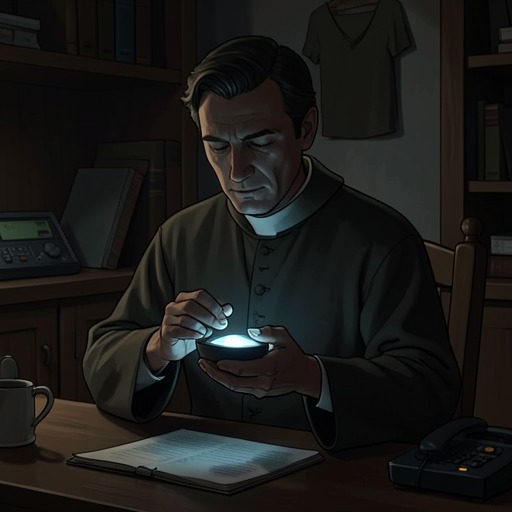
Father Ferro’s vocation is described as more than offering peace, shelter, and mercy. He is prepared to forgive sins and, on the night of Quart’s visit, to carry them as well. The image makes spiritual consolation costly: Ferro shoulders a weight that exceeds what his tired body can bear, beneath a heaven Quart perceives as stripped of feeling.
The false pearl found outside its place in the Virgin of Our Lady of Tears gives Quart a way to understand that burden. Once removed from the image, the pearl becomes, in his reflection, a mortal object; the mystery around the church cannot be contained by ordinary police reasoning. Quart sees the threatened sanctuary as a refuge for people seeking consolation, and Ferro’s willingness to carry another’s guilt as an answer to a danger that is moral as well as criminal.
Quart’s Request for Absolution
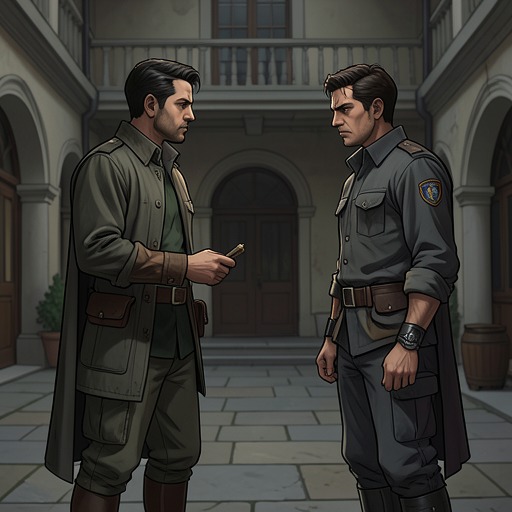
After considering the pearl and what it represents, Quart follows Simeón Navajo down a long white corridor to a small room where Ferro is seated under guard. The priest is without his cassock, wearing gray trousers, old unpolished shoes, and a white shirt buttoned to the neck. Though the police have spared him handcuffs, his unkempt hair, marked face, and tired appearance make him seem small and exposed.
Quart goes to him and kneels while Navajo and the guard watch from the doorway. He asks the priest to absolve him, acknowledging that he has sinned. The gesture is not merely private remorse: Quart needs to make his contrition and respect publicly visible. His request places him, even briefly, in the position of someone seeking the shelter Ferro has spent years offering others.
The Ritual’s Response
Ferro first looks at the kneeling Quart in astonishment. Then he slowly raises a hand and makes the sign of the cross over his head. Recognition appears in the priest’s wet eyes; his chin and lips tremble as he silently gives the ancient formula of consolation and hope. The exchange needs no spoken answer to complete its meaning: the ritual supplies the response that both men can recognize.
The scene presents bearing another’s sins not as an abstract doctrine but as an enacted relation. Quart makes his need visible; Ferro receives it through the gestures of his office. The watching officers witness a moment that exceeds the ordinary police encounter, while the priest’s compassion makes absolution a form of shelter rather than a judgment imposed from above.
Shared Burden and Narrative Significance
Quart’s reflections frame the scene through two complementary images of solitary endurance: the fighter who draws his sword for a battle that gives meaning to everything, and the priest who takes up the cross of other people’s sins. The novel treats them as two sides of the same coin, forms of lucid heroism without banners or victory. Both figures continue their work despite defeat, isolated at the edge of a board whose larger outcome they cannot command.
The absolution joins the old priest’s burden to Quart’s recognition of kinship with him. As Quart leaves, the scene’s consolation does not undo the church’s danger or settle the question of who caused the deaths around it. Instead, it gives the men a moment of mutual acknowledgment: the solitary soldier recognizes another brother still fighting in his own corner, and the priest’s ritual offers a fragile refuge where certainty is unavailable.