Carlota Bruner
La piel del tamborCarlota Bruner is the absent center of a family tragedy: a young woman whose love for the sailor Manuel Xaloc was defeated not by a lack of devotion but by a deliberate severing of communication. Her intercepted letters, lost years at a window overlooking the river, and twenty pearls preserved on a Virgin’s image turn her story into both a private grief and a public inheritance. Through Macarena Bruner’s memories and the discovery of Carlota’s trunk, the novel makes her a figure of waiting, damaged memory, and resistance to oblivion.
Identity and Family Background
Carlota was the elder sister of Macarena’s grandfather and thus Macarena’s great-aunt. She belonged to the Bruner family of Seville, whose patriarchal authority shaped the course of her life: her father, Luis Bruner, was a duke who opposed her relationship with Xaloc and intervened to keep the lovers apart. Macarena later describes Carlota as a romantic young woman, raised in a protected, artificial world, who encountered in Xaloc a man unlike the sheltered life around her. Their love became a family story, but the family’s power helped make its happy outcome impossible.
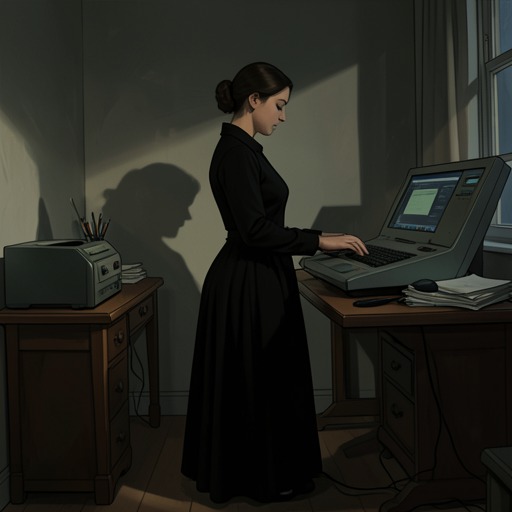
Carlota’s story was passed down in fragments: the family knew that she had loved a sailor, waited for his return, and eventually lost her reason. Macarena had been fascinated by it since childhood. She spent time with Carlota’s trunk, read the letters that had never reached their destination, and tried on the old dresses at the window where Carlota was said to have watched the river. The inherited story was therefore not merely something Macarena heard; it took shape through the objects and places she repeatedly revisited.
Love, Separation, and the Years of Waiting
When Xaloc left for the Americas, Carlota continued writing to him almost every week for years. Her father bribed local postal officials so that the letters would not reach their destination; Carlota received no letters in return, and the family believes Xaloc received none from her either. Macarena identifies the intercepted correspondence as the cause of the lovers’ separation. The silence between them was imposed, not chosen, while each remained without the knowledge that might have corrected it.
Xaloc made a life at sea, eventually gaining command of a ship and trading in the Caribbean between Mexico, Florida, and the coasts of Cuba. Macarena recounts that he also engaged in piracy: vessels encountered by his ship were found mysteriously plundered or went down without trace, and the Americans eventually put a price on his head. After six years, he returned with money, gold, and twenty pearls intended for his wedding to Carlota, despite having received no news from her. He believed, reasonably, that her family had cut off their communication, and trusted that she still loved him.
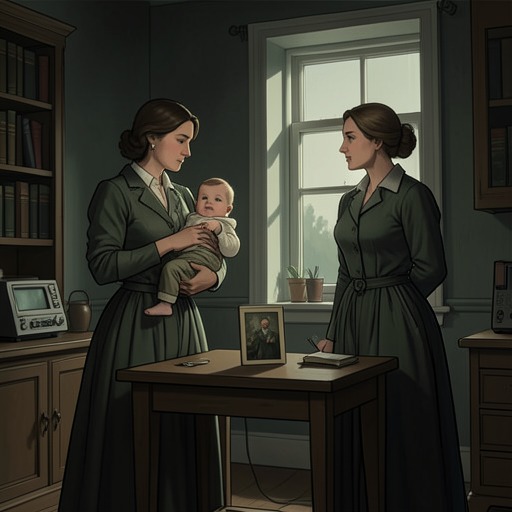
By the time Xaloc returned, Carlota had been waiting at the tower window for two years and had lost her reason. Her great-grandfather initially refused to let Xaloc see her, blaming him for her condition, but eventually consented after doctors advised him and his wife pleaded with him. Xaloc arrived in the family courtyard in a dark-blue merchant navy uniform with gold buttons, his skin darkened by the sun and his hair and whiskers gone gray. Carlota treated him as a stranger. After ten minutes, when the clock struck, she said that she had to go to the tower because he might return at any moment, and left without recognizing the man who had come back for her.
The Letters and the Trunk
The trunk preserved by the family makes the scale of Carlota’s private world tangible. It held keepsakes and domestic remnants—old fans, worn dresses and lace, photographs, illustrated magazines, poetry books, school notebooks, a braid of very light brown hair, and other accumulated objects—as well as a substantial bundle of correspondence. Quart estimates that it contained about fifty letters and postcards. Their paper had yellowed and become brittle; the ink had faded from black or blue to diluted sepia, and none bore a postmark. All were written in Carlota’s fine, slanting hand and addressed to Captain Manuel Xaloc at the port of Havana, Cuba.
One letter, dated April 11, 1896, reveals the intimacy of the waiting that the family legend can only summarize. Carlota suspects that her family is interfering with Xaloc’s mail and tries to send the letter through a maid she believes trustworthy. She describes the small, imagined reassurance of a clocklike beat in her heart, and renews her promise to wait. She sits in the tower during the heat of the afternoon, watching the river for white sails; in her loneliness, painted galleons seem to move, and she dreams of children playing on a beach. Hope, doubt, and fear of being forgotten coexist in the same appeal for his return.
The correspondence has only one side. Macarena says that her great-grandfather burned Xaloc’s letters as they arrived at the post office, leaving the family with Carlota’s words but no record of what he wrote. She also confirms that Xaloc never read the letter Quart examines—or any of the others. Carlota remained sane for another six months after writing it, and then darkness overtook her. Macarena describes the woman Xaloc met in the courtyard as already gone: a shadow moving before him, unable to recognize him. The surviving letters thus preserve both a voice and the evidence of its failure to reach the person for whom it was meant.
The Pearls and the Inherited Memorial
Xaloc’s return brought twenty pearls intended as a wedding gift. Carlota never married him, and she was buried in the crypt of the church where the wedding might have taken place. After her death, Macarena’s grandfather Pedro ordered the pearls set as tears on the image of the Virgin. Macarena calls them Carlota’s tears and Xaloc’s testament: the jewels no longer signify a future marriage but memorialize a love that separation had made impossible.
For Macarena, the church, the pearls, the letters, and Carlota’s remembered life belong to one inheritance. She tells Quart that the church is now all that remains of Carlota and Xaloc, alongside Carlota’s memories and the surviving correspondence. The story had itself become legend, with songs made about the lovers. Its material remains—a sacred image bearing the pearls and a trunk of letters—allow a private catastrophe to endure beyond the people who suffered it.
Memory, Oblivion, and Macarena’s Cause
Macarena understands her defense of the church as a personal battle rather than simply an extension of Father Ferro’s cause. She calls it a struggle against time and oblivion, and links it directly to the memory of Carlota. Conscious that her old family caste is disappearing and that there is little place left for people or memories like hers, she describes herself as defending the space and things she loves. She means both Nuestra Señora de las Lágrimas and Carlota’s story. Her determination gives the old romance a present consequence: remembrance becomes a reason to resist the disappearance of the church that houses its memorial.
The novel also sets Carlota’s waiting against the changing river and port. She watched the Guadalquivir for twelve years after Xaloc’s visit. Meanwhile, ships gradually vanished from the river and the port declined; the schooners stopped traveling upstream. Eventually Carlota, too, disappeared from the window. The passage of time erases the visible scene of her vigil, but not its objects or its telling: the letters, pearls, and church carry its remnants forward. Carlota’s enduring significance lies in this tension between a story preserved and a life that could not be restored.