Carlota Bruner and Manuel Xaloc's tragic separation
La piel del tamborCarlota Bruner and Manuel Xaloc’s tragic separation is a love story broken not by distance alone but by a family’s calculated interception of communication. Xaloc’s departure for the Americas and Carlota’s years of unanswered writing end in a reunion she cannot comprehend; the pearls he had gathered for their wedding become an offering to the Virgin of Our Lady of Tears, while the surviving letters preserve only one side of their lost exchange. Their story reaches the present through family memory, the church, and a legend of a ghostly ship on the Guadalquivir River.
The lovers and the obstruction
Carlota was a young aristocrat; Manuel Xaloc was a Sevillian sailor without a fortune. He emigrated to America in the last decade of the nineteenth century, spent time as a pirate in the Antilles, and disappeared at sea during the Spanish–American War of 1898. Gris Marsala recounts their romance as a familiar kind of romantic plot—a young woman opposed by her parents and a sailor seeking his fortune—but identifies the decisive cruelty as the family’s obstruction. The aristocratic household imposed a blockade, and the lovers’ letters did not arrive.
Carlota’s great-grandfather, Duke Luis Bruner, made that separation deliberate. When Xaloc left, Carlota wrote him a letter or postcard almost every week. Her father bribed the city’s postal officials, preventing her letters from reaching Xaloc and ensuring that letters sent to her did not arrive either. For six years, each lover was left without the other’s words. The silence was not evidence that love had ended; it was a condition manufactured around them.
Return and irreversible loss
Xaloc returned in 1898, shortly before the outbreak of the conflict in Cuba, but Carlota was by then mentally ill and unable to recognize anyone. The long-awaited meeting therefore reversed the promise of reunion: physical return could not restore the person whom years of isolation had altered. Gris describes Carlota as having spent her days at the window, looking toward the river, and says she had lost her reason before Xaloc came back.
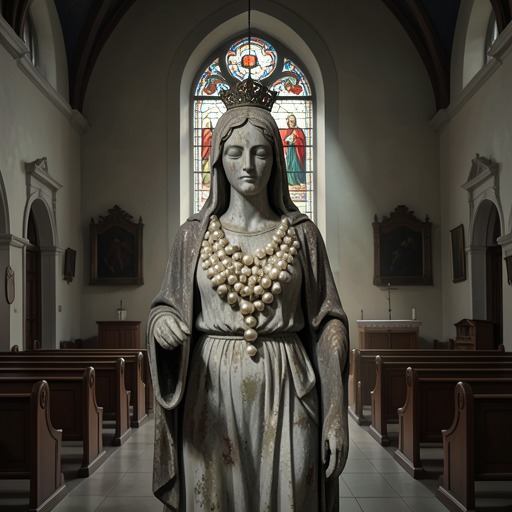
Xaloc went back to Havana in time to take part in the war. Before leaving, he placed with the church the dowry he had gathered for Carlota: twenty pearls intended for the necklace she would wear on their wedding day. Carlota had always wanted to marry in Our Lady of Tears. Instead of adorning a bridal necklace, the pearls came to rest on the Virgin’s image, where they could be seen on her face, in her starry crown, and against her blue mantle. The gift preserves the marriage that never took place as a visible religious offering, while marking the distance between the intended ceremony and the life that followed.
Letters, inheritance, and the one-sided archive
The separation survives in an uneven archive. Carlota’s letters were not destroyed; they were kept in the trunk of her belongings after her death in 1910. Macarena Bruner, her great-niece, encountered the trunk as a child, trying on Carlota’s dresses and jet necklaces before reading the letters one by one. The collection also held travel brochures, hotel and ship pamphlets, and reminders of Carlota’s journeys with her parents to the Paris Universal Exposition and Tunisia, where she visited the ruins of Carthage. To Macarena, the trunk offered the outline of a whole life, preserved among old lace and worn muslin.
When Lorenzo Quart examines the bundle, he estimates that it contains about fifty items, nearly two-thirds folded letters and the rest postcards. Their paper has yellowed and grown brittle; their ink, once black or blue, has faded to sepia and sometimes become illegible. Every item is written in Carlota’s fine, slanting English hand and addressed to Captain Don Manuel Xaloc at the port of Havana, Cuba. None bears a postmark. Their survival gives readers access to what Carlota wrote, but not to the replies that might have revealed Xaloc’s side of the relationship.
Macarena explains why the archive is so incomplete: her great-grandfather burned Xaloc’s letters as they arrived at the post office. No one dared destroy Carlota’s own writing, but the correspondence was preserved only on one side. The surviving bundle thus records both an attachment sustained over years and the power that prevented it from becoming a conversation. Its silences are concrete: there are no postmarks and no letters from Xaloc, only Carlota’s words addressed across an enforced absence.
Memory, legend, and the church
The story is encountered in the present through spaces and objects rather than through a complete record. In the church crypt, Quart sees Carlota’s name among the Bruner family tombs and learns from Gris that she loved Xaloc, or perhaps was undone by his absence. The twenty pearls on the Virgin connect that family history to the church’s sacred image; the old postcard of the church, the tomb, and the trunk each preserve a different fragment. Macarena’s commitment to defend the church is also a personal struggle against time and forgetting: she names the memory of Carlota alongside Our Lady of Tears among the things she means to protect.
Macarena turns the family history into a legend. Recalling a song about the piano of a girl in Seville, she describes Carlota returning to her window on moonlit nights while her lover’s ghostly schooner casts off on the Guadalquivir and sails downstream. As a child, Macarena says, she spent nights watching for them and once saw a pale silhouette at the window and white sails moving through the river mist. The legend does not undo the historical ending: Carlota failed to recognize Xaloc, and he left again. Instead, it gives the unfulfilled return a recurring imaginative form, carrying the lovers’ separation into the present as an act of memory.