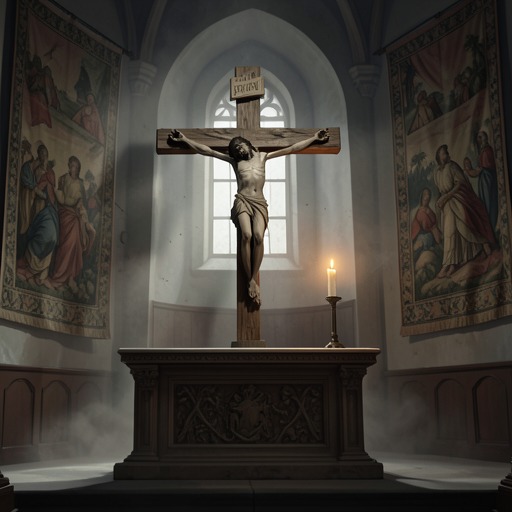
Chillias de Anso church art sale scandal
La piel del tamborThe Chillias de Anso church art sale scandal is the documented earlier case that complicates Lorenzo Quart’s assessment of Father Príamo Ferro. A fifteenth-century panel disappeared from Ferro’s former parish in the Pyrenees; although the priest received only a simple reprimand, later inquiries connected him to the panel’s sale through a Madrid auction house. The evidence establishes a questionable transaction, but not the full circumstances behind it, leaving the episode useful both as a genuine shadow over Ferro and as material that church authorities may deploy against him.
The Earlier Ecclesiastical Inquiry
Ten years before Quart’s investigation in Seville, Ferro had been subject to an ecclesiastical inquiry in the diocese of Huesca. The matter arose during his final period in charge of the parish of Cillas de Ansó, where both a painted panel and a crucifix had gone missing. The crucifix was described as unremarkable; the panel was more consequential: it dated from the first quarter of the fifteenth century and was attributed to the Master of Retascón.
The inquiry did not end in suspension or a major punishment. The parish was considered minor, and the narrative notes that such incidents were common in an era when parish priests had considerable freedom over the property entrusted to them. Ferro emerged with a simple reprimand from his ordinary. That limited disciplinary outcome neither clears him of involvement nor proves a serious criminal scheme; it establishes the institutional record that Quart later checks against other sources.
The Panel’s Route to the Market
Quart follows the archival record with police assistance. Archbishop Corvo confirms the main points of Ferro’s file, while Simeón Navajo makes calls to Inspector Feijoo in Madrid, who is responsible for the art-investigation group. Their inquiries identify a panel from the Master of Retascón matching the missing work point for point. It had been acquired legally, with a proper receipt, by the Claymore auction house in Madrid and then resold for a high price.
The auction house’s director, the dealer Francisco Montegrifo, confirms that he paid Ferro a sum for the work. The amount was small beside the panel’s eventual auction price, which was six times as high. Montegrifo characterizes the disparity as a matter of supply and demand. The lawful paperwork and the later high resale value clarify the commercial route, but they do not erase the central unresolved fact: Ferro received money in connection with an artwork missing from his parish.
Quart’s Use of the Evidence
The old case enters the present through more than one channel. Journalist Honorato Bonafé had supplied information that closely matched what Quart found in the diocesan file. That convergence makes the story harder to dismiss as rumor, but also prompts Quart to wonder whether Bonafé’s source might be connected, directly or indirectly, to Corvo. The archbishop had been guarded in other matters and unusually forthcoming about Ferro’s past; Quart suspects that the priest’s record may be allowed to circulate because it serves the archbishop’s purposes.
When Óscar Lobato defends Ferro as an honest man, Quart does not claim the file proves that Ferro has always been honest. He points instead to the documented sale and the payment confirmed by Claymore. Lobato refuses the insinuation and says he respects the man he knows. The exchange preserves an important distinction: Quart can establish the earlier transaction, while Ferro’s character and the complete circumstances of the sale remain contested.
The Case in the Seville Conflict
The scandal matters because Ferro’s position in Seville is already precarious. The archbishop tells Quart that he has requested Ferro’s suspension from office, but that the process in Rome is slow; he also links the timing to the Vatican computer intrusion and Quart’s anticipated report. The old inquiry gives the church hierarchy a concrete disciplinary history to invoke as it confronts a priest whose independent conduct has become an obstacle to its plans for Nuestra Señora de las Lágrimas.
At the same time, Ferro’s earlier case does not settle the conflict over the church. Its immediate subject is missing church art and the priest’s connection to its sale, not the later dispute over the Thursday Mass condition that protects the building from demolition. Quart’s investigation therefore has to hold two facts together: Ferro’s record contains a substantiated, troubling episode, and the institutions pressing against him may have reasons to circulate that episode selectively. The scandal’s significance lies in that double edge: evidence can expose a real past act and still become an instrument in a present struggle.