Church of Our Lady of Tears
La piel del tamborThe Church of Our Lady of Tears is a small Baroque church in Seville’s Santa Cruz district, where an unfinished restoration and two deaths turn a threatened building into the center of a conflict over land, church authority, and inherited memory. Its cracked appearance is contested: officials use the language of ruin to justify demolition, while the architect responsible for the restoration argues that the structure remains sound. The church’s survival also depends on an old privilege requiring a Thursday Mass, and on the people who continue to treat it as more than a valuable plot.
Setting and Appearance
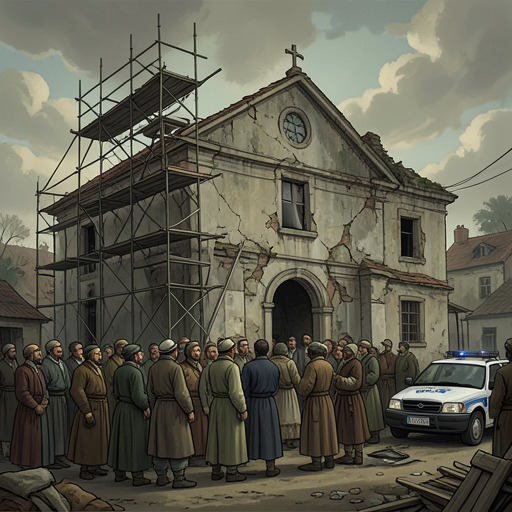
On Lorenzo Quart’s first morning in Seville, the church is difficult to find among Santa Cruz’s narrow, quiet streets. Its small brick facade occupies a corner of a close-set square with white and ochre walls, wrought-iron grilles, tiled benches, and orange trees. Timber braces prop up the bell gable and outer wall; metal scaffolding partly hides a tiled Christ, while a concrete mixer, gravel, and cement sacks stand nearby. The Baroque portal is framed by twisted Solomonic columns, and a niche above it holds a statue of the Virgin—decapitated. Nothing in the bright morning initially appears mysterious, but the damaged figure and makeshift supports change the impression of the place. The church’s neglected fabric begins to look ominous, in keeping with the anonymous warning that it is a church that kills to defend itself.
The interior likewise records age and neglect without reducing the building to rubble. Its rectangular single nave has a barrel vault with lunettes, short transept arms, and an elliptical dome topped by a blind lantern. Candle smoke and fire have obscured the dome’s frescoes; damp has marked the walls and damaged their surfaces. In the crypt, a worn, damp chamber holds memorial slabs in three tiers. Its marble heraldic shield bears a black cross and the motto “Oderint dum probent,” and its inscriptions commemorate fourteen dukes of the Nuevo Extremo family. Together, nave, crypt, tombs, and altar make the building a physical archive of religious devotion and family history.
Restoration and the Demolition Dispute
The restoration has been stalled for want of money. Gris Marsala, an American architect commissioned by the Eurnekian Foundation, has worked on the project for two years; the foundation supplied a third of its original funding. The team began with three architects, but the two Spaniards left, and the work has since nearly stopped. When Quart first sees the building, its bracing and scaffolding seem to support the official claim that it is unsafe.
Marsala disputes that interpretation. She says the church has been badly neglected for roughly 150 years, but maintains that its structure is still solid, with no irreversible cracks in the walls or vault. Most damage, in her account, is to the plaster and other finishes, caused by moisture entering through defective roofs. The roofing problem has been addressed by relaying the tiles with lime, cement, and sand: nearly ten tons of material were carried up to a height of fifteen metres by Marsala and Father Óscar. She acknowledges a missing section of gilded plaster cornice, almost a metre long and around ten metres above the floor, where a piece fell and killed Father Urbizu. The damage is real, but she presents it as repairable rather than proof that the building must be demolished.
The dispute has substantial stakes. The church’s plot lies in the historic Santa Cruz district, near the cathedral and the Archbishop’s Palace. Seville’s municipal authorities want to expropriate the property, while an aristocratic family connected to a bank asserts old rights to it. The local archbishop, Aquilino Corvo, says the church is condemned and treats its ruin as an administrative and technical question. The cultural heritage authorities have declined to preserve it for lack of funds, and the city council is close to confirming the decision. The deaths of the municipal architect who was examining the building and Father Urbizu, secretary to the archbishop, complicate what might otherwise have been a familiar contest over valuable urban land.
Privilege, Ritual, and Institutional Power
An old privilege, granted in 1687 with papal sanction, is the chief procedural obstacle to secularizing and demolishing the church. It requires a Mass every Thursday for the soul of Gaspar Bruner de Lebrija, the church’s benefactor. As long as the Mass is said, the church retains its privileges. The archbishop explains that Gaspar died on a Thursday; Macarena Bruner specifies that the anniversary obligation is observed at eight in the morning. The privilege gives a recurring ritual a concrete legal and institutional consequence: the church’s protection turns on an observance that can be checked for failure.
That vulnerability produces a weekly scene of surveillance. An emissary of the archbishop and a notary paid by Pencho Gavira sit in the back pews, each watching for an irregularity or lapse. Macarena regards the arrangement as nearly absurd, yet knows its consequences: any priest who failed to say the Mass, or omitted its required form, could leave the way open for demolition. She fears that attempts may be made against Príamo Ferro, the elderly parish priest, especially if Father Óscar is removed. The requirement does not automatically secure the church; it makes its survival depend on an exact, repeated act and on the priest who performs it.
The conflict also exposes tensions among church authorities. Corvo has sought Ferro’s suspension from office, citing the priest’s personal positions and disregard for episcopal orders, but the process in Rome is slow. Meanwhile, Quart is sent by the Institute for External Works to identify the author of a letter, maintain discreet contact with the local ecclesiastical authority, and conduct the inquiry reasonably. The investigation arrives in a church where both formal discipline and an inherited privilege are being used to decide what may happen to the building. Its future is shaped not only by the condition of the masonry but by competing jurisdictions, administrative delays, and local power.
Family Memory and Sacred Space
The church’s significance for the Bruner family exceeds its land value. In the crypt, the old family tombs place the present in the company of fourteen generations of dukes, while the more recent grave marked with the name Carlota Victoria Amelia gives the family history a personal focus. Macarena explains that the idea of opening Carlota’s trunk may help Quart understand what the church means. The building is therefore not simply a monument to an abstract past: it is bound to objects and stories through which the family’s memory is kept.
The altar gathers those inheritances into a single image. The Virgin’s statue, attributed to Martínez Montañés, stands beneath a canopy among gilded carving, angels, and praying figures of Gaspar Bruner de Lebrija and his wife. The twenty pearls of Captain Xaloc are set across the Virgin’s face, crown, and blue robe. Against the scaffolding that supports the work around it, the statue appears both treasured and exposed. The damaged church is not an untouched relic: its image, fabric, and history have been altered, repaired, and repeatedly placed at risk.
Macarena describes her own defense of the church as a battle against time and forgetting, not merely as an extension of Ferro’s struggle. She sees her family’s social world disappearing, and names the church and Carlota’s memory among the things she still loves and intends to defend. Her account makes preservation an act of personal and collective remembrance. The church’s inherited privilege gives that defense a practical foothold, while the family tombs and the story Macarena wishes to protect give it emotional meaning.
Quart and the Church’s Narrative Role
For Quart, the church first presents itself as an assignment: identify the writer of the threatening message and report on a dispute already complicated by two deaths. Its appearance challenges the detached, technical posture he brings to the work. A postcard tucked into his hotel Bible shows the church in 1895, with the Virgin’s head intact and the building in better condition than it is now. The image places the present facade beside an earlier record of it, making change visible in the contrast between two versions of the same place.
The building also becomes the setting in which Quart’s professional role meets his capacity for sympathy. He is sent as an investigator who may have to assess Ferro’s conduct, yet he recognizes the old priest’s church as a chosen last position: a small and battered refuge where the remaining faithful are held apart from forces threatening to strip away what they have. The altar and its pearls, the crypt and its family names, the damage to the cornice, and the weekly Mass all draw the plot’s separate disputes into one space. The church matters because its survival cannot be settled by calling it old or unsafe; it depends on what its structure can bear, what its people continue to do, and whether its accumulated history is treated as a reason to preserve it or as an obstacle to development.