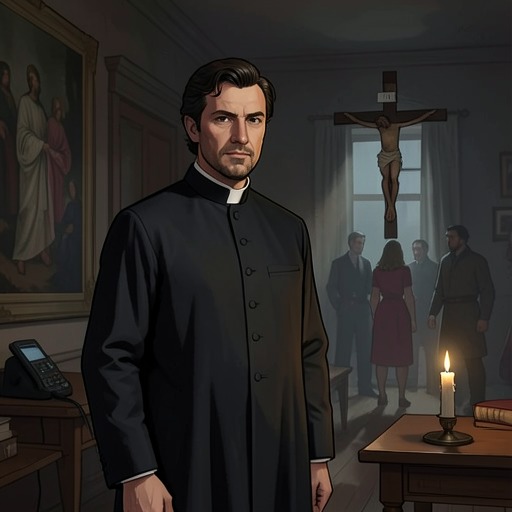
Discipline as a substitute for faith
La piel del tamborDiscipline as a substitute for faith is the governing paradox of Lorenzo Quart’s vocation: he does not rest on belief in revealed truths, yet he serves the Church with unusual effectiveness by acting as though faith were present and by submitting to the discipline that takes its place. In the novel, this private arrangement meets a larger institutional test at Nuestra Señora de las Lágrimas, where ritual observance, ecclesiastical procedure, and a Thursday Mass condition help preserve a threatened church even as their defenders wrestle with doubt.
Quart’s Discipline and the Shape of His Vocation
Quart’s creed consists less in accepting revealed truths than in acting according to the assumption that he has faith, without requiring faith as a premise. The Catholic Church has offered him what military service offers other young people: a place where, if the basic concept is not questioned, rules resolve most problems. For him, discipline performs the work that faith does not. Monseñor Spada’s half-joking description of Quart as a good soldier therefore captures more than his efficiency; it names the structure of his religious identity. His pride and rigor, joined to his lack of belief, make him especially effective at his work.
That structure has roots in loss rather than doctrine. Quart is the orphaned son of a fisherman drowned in a shipwreck. A rough country priest helped him enter the seminary, where his discipline and ability attracted the attention of his superiors. As a boy, Quart watched fishing boats struggle toward harbor through a storm with ten-metre waves. When one boat failed to return, he understood that a fisherman’s disappearance meant the loss of a father, husband, brother, or uncle, and left families waiting by the lighthouse. His mother held his frozen hand on the breakwater as the surviving men removed their caps in greeting; then no more boats came. From that day he learned that praying to the sea was useless and resolved that nobody would ever wait for him on a breakwater in the rain. The memory gives his self-command an emotional foundation: discipline is not simply an institutional habit but a way of living with a world in which prayer does not guarantee rescue.
Ritual as a Working Rule
Quart’s discipline appears in small, repeated practices as well as in his professional conduct. Between appointments in Seville, he stops at the Giralda brewery and reads an old octavo copy of Bernard of Clairvaux’s In Praise of the New Knighthood. He alternates its reading with the breviary’s Maitines, Laudes, Vísperas, and Completas, observing the routine meticulously—not out of piety, but out of pride. The medieval sermon helps him endure the loneliness of his work, and he imagines himself as the last survivor of a defeated order, among the Templars who endured Hattin, Acre, Chinon, or the Paris fires. The image of the solitary knight turns an inherited religious discipline into a personal code of endurance.
The same preference for rules governs his assignment. The director of the Institute for External Works sends Quart to Seville for several days to identify the author of a letter, maintain prudent contact with the local ecclesiastical authority, and conduct the matter discreetly and reasonably. At the Archbishop’s Palace of Seville, Quart learns that the church cannot be secularized for demolition while a privilege granted in 1687 remains in force: Mass must be celebrated every Thursday for the soul of Gaspar Bruner de Lebrija, the church’s benefactor. The Archbishop says the privilege is explicit; its practical effect is to make an inherited ritual obligation a legal obstacle to demolition.
Discipline, Authority, and the Thursday Mass
The rule does not remove conflict; it gives the conflict a procedural form. The local archbishop explains that his difficulty is not a lack of authority to prevent a priest from saying Mass, but a problem of discipline. Father Príamo Ferro, though elderly and in some respects ultraconservative, disregards the archbishop’s pastorals and calls to order. The archbishop has asked Rome to suspend Ferro from office, but the process is slow, and he expects Rome to wait for Quart’s report after the Vatican computer intrusion. Quart recognizes that the assignment leaves the difficult decision to him while allowing the archbishop to keep his hands clean.
Macarena Bruner describes how closely the old privilege is watched. Every Thursday at eight in the morning—the day and hour associated with Gaspar Bruner de Lebrija’s death in 1709—an emissary of the archbishop and a notary paid by Pencho Gavira sit in the back pews, each alert for an irregularity or lapse. The church is protected only so long as the prescribed Mass is properly maintained. Macarena fears that, with Father Óscar removed from the parish, someone may try to act against Ferro; any priest who failed to say the Mass or omitted its required formula could leave the church exposed to demolition. Ritual here is both devotion and a vulnerable mechanism of institutional protection.
Doubt, Consolation, and the Church
The novel places Quart’s disciplined unbelief beside Ferro’s more openly painful uncertainty. At sixty-four, Ferro recalls having read the philosophers from Socrates to Saint Augustine and retaining only a bitter-sweet taste of melancholy and disillusion. What he knows of human beings, he says, is that they remember, fear, and die. For a quarter of a century he sat with the dying, whose hands clung to his because he was their only consolation, while his own prayers received no answer. He had wanted to confront God after witnessing suffering and death, but the silence endured.
Ferro frames faith less as certainty than as hope and consolation in the face of mortality. People know that they will die and fear that nothing will remain of them; without something more, the universe appears chaotic and meaningless. That need, he argues, justifies the existence of Nuestra Señora de las Lágrimas even if the priest himself has faith or does not. Its Baroque splendour—the carvings, gilding, and lavish altars—offers worshippers an experience capable of sustaining hope where analysis might destroy it. Quart challenges this as alienation, comparing the church’s method to seventeenth-century television. Their exchange reveals a tension between discipline that can preserve forms of faith for others and the danger that those same forms may substitute spectacle and obedience for understanding.
A later conversation shifts from institutional order to cosmic scale. Quart says astronomy borders on despair; Ferro answers that it can instead bring serenity, because only what is grave and valuable hurts to lose. Against the universe’s vastness, he suggests, perhaps what remains is a friendly hand offering resignation and consolation before the stars go out. Quart’s own discipline cannot supply that assurance, but the gesture of companionship offers a human counterpart to the ritual and regulations on which he relies. The concept thus remains deliberately unresolved: discipline lets Quart act without belief, while the threatened church’s rites preserve a place where other people may still find the comfort he cannot claim for himself.