Don Ibrahim's Incendiary Device
La piel del tamborDon Ibrahim's Incendiary Device is an improvised firebomb meant to damage a church while making the destruction look accidental. As both a practical instrument of a property scheme and the center of a comic domestic accident, it brings together the conspirators' calculations, their self-serving justifications, and the stubborn material consequences they cannot control.
Purpose and preparation
The device is prepared in the midst of an effort to set fire to the church. Peregil has directed the three companions to hasten the operation: total destruction is unnecessary, but damage would suffice, and the building's stacked wooden benches and old roof beams could help the fire spread. Above all, the blaze must appear accidental. Don Ibrahim and his companions are therefore not acting on an independent plan of their own; they are carrying out another man's design while trying to disguise its origin.
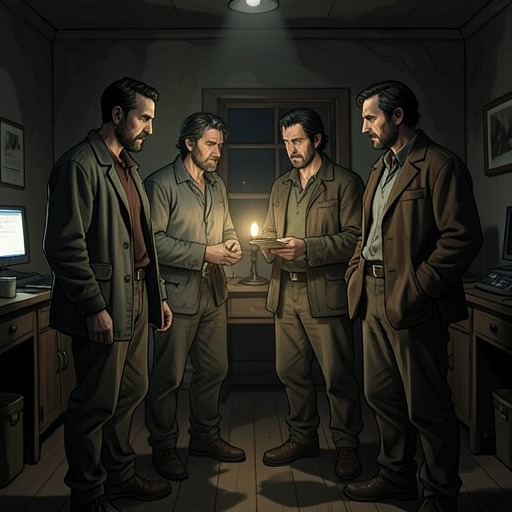
Don Ibrahim pours the gasoline carefully into a bottle, laying newspaper on the table to protect its varnish and wiping fuel from the cut glass and the Anís del Mono label. The gasoline is unleaded, 98-octane fuel. The choice is presented as the Niña's sound judgment: a consecrated church, she insists, should not be set alight with just anything. The Potro has been sent to the nearest petrol station with an empty Carbonell olive-oil tin and returns with a litre. Don Ibrahim declares that a litre is enough, adopting the grave manner of an expert and crediting his knowledge to a supposed lesson from Ernesto Che Guevara over mojitos in Santa Clara.
The proposed ignition mechanism is as makeshift as the bottle itself: a thin candle, matches, a wind-up alarm clock, two metres of string, and a bottle arranged to fall. Don Ibrahim is proud of the contraption. The three men are meant to be in a bar, visible to everyone, when it goes off, so that they will have an alibi. The plan depends on ordinary objects behaving in a precisely arranged sequence—and on the fire remaining safely elsewhere until the conspirators are away.
Complicity and hesitation
The Niña resists taking part because the target is a sacred place. Her companions persuade her by arguing that the money they expect to obtain will pay for masses in other churches to atone for the deed. They also dress their involvement in mock legal reasoning: the three are merely executing someone else's crime, while the ultimate responsibility belongs to the person who caused it—Peregil. The elaborate rationalization does not remove the Niña's reluctance. She refuses to perform the act of setting the fire and limits herself to supporting tasks, including preparing the meal.
Don Ibrahim describes himself as a leader who reasons with his troop rather than imposing decisions; the three are, in his telling, his tribe, clan, and family. That claim of familial solidarity sits uneasily beside their assigned roles in a criminal plan. The Potro offers no objection, responding with his characteristic, fatalistic assent. Don Ibrahim respects the Niña's conscience, but neither respect nor joking argument changes the purpose of the device: the church is to be damaged for someone else's benefit.
Accidental ignition
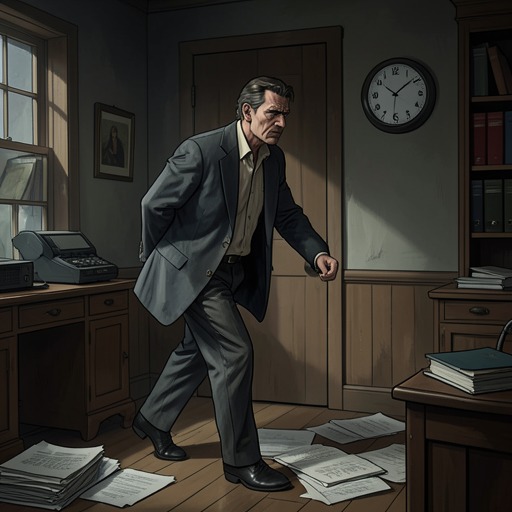
The intended mechanism is never used at the church. While Don Ibrahim is still handling the gasoline in the room, he sees the Potro pass the table and instinctively bring his cigarette butt toward the ashtray. A gasoline-damp cloth is lying there. Don Ibrahim calls out, but the Potro has already dropped the cigarette. Don Ibrahim tries to stop what follows and knocks over the bottle of Anís del Mono.
The planned firebomb's components thus turn the preparation itself into an immediate hazard. The cigarette, the fuel-soaked cloth, and the bottle on the table form an uncontrolled chain of events in place of the clockwork arrangement Don Ibrahim had devised. The device's failure is not simply that it does not ignite at the intended time or place: its dangerous materials act within the ordinary room, before the men have reached their intended alibi in the bar.
Damage and aftermath
The accident causes superficial burns, a scorched table, and a smoke stain on the ceiling. The Potro runs around the room with his left arm on fire. The Niña reacts quickly, spraying Don Ibrahim and the Potro with a kitchen siphon and throwing a blanket over the table to put out the flames. When the firefighters arrive, there is nothing left to extinguish. The three partners are left with the neighbours gathered at the door and their own burning embarrassment.
Don Ibrahim's carefully prepared gasoline and device have led not to the church's destruction but to a fire in the conspirators' room. His eyebrows and moustache are singed; the Potro is burned; the Niña obtains ointment and gauze from the pharmacy. The partners tacitly agree never to speak of the mishap again. Don Ibrahim calls it one of life's painful chapters that must be forgotten quickly, a comic effort at closure that cannot undo the visible damage or the failed plan.
Narrative significance
The device makes the conspirators' attempt to turn violence into a controlled, deniable operation collapse into slapstick. Its materials are ordinary and legible—fuel, glass, cloth, a cigarette—yet their arrangement resists Don Ibrahim's confidence in his own expertise. He has designed an elaborate mechanism and rehearsed an alibi, but the most consequential ignition comes from a casual gesture at the ashtray. In this episode, the objects do not remain passive instruments in a human scheme: their physical proximity and combustible qualities redirect the action before the plan can be carried out.
The scene also sharpens the contrast between calculated damage and unintended consequence. Peregil's instructions treat harm to the church as a matter of degree, while the Niña's objection keeps the church's consecrated status in view. Their attempted moral accounting—future masses, borrowed responsibility, and the claim that they merely execute another's crime—stands beside the mundane evidence of the room: spilled fuel, a burning arm, a scorched table. Don Ibrahim's device is therefore both a plot mechanism and an emblem of the group's compromised agency: they intend to control the appearance and extent of destruction, but cannot control even the fire they have prepared.