Gaspar Bruner's 1687 land donation for a church
La piel del tamborGaspar Bruner's 1687 land donation for a church created more than a foundation for Nuestra Señora de las Lágrimas: it bound the building to his family through a condition of perpetual remembrance. A weekly Mass for his soul became both a devotional obligation and, centuries later, the church’s most consequential protection against demolition. The legacy endured not as an abstract inheritance but through a repeated rite whose observance could be watched, challenged, and potentially interrupted.
The Donation and the Family Foundation
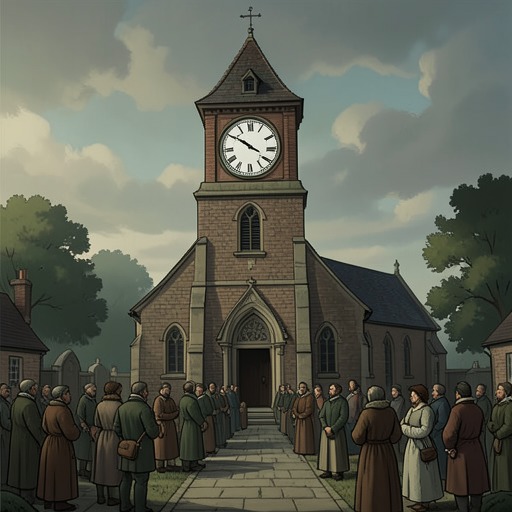
Gaspar Bruner de Lebrija ceded land from his property in 1687 for the construction of the church, stipulating that a Mass be celebrated for his soul once a week. His burial place was in a private crypt, discreetly entered beside the main altar; generations of the Dukes of the New Extremadura rested there. A kneeling image of Gaspar, carved by Duque Cornejo, stood beside the Virgin, accompanied by a figure representing his wife. The arrangement made family commemoration part of the church’s physical and ritual design.
The donation initiated a continuing family association rather than a single act of patronage. Gaspar’s son, Guzmán Bruner, paid to complete the altarpiece featuring his parents and brought the Virgin’s image to the church in 1711. The building was designed by Pedro Romero, the duke’s trusted architect, who also served the Duke of Medina-Sidonia. Gris Marsala explained that the Bruner connection still existed, although diminished, and that it lay at the heart of the present conflict. The church’s architecture, its devotional furnishings, and its recurring service thus preserved the donor’s influence across generations even as the family’s standing waned.
The Privilege and Its Practical Force
The condition attached to the donation acquired legal force through an old privilege granted in 1687 with papal sanction. The Archbishop of Seville told Lorenzo Quart that the church would retain its fueros so long as Mass was said there each Thursday for Gaspar Bruner de Lebrija. When Quart asked why Thursday mattered, the archbishop said that Gaspar had apparently died on that day, and speculated that the powerful Bruner family had secured the predecessor’s assent through leverage. The account presents the privilege as both a formal ecclesiastical instrument and the residue of family power.
The privilege became an obstacle to secularizing the building, a prerequisite for its demolition. The archbishop admitted that this process had become complicated: the written condition restricted what could be done to the church, even though the archdiocese wanted to proceed. The conflict was not simply a question of whether a church could be demolished. It turned on whether the inherited obligation remained in force, who could ensure its observance, and whether a parish priest’s conduct could be brought under disciplinary control.
A Repeated Mass Under Surveillance
Father Ferro did more than meet the condition once a week. The archbishop acknowledged that he celebrated Mass every day at eight in the morning, except Sundays and holy days, when he celebrated two. His daily practice therefore exceeded the Thursday requirement, but the Thursday Mass carried a distinct institutional consequence: it kept the privilege operative. In the contest over the church, repetition was not mere routine. The rite was the hinge between the donor’s past and the building’s present legal status.
That hinge drew observers. Macarena Bruner told Quart that every Thursday an emissary of the archbishop and a notary paid by Pencho Gavira sat in the last row, each watching for an irregularity or lapse. Their presence made the service a test as well as an act of worship. If a priest failed to say Mass or omitted the required formula, the church could lose its protection and be demolished; the archbishop and Banco Cartujano would then prevail. Macarena feared that, after Óscar Lobato’s removal, those opposed to the church might try something against Ferro. The inherited condition thus depended on a living priest, a correctly performed service, and continual scrutiny.
The Church, Memory, and the Redevelopment Conflict
The 1687 arrangement gave the present-day dispute a deeper timescale than the immediate arguments about the church’s condition. Gris, the architect responsible for its restoration, said the work had been nearly halted for lack of approved budgets and incoming funds. The building was three centuries old; she contrasted its neglect with the reverence an equally old building would receive in her own country. She also rejected claims that it was structurally beyond repair: although poorly maintained for roughly 150 years, its structure remained sound, with no irreversible cracks in the walls or vault. Much of the damage lay in surfaces affected by water entering through defective roofs, which she and Father Óscar had repaired by carrying almost ten tons of material up to a height of fifteen meters.
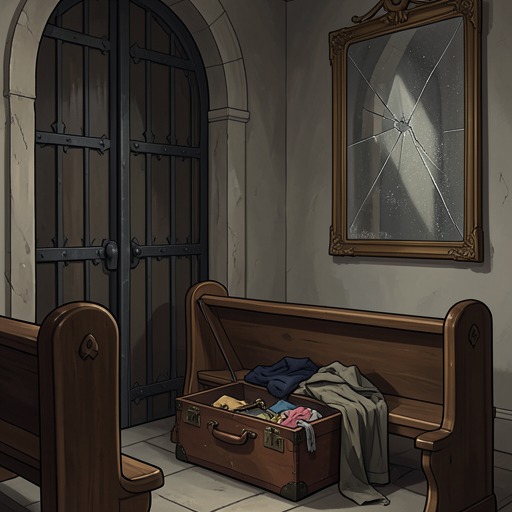
For Macarena, the church’s importance was inseparable from the family’s threatened memory. She urged Quart to look into Carlota’s trunk to understand what Nuestra Señora de las Lágrimas meant. She later described her own struggle as a battle against time and forgetting, one fought for the church and for Carlota’s memory. The ancient privilege gave that attachment a material and procedural form: each Thursday, the family’s past returned as a service that had to be performed in the present. Yet the protection was precarious. It preserved the church only while the condition was honored and could not by itself resolve the financial, political, or disciplinary pressures directed against it.
Narrative Significance
The donation’s legacy links sacred space, family commemoration, and property law without making them identical. Gaspar’s requirement was an act of remembrance; later, the sanctioned privilege made that remembrance a constraint on demolition. Centuries on, the same Mass mattered to people with sharply different stakes: Ferro maintained the practice, the archbishop faced the limits of authority and the difficulty of suspending him, and Gavira’s notary monitored compliance on behalf of the redevelopment effort. The service’s devotional meaning and its legal effect operated together, but they also exposed the church to surveillance and procedural attack.
The church’s survival therefore depended on a strikingly small and repetitive act: a Mass said on the right day, in the right place, for the soul of a long-dead benefactor. Against modern redevelopment and institutional maneuvering, this inherited obligation offered temporary protection, not a final settlement. Its power lay in binding an old family grant to present action—and in making memory something that had to be enacted again each week.