Government of Andalusia
La piel del tamborThe Government of Andalusia is a regional authority whose decisions shape two linked property schemes in the novel: the proposed redevelopment of land around Nuestra Señora de las Lágrimas in Seville and the Puerto Targa resort project near Doñana National Park. Its reversal on protected-land construction helps make the latter sale appear viable, while the bank’s internal investigation reveals how that anticipated sale was being used to mask serious financial risks.
Role in the Puerto Targa project
Puerto Targa was established to develop a golf course, luxury homes, and a marina in a protected area near Doñana National Park. The Government of Andalusia had previously opposed construction there, but administrative obstacles were unexpectedly lifted. The change made the project’s planned sale to the Saudi-backed Sun Qafer Alley seem attainable and helped sustain the claim that the transaction would produce a major gain for the Banco Cartujano.
The Government’s authorization was one of several approvals cited in the bank’s account of the proposed sale, alongside authorization from the Council of Ministers. The apparent readiness of the transaction mattered because the bank had acquired 78 percent of Puerto Targa after a capital expansion, while private investors held the remainder. The report also recorded suspicions that H.P. Sunrise, an offshore company that held a substantial share, might be connected to vice-president Pencho Gavira; it did not establish that connection as proven.
Reversal and financial consequences
The internal investigation described Puerto Targa as almost entirely financed by the Banco Cartujano through a complicated structure involving companies registered in Gibraltar. According to the report, the bank had effectively sold the company to itself through those intermediaries, allowing the 7.02 billion pesetas attributed to the acquisition to appear as income in an earlier balance sheet. A later sale to Sun Qafer Alley was expected to generate a further apparent gain and help cover a hole of more than 10 billion pesetas.
The expected sale remained incomplete even as the bank’s risks grew. The investigation identified concealed exposures totaling 20.028 billion pesetas, of which only 7.02 billion related to Puerto Targa. It warned that the promised transaction might still normalize the bank’s position, but that failure would leave Banco Cartujano in grave difficulty; the report also described falsified accounting, costly searches for funds, and reckless risk-taking. The Government of Andalusia’s shift in position was therefore not merely a planning detail: it helped clear a path for a project being used as a prospective remedy for a much broader banking crisis.
Connection to the church redevelopment
The Puerto Targa sale was linked to the plan for Nuestra Señora de las Lágrimas. Pencho Gavira described the church site as part of a major urban-development opportunity in Santa Cruz and connected it to a transaction worth an estimated 180 to 200 million dollars. The proposed redevelopment depended on the archbishop agreeing to secularize the land, remove the parish priest, and demolish the church; in return, the diocese would receive compensation, funding for a church in one of Seville’s poorer districts, and support for social work among the Roma community.
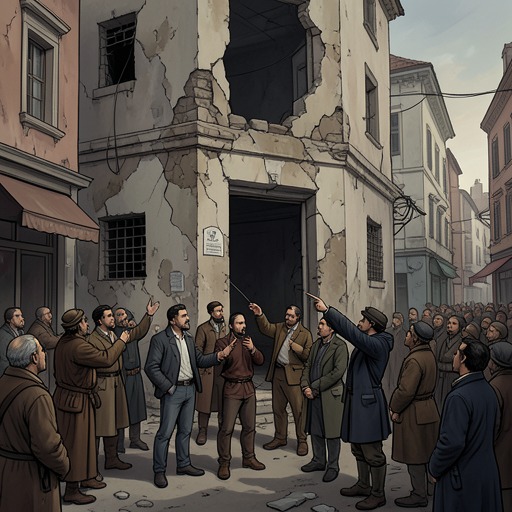
The church’s physical condition was contested. Architect Gris Marsala said that the building had suffered neglect for roughly 150 years but remained structurally sound, without irreversible cracks in its walls or vault. She identified the plaster fragment that had fallen and killed Father Urbizu as a localized defect, while rejecting the broad claim that the building was about to collapse. The contrast between that repairable damage and the sweeping case for demolition placed heritage preservation against the financial and institutional interests surrounding the land.
Institutional significance
The Government of Andalusia’s actions belong to a wider pattern in which formal authority and practical leverage are distributed among public agencies, church officials, and financial actors. The regional authority could remove administrative barriers to construction, but the narrative presents the resulting opportunity as only one part of a transaction whose outcome also depended on bank financing, national approval, a foreign buyer, and church decisions about its property.
The contrast is consequential: a protected-area project could advance after the regional government reversed its opposition, while a three-century-old church faced demolition despite an architect’s assessment that its structure remained sound. In this way, the Government’s planning role connects environmental and urban policy to the novel’s critique of institutional bargaining, speculative development, and the shifting of financial risk onto a bank and its conservative small shareholders.