Gris Marsala
La piel del tamborGris Marsala is an American religious sister and restoration architect whose work at a deteriorating Seville church makes her both its practical guardian and one of the novel’s clearest voices for memory. Though formally still a member of her order, she lives under an indefinite dispensation rather than having left religious life. She argues that buildings, paintings, and books preserve the past that allows people to know who they are; when such things are destroyed, people are made more orphaned. Her commitment to the church is therefore at once professional, historical, and personal.
Identity and Background
When Lorenzo Quart first encounters her inside the church, Gris is high on scaffolding photographing the leaded glass of the windows. She is in her forties, with gray hair tied in a short braid at the nape of her neck, a long-sleeved polo shirt, plaster-stained jeans, and sneakers. She climbs down from the metal structure with agility. Her practical clothes and ease on the scaffolding make her look almost like a younger woman from behind, while her gray hair and lined face mark the years she has lived.
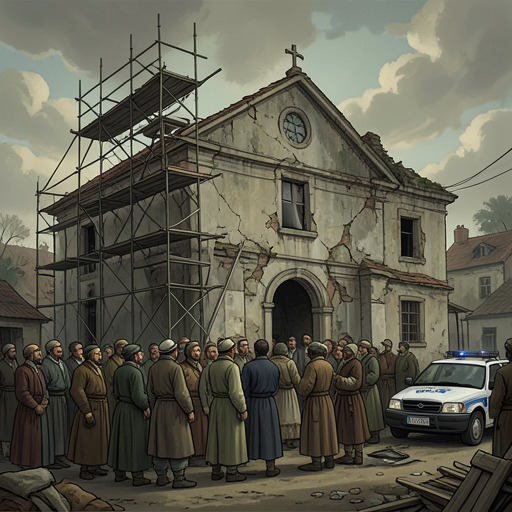
Gris is a North American architect responsible for the church’s restoration, a position she has held for two years on behalf of the Eurnekian Foundation. The foundation supplied a third of the original restoration budget. The project began with Gris and two Spanish colleagues, but both colleagues left; funding failed to arrive, and the work fell nearly still. The church’s damaged condition, then, is not evidence of her indifference or lack of expertise: it is the visible result of a project deprived of the money it needs. She tells Quart that the restoration has been nearly paralyzed for some time, and adds that the church has also been marked by two deaths.
Her history, later summarized in a report Quart receives from Rome, gives a more complicated shape to her apparent distance from convent life. She entered a religious order at eighteen, studied architecture and fine arts at the University of Los Angeles, and pursued specialized courses in Seville, Madrid, and Rome. After a distinguished academic record, she taught art for seven years and directed a religious university college in Santa Barbara for four. A personal crisis accompanied by health complications led to an indefinite temporary dispensation. She has spent years in Seville teaching fine arts to American students, lives in a private home, and maintains little contact with a local house of her order. She has not sought to leave religious life, and the report notes no special training in computer science.
Work at the Church and Its Stakes
Gris’s restoration work places her among the people resisting the church’s decline. She is not simply an observer of the building’s ruin: she climbs its scaffolding, photographs its windows, and accepts responsibility for the restoration even as budgets and personnel disappear. The contrast between her activity and the stalled project makes the limits of individual care plain. Commitment can preserve the work’s purpose, but it cannot conjure the missing funds or reverse the broader neglect on its own.
She understands the church as one part of a much larger inheritance. Speaking with Quart, she rejects the idea that there are too many old places to preserve. A building, an old painting, or an ancient book, she insists, belongs to humanity’s memory; to lose one is to become poorer. She makes this case with particular force because she is American: her nationality, she says, does not separate her from Europe’s inheritance but makes its preservation a matter shared across borders. No one has the right to let that inheritance disappear.
For Gris, memory is more than an archive of attractive objects. She says Europe’s long memory can be encountered by entering a place, looking across a landscape, or leaning against an old wall: the past, personal recollection, and the self are all present there. She has been made an orphan several times, and describes orphanhood as a form of slavery. Memory provides steadiness, a sense of identity and direction; without it, a person is vulnerable to whoever arrives and claims the power to define them. Her conclusion is political as well as intimate: defending memory is defending freedom, and only angels can afford to remain spectators.
Religious Status and Relationships
To Quart, Gris first appears as a capable but unconventional restoration architect. He learns from the church hierarchy that she is also a nun. Aquilino Corvo describes her as an American sister, an expert in religious-monument restoration, and a member of Príamo Ferro’s informal camp alongside Óscar Lobato and Macarena Bruner. Corvo cannot order her away: she has the dispensations of her order and is outside his jurisdiction. Her position makes her an awkward presence in the church dispute, aligned with its defenders but not subject to the local prelate’s direct command.
Gris’s religious life is neither a simple rejection nor an uncomplicated return to the order. She has not formally requested separation from religious life, yet her dispensation is indefinite, her contact with her order is slight, and her daily life is based in a private home. When Quart asks whether she might return, she cannot say. The answer may depend on the church and on what happens there; she thinks that may be why she has stayed. Her spiritual status is thus suspended rather than resolved, just as the restoration itself is suspended between purpose and abandonment.
She also becomes an intermediary between Quart and Macarena. Gris tells him that Macarena visits the church each morning and comes with her mother on Thursdays and Sundays. She passes along Macarena’s remarks about him, including that he is not as different from Príamo as he imagines and that she finds him attractive. Gris presents the information with a teasing smile, but gives Quart no reason to treat her as a romantic rival: when he asks about their friendship, she laughs and says she is not a lesbian. She describes herself as forty-six and a virgin by vows and by her own choice. The candor joins self-possession to religious discipline without making either an explanation for the other.
Memory, Emptiness, and the Church
Gris’s attachment to the church has an inward dimension that she does not fully resolve. She asks Quart whether he has ever felt an unexpected emptiness where he believes his heart to be, as if it briefly stopped before life continued. The moment leaves a person wondering whether something is wrong. She does not claim that the church will answer that question; she says only that some places contain answers, and that this intuition can keep a person circling a place, watchful. Her decision to remain in Seville is therefore connected to a search whose object remains uncertain.
Her comments about memory make this uncertainty more than a private mood. If remembering gives a person bearings, then the destruction of a place threatens not only shared cultural inheritance but the possibility of finding oneself within a past. The church’s worn stones and damaged windows hold a history that cannot be replaced by a new building or by an abstract account of what once stood there. Gris’s conservation work gives her conviction a material form: the claim that memory must be defended is enacted through the labor of documenting and restoring a particular place.
Later Scenes and Narrative Role
Gris reappears in the church while Quart is looking at the Virgin statue, whose face and garments bear Captain Xaloc’s twenty pearls. She quotes Genesis as she approaches him without being heard, moving quietly in her sneakers. Quart notices the scar on the inside of her right wrist, a pale line three centimeters long, and wonders whether it was intentional; the narrative does not settle the question. Gris lets the wrist cease to be hidden, then asks whether Quart has seen Macarena. Her presence connects the church’s devotional imagery and its contemporary community, while the scar introduces a private wound without disclosing its cause.
At another meeting, she stands by the holy-water font in the old blue polo and plaster-marked jeans. Her account of Europe’s long memory leads into Quart’s recollection of the report on her life, setting the facts of her education and religious career beside her own testimony about orphanhood and freedom. The juxtaposition leaves neither account sufficient by itself: official details describe the path that brought her to Seville, while Gris’s words show what preservation means to her now.
Later, after a police agent calls Simeón Navajo away, Quart finds Gris seated near the high altar, hugging her legs and resting her chin on her knees. Asked how she feels, she says she is dazed, though all right. The brief exchange does not explain her condition or provide a resolution to her uncertain religious future. It returns her to the church in a posture quieter than her work on the scaffolding, but still within the place on which she has chosen to wait. Across these scenes, Gris serves as the novel’s advocate for memory made tangible: not a guarantee that the past can be recovered, but a reason to resist letting it vanish without a struggle.