Jerzy Iwaszkiewicz
La piel del tamborJerzy Iwaszkiewicz is a cardinal, bishop of Kraków, and prefect of the Congregation for the Doctrine of the Faith. In the novel he embodies the Church’s formidable disciplinary power: at once a silent presence behind an investigation in Seville and an advocate of suppressing dissent in the name of institutional authority. His instructions to Lorenzo Quart make the investigation a test not only of facts, but also of who will control their public meaning.
Identity and Presence
Iwaszkiewicz was promoted to the cardinalate by Pope Wojtyła, his compatriot, and leads the Congregation for the Doctrine of the Faith, known before 1965 as the Holy Office or the Inquisition. When Quart first encounters him, he is a thin, motionless silhouette against a window. He does not answer Quart’s formal greeting, leaving Archbishop Paolo Spada to speak for him. The stillness is not incidental: Iwaszkiewicz’s authority is conveyed through his refusal to explain himself as much as through his office.
His institutional presence turns an ordinary briefing into a confrontation. Spada says that Iwaszkiewicz wants the Holy Office to intervene “the old way,” and Iwaszkiewicz lets the phrase stand. The prospect is not merely administrative: the Church has two recent deaths connected to the troubled parish, and the cardinal regards the matter as potentially worse than scandal. Yet the Pope wants a proper inquiry and considers direct Holy Office involvement excessive. Iwaszkiewicz’s preferred response is therefore checked, for the moment, by the need to proceed through a less openly coercive channel.
The Investigation and Its Limits
The initial decision assigns the inquiry to the Institute for External Works, with Quart as its investigator. Iwaszkiewicz insists that the assignment be understood as informational only. Quart must maintain “exquisite neutrality,” avoid publicity and scandal, and report what he finds so that later action can be determined from the evidence. The qualification “for the moment” leaves open the possibility that the matter could be transferred to the Congregation if serious grounds emerge.
The cardinal’s warning about truth sharpens the restrictions. He distinguishes truth itself from truth aired publicly, cautioning Quart that in the present age disclosure does not invariably make people free. His invocation of God accompanies a demand for silence, making religious language serve both as spiritual assurance and as institutional discipline. The inquiry may uncover facts, but Iwaszkiewicz seeks to control when and how those facts become public.
When Iwaszkiewicz speaks of transferring the case to the “official arm of the Inquisition,” he is corrected: the Inquisition ceased to exist thirty years earlier. Spada immediately reformulates the proposal as a referral to the Congregation for the Doctrine of the Faith. The exchange exposes the tension between formal institutional change and the persistence of older methods and memories. Iwaszkiewicz’s office has a modern name; the threat implied by its predecessor remains legible.
Authority, Dissent, and Institutional Power
Spada later describes the Church’s struggle as a struggle for unquestioned authority. In his account, the Congregation’s importance has grown since the 1980s, and the Inquisition’s revival offers a means of silencing dissidents. He names intellectual disqualification, excommunication, and the stake as recurring instruments by which the Church has dealt with opponents. Iwaszkiewicz is identified as a representative of this reactionary, hard-line current, though the speech is Spada’s analysis rather than the cardinal’s own explanation.
That institutional conflict carries a personal history for Quart. Hearing the Inquisition invoked brings to mind Nelson Corona, a priest of the Liberation Church whose coffin Quart once supplied. The recollection connects the cardinal’s disciplinary world to the consequences of Church conflict beyond the meeting room: the debate over authority is not abstract to Quart, who has encountered its human cost.
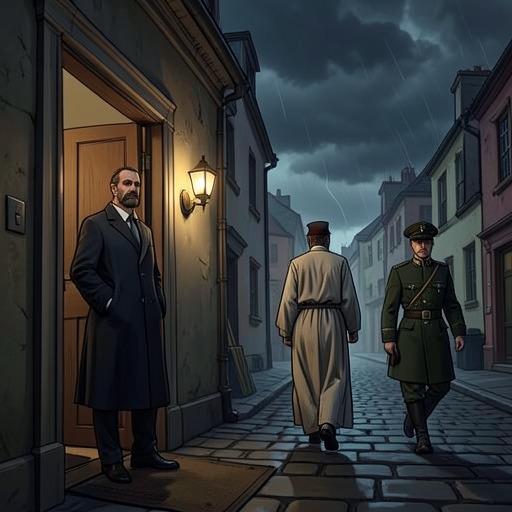
Iwaszkiewicz’s brief remark that “we no longer burn anyone” sounds less like a repudiation of the old practice than regret that it is unavailable. The line condenses the novel’s unease about institutions that change their language without necessarily surrendering their appetite for control. His own silence and Spada’s account together make him less a fully disclosed private character than the concentrated image of a system able to discipline through both visible force and carefully managed procedure.
The Seville Parish and the Limits of Compromise
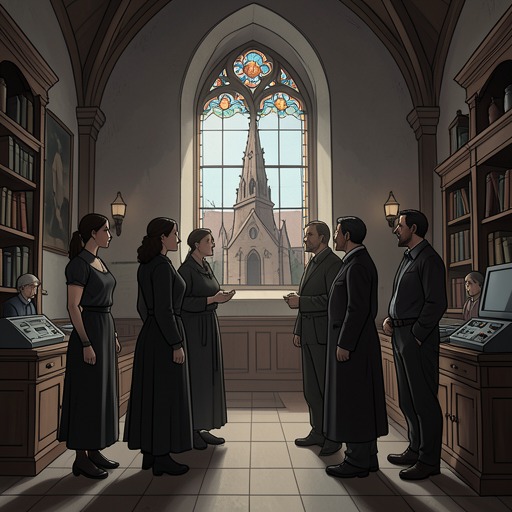
The same struggle over authority has a material stake in Seville. Archbishop Aquilino Corvo describes a Banco Cartujano plan to use the parish site, with compensation for the diocese, funding for a church in one of the city’s poorest neighborhoods, and support for social work among the Roma community. The arrangement is presented as a practical benefit, but it is stalled by the elderly parish priest’s refusal to yield. Corvo’s account shows how institutional leadership can frame a contested decision as a matter of financial necessity and charitable return.
The parish priest’s defiance sits within a broader crisis of the Church, as its critics see it. Óscar Lobato says that the Church has lost much of Europe through the Reformation, alienated reason, workers, youth, and women, and risks becoming empty pews inhabited by mice. He describes the immediate task as defending the parish from the submission and silence that Quart’s mission might bring. His indictment gives the local conflict a different meaning from Iwaszkiewicz’s: what the cardinal treats as a matter for controlled investigation and possible discipline, the parish’s defenders understand as a struggle over whether the Church can still serve its original message.
Iwaszkiewicz’s decisive role is therefore to define the boundary within which the inquiry may operate. He does not personally resolve the parish dispute in the supplied scenes, nor does the evidence establish what he ultimately does with Quart’s findings. Instead, he makes the stakes unmistakable: the investigation is authorized, but its neutrality, publicity, and eventual consequences are all subject to ecclesiastical power. The unspeaking silhouette at the window stands behind an institution that can call for facts while reserving the right to decide what those facts are allowed to mean.