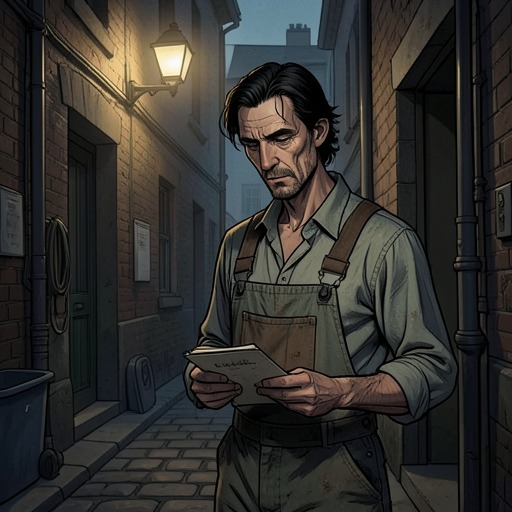
La ira de Dios
La piel del tambor“La ira de Dios” names a chapter and a charged idea in the novel: the possibility that violence inside a church might be read as divine punishment, even as the evidence points toward a human perpetrator. The expression resonates with the Thursday Mass that temporarily shields Nuestra Señora de las Lágrimas from demolition, and with Lorenzo Quart’s private suspicion that Father Príamo Ferro killed Honorato Bonafé. It holds sacred authority and earthly power together without resolving their boundary.
The chapter title and its image
The chapter opens with a brief, broken image: God’s wrath has vanished before human eyes, and no one can tell how. The lines offer neither an explanation nor a revelation. Instead, they frame disappearance itself as a problem of perception: a force may seem to have been present, yet its departure leaves no account of what happened. In the surrounding narrative, that uncertainty fits a world where religious language, institutional maneuvering, and physical violence overlap.
The title’s resonance is therefore not a simple claim that God intervenes. It makes divine anger available as a way to interpret events, while leaving open whether that interpretation reveals anything beyond human fear and suspicion.
A church protected by ritual and procedure
The church’s vulnerability is first described as a legal and ecclesiastical problem. Before demolition, it must be secularized, but an old privilege granted in 1687 provides that Nuestra Señora de las Lágrimas retains its rights so long as a Mass is celebrated there each Thursday for the soul of its benefactor, Gaspar Bruner de Lebrija. The Thursday service is tied to the day of his death; the privilege is not merely a devotional custom but a practical obstacle to redevelopment.
The Archbishop Aquilino Corvo distinguishes authority from discipline. He cannot simply prevent a parish priest from saying Mass, but he resents Father Ferro’s resistance to his pastorals and calls to order. Corvo has requested Ferro’s suspension from office, a process delayed in Rome; he also implies that the Vatican computer intrusion has made officials wait for Quart’s report. The conflict over the church thus passes through distinct channels: the old privilege, the local archbishop’s disciplinary authority, and a Roman procedure that moves too slowly to settle the immediate contest.
Macarena Bruner explains what that procedural stalemate looks like on the ground. Every Thursday at eight in the morning, an emissary of the Archbishop and a notary paid by Pencho Gavira sit at the back of the church, watching for an irregularity or lapse in the required Mass. The parish is impoverished: donations do not cover even the cost of candles, and the priest’s small salary cannot sustain the restoration. A ritual that might seem quaint has become a watched condition on which the building’s survival depends.
Suspicion and the human source of violence
The phrase takes on a darker, more personal meaning when Quart thinks about Bonafé, who was found dead in the confessional. Macarena invokes the biblical story of Uzzah, struck dead after daring to touch the Ark of the Covenant, but insists that Father Ferro would never commit such an act. Quart does not answer aloud. He privately imagines Ferro as the person who killed Bonafé, connecting the priest with what Macarena has cast as divine wrath.
That contrast does not establish supernatural punishment. It exposes the gap between a sacred explanation and a human suspicion: the language of God’s anger can frame a death, but Quart’s thought directs attention back to a possible perpetrator. The confession booth, a place associated with religious practice, becomes the setting of a killing whose meaning remains morally and spiritually unsettled.
Secrecy, power, and the unresolved meaning
Quart’s assignment reflects the same uncertainty at the institutional level. The director of the Institute for External Works sends him to Seville to identify the author of a letter, maintain prudent contact with local church authorities, and keep the inquiry discreet and reasonable. Later, after an audience with Corvo, Quart leaves the Archbishop’s Palace thinking of the old bishops’ prison where disobedient priests were confined. Modern telephones and ordinary correspondence have changed the means of communication, but the memory of coercive church discipline remains close to the present dispute.
Across these details, “La ira de Dios” gathers several kinds of force without equating them: the threat of demolition, the discipline of the hierarchy, the persistent ritual obligation, and the suspected killing of Bonafé. The chapter’s opening image of a wrath that has disappeared offers no final verdict. Rather, it sharpens the novel’s central ambiguity: religious terms can make violence intelligible, but they cannot by themselves determine who committed it, who benefits from it, or whether it was divine at all.