La misa de ocho
La piel del tamborLa misa de ocho is both a fixed hour in the life of Nuestra Señora de las Lágrimas and the novel’s culminating act of ritual continuity. Established as a condition attached to the church’s old privilege, the Thursday service has practical force in a demolition dispute; repeated by Lorenzo Quart at the end, it becomes a source of composure and a form of participation in the community he was sent to investigate.
The Mass as a Legal Condition
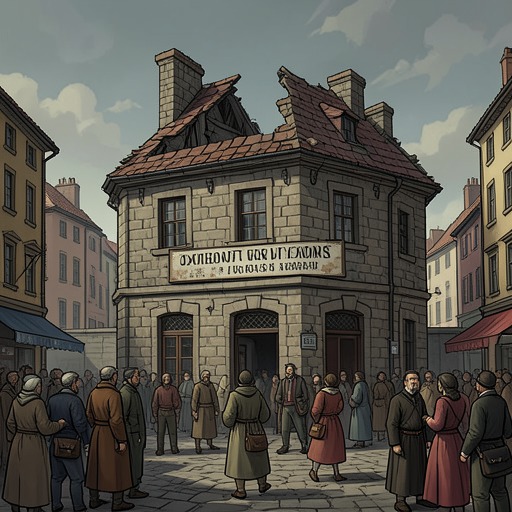
An ancient privilege granted in 1687 stipulates that Nuestra Señora de las Lágrimas must retain its rights so long as a Mass is said there each Thursday for the soul of its benefactor, Gaspar Bruner de Lebrija. The condition complicates the archbishop’s effort to secularize the building before demolition. The obligation is not merely a devotional custom: it gives the church a concrete defense against redevelopment, and makes the continued celebration of Mass a matter of property and ecclesiastical procedure.
The privilege requires the Thursday Mass at eight in the morning, the hour associated with Gaspar’s death in 1709. Príamo Ferro does more than meet that minimum: he celebrates Mass every day, and twice on Sundays and holy days. Macarena Bruner explains that each Thursday an envoy of the archbishop and a notary paid by Pencho Gavira sit in the last row, watching for an omission or mistake that could invalidate the condition. The service is thus observed both by the faithful and by those seeking grounds to end it.
The archbishop distinguishes the problem from a simple exercise of authority. He has sought Ferro’s suspension from office, but the process is slow; he also recognizes that he cannot straightforwardly prevent a parish priest from saying Mass. The old privilege, the priest’s persistence, and the rules governing discipline leave demolition caught in a procedural struggle. The service protects the church only while its terms continue to be fulfilled, so its repetition is both ordinary parish life and a precarious institutional safeguard.
Ferro’s Traditional Liturgy
Quart witnesses Ferro celebrating in a church still under repair, with the faithful gathered among scaffolding and displaced pews. The priest’s vestments mark his attachment to older forms: he wears the amice once customary before the Second Vatican Council and an old guitar-shaped chasuble. The congregation is modest and local—workers, retirees, housewives, older women—and Ferro’s unamplified voice fills the nave without hesitation.
Ferro also uses Latin for parts of the Mass not directed to the congregation or recited collectively. This departs from the Church’s post-Paul VI provisions that Mass be celebrated in the parish’s vernacular to encourage understanding and participation, though the practice is not described as a grave infraction and special privileges can permit Latin. His celebration therefore embodies a partial resistance to ecclesiastical modernization: the language and vestments preserve inherited forms even as the surrounding institution seeks to discipline him.
The effect on Quart is more complicated than his initial skepticism. At the altar, Ferro’s measured gestures and the handling of the host and chalice lend the old priest an authority that his worn clothing and provincial appearance otherwise conceal. Quart sees that the congregation’s attention does not depend solely on whether God rewards, condemns, or grants eternal life. In the silence, the people find consolation: warmth against cold, and a friendly hand in darkness. The ritual’s human effect becomes legible to him even while its theological claims remain uncertain.
Repetition, Memory, and Quart’s Turn
The Mass links repeated liturgical words to a history much older than the immediate redevelopment conflict. During the service Quart recognizes that the words Ferro repeats have endured for centuries; their continuity reaches, in the novel’s imagery, beneath the tears of Carlota Bruner and Captain Xaloc. What had looked to Quart like an eccentric priest’s stubbornness now appears as the making of a small refuge for people burdened by age and life. His attention shifts from judging Ferro to understanding what the priest’s actions sustain.
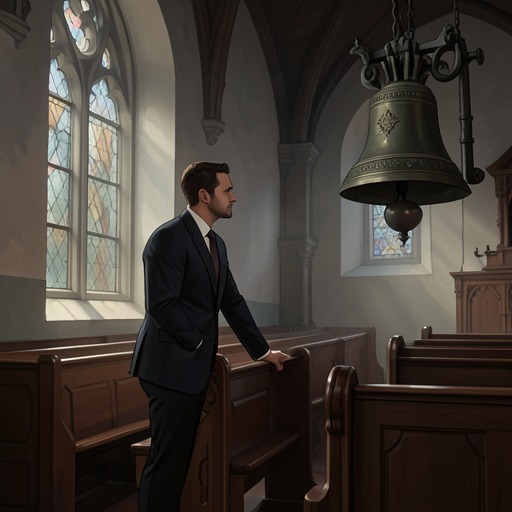
At the novel’s close, after Ferro is to go to prison for the killing of Honorato Bonafé, Quart returns to the church before the scheduled service. He waits for daylight without praying, uncertain before whom he could pray and unwilling to rely on the habits of professional discipline. Yet the old building offers a silent consolation. He rings the bell, waits, and rings it again; with fifteen minutes remaining before eight, he lights the retable and six candles, prepares the books and cruets, washes, and dresses for Mass in the order learned at the seminary.
Quart puts on the same disused amice he had noticed on Ferro, chooses a sufficiently long alb, and wears a worn white chasuble embroidered with a faded gold Christogram. The precise sequence of dressing and preparation steadies him. Although he has not slept, familiar movements bring peace, connecting his solitude to the solitary lives of generations of men who have repeated the ritual for nearly two thousand years. At the appointed hour, the service is no longer only the practice he was sent to examine: Quart has taken responsibility for carrying it forward.
Narrative and Thematic Significance
The chapter titled La misa de ocho follows an ending that resists uncomplicated happiness. Its final Mass does not resolve the church’s material damage or erase the consequences of Ferro’s crime and imprisonment. Instead, it returns the narrative to the hour around which the old privilege turns, making a recurring obligation into a personal act. The service’s significance lies precisely in this distinction: it can preserve a claim on the church, but it also gives the people gathered there consolation that no legal procedure can supply.
The closing scene keeps faith and doubt together. Quart does not suddenly become certain of God; the universe’s apparent indifference remains part of his reflection. But he proceeds through the ritual anyway, finding in its ordered gestures a way to inhabit uncertainty and a history shared with others. La misa de ocho therefore joins law, memory, and consolation: an inherited condition that delays demolition, an old priest’s daily practice, and Quart’s final, deliberate participation in the life of the threatened church.