La orfandad
La piel del tamborLa orfandad names more than the absence of parents: it is the condition of having no secure inheritance, history, or account of oneself. In the novel, memory can answer that condition. For Gris Marsala, discovering her ties to Europe turns estrangement into belonging; for Macarena Bruner, defending family and church history becomes a struggle against erasure. The contrast makes remembrance not nostalgia alone but a source of identity and freedom.
From estrangement to belonging
Gris explains that, as an American, she had sometimes felt that Europe’s old buildings were made by strangers. Then, one day, she understood that this history was her own: her ancestors had, in a sense, placed stone upon stone. A turn around a corner could become an act of recognition. She had thought herself orphaned and found that she was not; this recognition helps explain why she no longer wants to return to the United States.
Her account makes belonging an acquired recognition rather than an uncomplicated birthright. The city’s layered past—its different histories, ties, and prayers—offers a form of inheritance that exceeds individual recollection. Against the present-day distractions surrounding the Giralda, the surviving stones seem capable of speaking to anyone who will listen. History can make a stranger feel related to a place, but only when its traces remain available to be read.
Memory as freedom
Gris says she has been made an orphan several times and calls orphanhood a form of slavery. Memory gives a person poise: it helps establish who they are, where they are going, and where they will not go. Without it, a person is at the mercy of whoever arrives first and calls them a child. Her maxim, “Defender la memoria es defender la libertad,” links personal identity to resistance against imposed claims and dependence.
This is why she refuses the position of a detached spectator. Only angels, she says, can afford that luxury. The claim connects remembering to action: to defend a past is also to defend the right to define one’s place in the present. Her language turns a private sense of loss into a conflict over agency, inheritance, and who gets to name whom.
Macarena and an inherited world
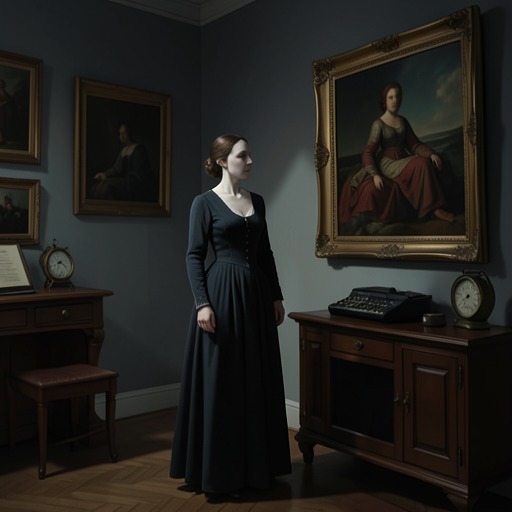
Gris sees Macarena Bruner as defending her own memory through particular remnants: certain recollections, her great-aunt’s trunk, and books that shaped her from childhood. She describes Macarena as an orphan clinging to what remains of a shipwreck. The image makes her attachment neither abstract nor secure: the inherited world has already disappeared, and what survives is fragmentary.
Macarena herself describes her struggle as a personal battle against time and oblivion. She belongs to an extinguishing caste and recognizes that there is no longer room for people like her family—or for memories like hers. She nevertheless intends to defend the things she loves, including Nuestra Señora de las Lágrimas and the memory of Carlota Bruner. Her readiness to accept an ending after fighting to the last makes the defense of memory a deliberate commitment rather than a promise that the lost world can be restored.
Objects and places as memory’s supports
The novel gives remembrance material forms. In Nuestra Señora de las Lágrimas, Quart descends past a rusted gate into a damp, dim burial chamber lined with memorial plaques. The Bruner arms and the motto “Oderint dum probent” preside over the tombs; among the names of dukes, discoverers, politicians, and soldiers, Carlota Victoria Amelia is the only woman named in the chamber. The old family burial place makes inherited history visible, while its decay and empty niches suggest how precarious that inheritance has become.
Carlota’s trunk preserves another kind of archive. It holds worn personal objects and a bundle of roughly fifty letters and postcards addressed to Captain Manuel Xaloc in Havana. The letters are in Carlota’s fine, slanting hand, but none bears a postmark; Macarena explains that her great-grandfather burned Xaloc’s letters as they arrived. What survives therefore records one side of a relationship while leaving the other irretrievably absent. The trunk preserves memory, but its silence also gives physical form to loss.
An old postcard of the church performs a similar work across time. Its image shows the building in 1895, in better condition than it is in Quart’s present, and brings an earlier street scene into view. Against the deteriorating church and the threatened inheritance Macarena defends, the postcard makes the distance between past and present tangible. Across the city, the tomb, the church, the trunk, and the surviving paper traces show that memory depends on things and places—and can be diminished when they are neglected, destroyed, or lost.