Lorenzo Quart
La piel del tamborLorenzo Quart is a priest and investigator for the Institute for External Works whose service is built less on religious certainty than on discipline, procedure, and exact observation. Sent from Rome to Seville to identify an anonymous hacker and assess a threatened parish, he arrives as an agent expected to report facts, not offer consolation. Yet the church, its people, and the consequences of his investigation gradually make that distinction harder to maintain.
Identity and Formation
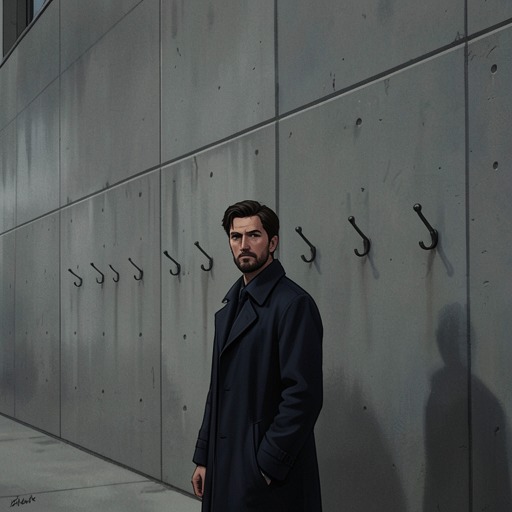
Quart is presented as an unusually controlled man. His dark clerical clothing is carefully maintained, and he observes the small rituals of his appearance with the precision of someone expecting an inspection. He has a navy silk tie for formal dress, replacing it with an identical one when it becomes worn or dirty; more often, he wears black Roman-collar shirts, which he irons himself. This self-discipline is not an incidental habit but an organizing principle: the rules governing his life offer a structure that belief itself does not.
Quart recognizes that charity and compassion are not his strengths, and that his disciplined nature does not make him humble. What he does possess is meticulousness and rigor, qualities that make him reliable to his superiors. His director treats him as a dependable instrument for difficult work. The contrast between his polished restraint and his limited confidence in the theological virtues establishes a central paradox: Quart can serve the Church effectively without possessing the inward certainty conventionally associated with religious vocation.
For Quart, faith is relative. The Church has provided something like the military institution it might offer another young man: a place where obedience to a framework settles many practical questions. Rules perform the work that faith does not. Archbishop Paolo Spada understands this partly ironic arrangement when he describes Quart as a good soldier. Quart’s pride and rigor, combined with his lack of settled belief, make him effective rather than simply disqualifying him from religious service.
The Mission in Seville
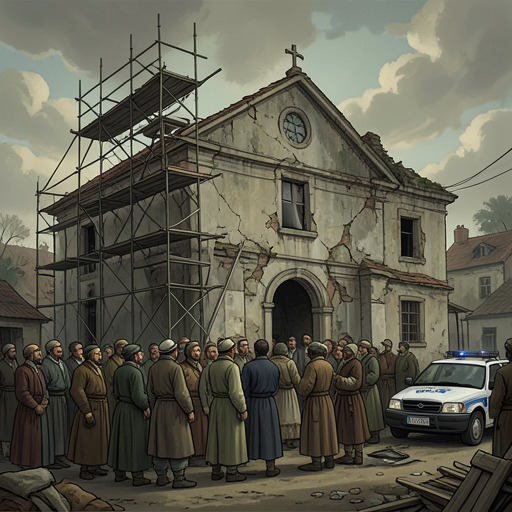
In early May, Quart receives orders in Rome to go to Seville and identify the author of an anonymous message. He is instructed to stay for several days, maintain prudent contact with the local ecclesiastical authorities, and handle the matter discreetly and reasonably. The assignment is investigative, but it also places him inside a local dispute over Nuestra Señora de las Lágrimas, whose demolition depends on first securing its secularization.
A privilege granted in 1687 complicates that process. The church is to retain its privileges so long as Mass is celebrated there each Thursday for the soul of its benefactor, Gaspar Bruner de Lebrija. The observance is tied to the day of his death, in 1709, and takes place at eight in the morning. As Quart learns, an envoy of the archbishop and a notary paid by Pencho Gavira attend the service, watching for an irregularity that could affect the church’s protection. The case is therefore not only a question of religious loyalty or property: its outcome turns on a repeated rite, an inherited condition, and the possibility that someone may fail to observe it correctly.
Quart’s inquiry expands beyond the hacker. His intended report is to cover the situation generally, including the possible identity of Vísperas. He also has to consider the police reports and the archdiocese’s inquiries into the deaths at the church, while keeping track of a postcard from Carlota Bruner and a biblical reference associated with her room. These strands remain distinct, but together they make the supposedly narrow assignment increasingly difficult to contain.
At first, Quart follows the investigative form with scrupulous neutrality. He prepares an eight-page report for Paolo Spada, transcribing his conversations with Archbishop Aquilino Corvo, Gris Marsala, and Father Príamo Ferro while deliberately withholding conclusions about the people, the church, and the hacker’s identity. His method is to document rather than decide. The report’s restraint reflects both professional discipline and his declared division of labor: he identifies facts and responsible parties, while others must determine what to do with them.
Encounter with Father Ferro
Quart’s encounters with Príamo Ferro test the limits of that detachment. When he asks how Ferro understands the claim that a church can kill in order to defend itself, Quart is trying to return from private speculation to the case at hand. He follows the required investigative procedure even when he believes it will accomplish little, asking whether Ferro understands the risks he faces and explaining that his report could become the starting point for serious disciplinary action. Ferro is sixty-four and near retirement, but Quart knows that age alone cannot protect him from his superiors’ scrutiny.
The force of ritual complicates Quart’s assessment. During Mass, he is moved, despite his technical skepticism and his disdain for Ferro’s rough presentation, by the solemn gestures and words. The ritual gives the elderly parish priest an authority that his worn clothing does not convey outside the service. After the Mass ends, Quart remains seated in the emptied church. Ferro leaves without looking toward him; Macarena Bruner passes without acknowledging him, and, after the other people have gone, Quart is left alone in the dim interior. The scene does not turn him into a believer. It does, however, show that he can be affected by the religious form he would otherwise analyze from a distance.
Ferro gives Quart a stark account of human life: people remember, fear, and die. He describes faith as a form of hope and consolation against the prospect that individual lives will disappear without a surviving memory. He also argues that the Baroque church’s images, gilding, and dramatic forms can sustain those who come seeking faith, whereas excessive analysis can destroy hope. Quart does not simply accept this argument, but he understands Ferro’s attachment to the church and recognizes that his own understanding does not answer the immediate human need Ferro describes.
Quart nevertheless insists that understanding Ferro is not the same as helping him. He calls himself a soldier, one who reports facts and searches for those responsible, not the compassionate cleric that others may have expected Rome to send. This self-description captures his role at the mission’s outset, but it also reveals its weakness: a strictly procedural account cannot settle what responsibility demands once the facts concern a threatened parish and vulnerable people.
Relationships, Pressure, and Change
Quart’s work brings him into contact with Macarena Bruner, whose attachment to the church and connection to its history form part of the mystery he is investigating. A warning makes clear that Quart has entered a web of consequential places and relationships: Seville, the church, Ferro, and Macarena are all named as matters he does not yet understand. The warning also marks the difference between an assignment that can be completed on paper and a local situation whose effects may not remain safely at a distance.
He continues to address the institutional problem directly. When Octavio Machuca notes that the disciplinary action against Ferro is proceeding slowly because the Roman priest has not gathered enough evidence, Quart’s investigation is revealed as a constraint on what local authorities can do. The lack of proof has consequences for Ferro’s immediate position, even as the church’s status remains tied to the Thursday Mass and the 1687 privilege.
The question of Vísperas eventually becomes less important to Quart than Ferro’s situation and the future of Nuestra Señora de las Lágrimas. He calls the hacker an incidental matter whose identity will become known sooner or later, and says that his report should enable decisions about the priest and the church to be made with knowledge of the facts. His priorities have changed in emphasis: the original objective remains, but the human and institutional stakes of the report now take precedence over solving the technical puzzle for its own sake.
Quart’s growing involvement is not a conversion to uncomplicated belief. His reflections remain shadowed by the possibility that the universe is indifferent and human life insignificant; in conversation, he considers the comfort offered by an understanding presence before all things end. He is still watching the clock, weighing evidence, and preparing reports. What changes is the object of his attention: he increasingly sees that the case cannot be responsibly reduced to the identity of an intruder or a list of infractions.
The Priest Behind the Investigator
At a police station, Quart approaches Ferro, who is being held in a small room under guard, and kneels before the older priest. The gesture reverses the professional distance that has defined their exchanges. Quart’s action is not presented as a finding in his investigation but as a priestly response to Ferro’s condition, recognizing a responsibility that cannot be discharged by documentation alone.
He later returns to Nuestra Señora de las Lágrimas before the eight o’clock Mass. Quart rings the church bell, waits a quarter of an hour, and rings it again with two final, separated strokes; fifteen minutes remain before the service. The action places him inside the church’s ritual time and its threatened continuity. The weekly observance that once appeared to Quart as a legal condition to monitor has become something he himself helps to enact.
This trajectory does not erase Quart’s skepticism or turn discipline into faith. Instead, it makes his disciplined service more personal: he remains the investigator who must distinguish evidence from assumption, but he also becomes willing to act within the ritual and pastoral responsibilities of his office. His defining significance lies in that uneasy passage from reporting on other people’s faith to performing an act of care within a religious community whose beliefs he cannot simply claim as his own.