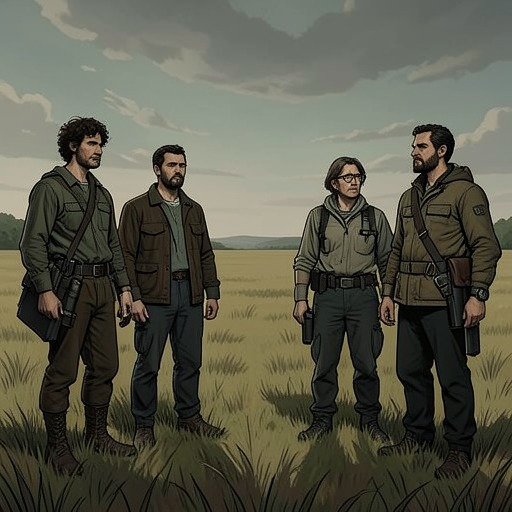
Lorenzo Quart—Príamo Ferro
La piel del tamborThe relationship between Lorenzo Quart and Príamo Ferro develops from wary opposition into a temporary spiritual and human fellowship. Sent by the Institute for External Works to investigate the church and its parish priest, Quart initially sees Ferro through the lens of ecclesiastical discipline and political conflict. But witnessing Ferro celebrate Mass, and later hearing him speak of unanswered prayer, death, and the need to console the living, unsettles that distance. Their affinity remains brief and unresolved: it rests less on shared doctrine than on recognition between two solitary priests confronting the limits of certainty.
An investigation shaped by institutional conflict
Quart arrives in Seville on the Institute for External Works director’s instructions: identify the writer of a letter, maintain prudent contact with local church authorities, and handle the matter discreetly. The assignment places him between the Roman institution that sent him and the local church whose fate is entangled with the threatened demolition of Nuestra Señora de las Lágrimas.
Archbishop Aquilino Corvo explains that demolition requires the church to be secularized, but an old privilege, granted in 1687 with papal sanction, protects its rights as long as Mass is celebrated there each Thursday for the soul of its benefactor, Gaspar Bruner de Lebrija. The weekday service is not incidental: Gaspar died on a Thursday, and the condition makes the parish’s continued observance a practical obstacle to redevelopment.
The legal and ecclesiastical complication sharpens the conflict between Quart and Ferro. Corvo says the problem is not his authority to prevent a priest from celebrating Mass, but Ferro’s refusal to heed pastoral directives. The archbishop has requested Ferro’s suspension from office, a process moving slowly in Rome. He also implies that officials there expect Quart to return with a report that could settle the matter. Quart reads Corvo’s approach as an effort to pass responsibility down the chain while keeping his own hands clean.
From disdain to recognition at Mass
At first, Quart’s judgment of Ferro is colored by the contrast between the priest’s rough appearance and the authority of his office. During Mass, however, the old parish priest’s gestures and words alter that impression. His worn cassock, unpolished shoes, and threadbare vestments do not diminish the solemnity of the rite; in the sanctuary, they seem almost to disappear beneath its accumulated meaning.
Quart watches Ferro celebrate before a congregation of roughly twenty people, many of them tired and old, their attention fixed on the priest’s hands and voice. He recognizes that the service offers them more than an argument about whether God exists: it gives them comfort, warmth against cold, and the feeling of a companion in darkness. Quart repeats the words of consecration inwardly, aware that he has crossed a threshold in understanding the church, its priest, and his own presence there.
That recognition does not turn into an immediate conversation. After Mass, Ferro leaves without looking toward Quart, and the worshippers—including Macarena Bruner—depart one by one. Óscar Lobato extinguishes the candles and the retable’s electric lights, while Quart remains alone in the dim church. The silence lets the scene’s effect settle: he can no longer dismiss Ferro merely as a stubborn provincial priest, because he has seen the small refuge the man creates for his parishioners.
Gris Marsala later warns Quart that certain places and people cannot be passed through without consequence. She names the city, the church, Ferro, and Macarena, and cautions him to understand what he is entering. Her warning frames the relationship as more than an official encounter: Quart is being drawn into a world whose claims cannot be neutralized by treating it as a case file.
A fragile fellowship between priests
A change becomes palpable when Quart and Ferro meet in the dovecote. Ferro lights a cigarette with a match cupped in his hand, and Quart notices a flicker of interest or curiosity in the priest’s dark eyes. The elevated space, set between earth and sky, seems to suspend their mutual distrust. Quart feels the rare impulse of fellowship that can arise between one cleric and another: two lost, solitary soldiers recognizing each other amid a hostile field.
Their exchange turns on the question of forgiveness and belief. Quart insists that forgiveness belongs to God, not to him. Ferro responds by recalling the learning he acquired as a young priest, when he read ancient philosophy from Socrates to Augustine, and the lasting taste of melancholy and disillusionment that remained after he forgot its arguments. At sixty-four, he says, what he knows of human beings is that they remember, fear, and die.
Ferro describes a quarter-century of isolation: forgotten by his bishop and the people around him, he celebrated Mass on Sundays in a small, nearly empty church and walked through snow, rain, and mud to administer the last rites to the elderly. At the bedsides of the dying, people clung to his hands because he was their only consolation. He prayed in one direction and received no answer. The confession gives Quart a way to understand the priest’s defiance that institutional labels cannot supply: Ferro’s tenacity has grown alongside long exposure to suffering and unanswered appeal.
For the first time, Quart understands the man before him, and Ferro seems to recognize that he has been understood. Their connection is not an easy reconciliation. It emerges through a shared awareness of what death does to human claims of permanence, and through the possibility that standing beside another person may matter even when no answer comes from above.
Faith, ritual, and the work of consolation
Ferro’s defense of Nuestra Señora de las Lágrimas does not depend on his claiming unshakable personal faith. He says the people who come to the church do have faith, and that their need is sufficient reason for the church to exist. In his account, the baroque sanctuary—with its carvings, gilding, and theatrical force—is a shelter built from symbols, protecting people from a world in which close analysis can strip away hope.
Quart challenges this defense as alienation, comparing the church’s function to television in the seventeenth century. Ferro accepts the provocation but counters that religious art once competed for attention with the Reformation, just as the modern papacy depends on television. He distrusts Mass turned into electronic spectacle, arguing that the church’s old stones, retable, and Latin are more dignified than amplified music and giant screens. Their disagreement is real: Quart questions the ethics of consolation offered through symbolic spectacle, while Ferro insists that bare faith cannot sustain the vulnerable.
Macarena explains how the Thursday obligation intensifies that defense in practical terms. Nuestra Señora de las Lágrimas remains protected only while Mass is said for Gaspar Bruner de Lebrija every Thursday at eight in the morning. A representative of the archbishop and a notary paid by Pencho Gavira wait at the back of the church, watching for an irregularity or omission that might end the protection. The old privilege thus joins spiritual practice to property and power: a repeated rite carries both the parishioners’ need for consolation and the building’s chance of survival.
Ferro argues that the parish must remain standing for the poor woman who still needs to kneel in search of hope or comfort. Priests like him, with all their miserable human limitations, remain necessary, he says, like the old, patched skin of a drum on which the glory of God still sounds. That image links his ministry to endurance rather than certainty. The service of the church is not, in his account, proof that doubt has vanished; it is work done while doubt and death remain.
A temporary alliance, not a resolution
The quietest sign of intimacy comes after Ferro has finished speaking. He closes the conversation, goes to the window, and looks toward the river; Quart joins him at the sill. They stand close, the priest’s head reaching only to Quart’s shoulder, and remain there in silence as Seville’s clocks strike six. The pause carries what neither man can settle in argument: a moment of proximity between two men who have recognized a similar burden.
Their affinity is expressed again in a conversation about astronomy. Quart says the subject seems close to despair. Ferro answers that it can instead bring serenity, because the pain of loss reveals what is grave, valuable, and transcendent. Against the image of a person as a tiny drop in the sea of the universe, he sets the possibility of a friendly hand offering resignation and comfort before the stars go out and the cold arrives. Quart reaches for the lamp, and its light makes the stars disappear. The gesture closes the exchange without disproving either man’s view.
The relationship remains constrained by the institutions surrounding them. Quart’s mission begins as an inquiry for Rome; Ferro is subject to Corvo’s disciplinary authority and the slow procedures of the Roman church. Even so, Quart’s departure from the Archbishop’s Palace recalls an older form of coercion: looking toward the Giralda, he thinks of the former episcopal prison where disobedient priests were confined and imagines that he and Ferro might once have exchanged views there while Corvo sent his account to Rome by a slow, ordinary route. Modern communications have changed the machinery, not erased the imbalance.
At this stage, the bond is best understood as a brief recognition rather than a settled alliance. Quart does not adopt Ferro’s defense of baroque ritual without reservation, and Ferro does not relinquish his distrust or his uncompromising commitment to the parish. Yet Quart’s encounter with the Mass and the priest’s account of a life among the dying changes the terms of his judgment. Their shared ground is the fragile human need for consolation—and the possibility that, in a universe that may offer no reply, one person can still remain beside another.