Maitines
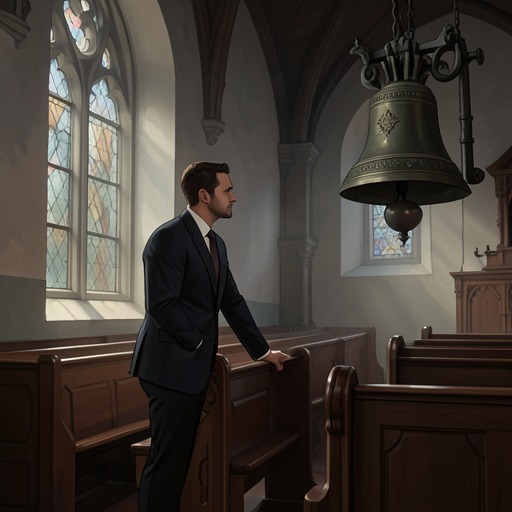
La piel del tamborMaitines, or Matins, is the dawn office in the cycle of canonical prayers that Lorenzo Quart follows with exacting regularity. It is not merely a devotional item on his schedule: alongside the other hours of the breviary, it gives form to his solitary working life, while the novel places disciplined prayer beside the communal ritual of Mass at Nuestra Señora de las Lágrimas. There, repetition carries both spiritual and practical force, sustaining worshippers and preserving a legal privilege that stands in the way of demolition.
Quart’s Rule of Prayer
In Seville, Quart takes an old copy of Bernard of Clairvaux’s In Praise of the New Knighthood to the Cervecería Giralda while he waits for an appointment at the Archbishopric. He alternates reading the medieval sermon with the breviary’s Maitines, Laudes, Vísperas, and Completas, observing the sequence rigorously. The routine is presented as an expression of his meticulous discipline, rooted less in piety than in pride. In the long intervals of a professional life spent in hotels, cafés, and airports, the book and the hours help him endure the solitude of his vocation; the routine gives an ordered shape to time that might otherwise be only waiting between journeys and appointments. The habit is part of Quart’s soldierly self-conception. Reading the medieval guide of the warrior monks, he imagines himself as a last survivor of their defeats and imprisonments, a tired, solitary Templar whose friends are all dead. Maitines thus belongs to a private structure of endurance: prayer and reading do not erase his isolation, but give it a repeated form he can inhabit.
The Parish’s Repeated Masses
The novel sets Quart’s personal observance against the public schedule at Nuestra Señora de las Lágrimas. Príamo Ferro says Mass every day at eight in the morning, and twice on Sundays and holy days. Quart attends one morning service in a church partly occupied by scaffolding: around twenty modest parishioners fill half the nave, while the remaining benches are stacked against the walls. Ferro celebrates beneath the illuminated altarpiece, with Óscar Lobato assisting him. The service makes tradition visible in Ferro’s clothes and gestures. He wears an amice, a pre–Second Vatican Council garment retained by only very old or highly traditional celebrants, and an old guitar-shaped chasuble, less convenient than the lighter style that replaced it. He reads the Gospel from memory and speaks in a firm, unmodulated voice. During the offertory he elevates the host and chalice, then washes his hands with water poured by his acolyte. These repeated actions lend the aged parish priest an authority that Quart’s initial disdain for him had obscured. Ferro also uses Latin for parts of the Mass not directly addressed to the congregation or recited collectively. The practice is not described as a grave violation: churches with special privileges may retain Latin, and the Pope himself sometimes celebrates in it. But Church provisions since Paul VI require Mass in each parish’s own language to improve understanding and participation. Ferro’s selective use of the old language therefore marks his incomplete accommodation to ecclesiastical modernity, even as its familiar solemnity deepens the service’s effect on Quart.
Repetition as Protection
The parish’s weekly obligation has consequences beyond worship. An old privilege granted in 1687, with papal sanction, requires a Thursday Mass for the soul of Gaspar Bruner de Lebrija, the church’s benefactor. As long as the Mass is said, the church retains its fueros. Gaspar died on a Thursday in 1709, and the inherited condition makes the repeated service a safeguard against secularization and demolition. Macarena Bruner explains the pressure this creates. Each Thursday, an emissary of the Archbishopric and a notary paid by Pencho Gavira watch from the last pew, waiting for an irregularity or lapse. The Archbishop has sought the suspension of Ferro from office, but the procedure moves slowly; he cannot simply prevent a parish priest from saying Mass. The ritual therefore operates at once as a recurring act of worship and as the condition on which the church’s protection depends. Its continuity is vulnerable: Macarena fears that if Óscar Lobato is removed from the parish, those seeking the church’s demolition may try something against Ferro.
Quart’s Recognition of Consolation
At Ferro’s altar, Quart’s understanding shifts. Despite his technical skepticism and his contempt for the priest, he is moved by the solemnity of the ritual. The congregation’s grave, attentive faces matter to him more in that moment than the question of whether a God dispenses reward, punishment, damnation, or eternal life. What the Mass provides is consolation: warmth against cold, or a friendly hand in darkness. Quart repeats the words of the consecration inwardly with the people gathered around him. That recognition changes how he sees the church and his assignment. Ferro is no longer only a provincial priest defying his superiors; he is creating a modest refuge through inherited words and gestures for people burdened by age and daily life. The daily Mass and Quart’s own canonical hours are distinct practices, but together they make repetition a counterforce to isolation: one orders the investigator’s private endurance, the other gathers a vulnerable parish into a shared moment of comfort. The church’s survival, meanwhile, remains attached to the exact recurrence of the Thursday service.