Manuel Xaloc
La piel del tamborManuel Xaloc is a merchant sailor whose love for Carlota Bruner is first obstructed by her family and then defeated by time and madness. Recounted by Macarena Bruner during a night walk with Lorenzo Quart, his story joins a private tragedy to the public violence of the Cuban War: a rejected lover returns with twenty pearls, leaves them at the church where he and Carlota had hoped to marry, and later dies leading his armed yacht into battle.
Identity and Background
Xaloc was a poor, thirty-year-old second officer aboard a steamer running between Seville and Sanlúcar when he met Carlota. She was a sheltered young woman from a powerful family, accustomed to an artificial world of protection and romantic novels; Macarena describes Xaloc as a real man, and their love as the sudden force that made Carlota unable to return to her former life. His shipboard uniform may have helped attract her, but the story presents the attachment as more than a passing fascination: after their first meeting, both remained bound to the possibility of a life together.
That possibility was cut off by Carlota’s great-grandfather, Luis Bruner. After Xaloc was discovered lingering near the gates of Casa del Postigo, Luis had him dismissed from his post and used his considerable influence to prevent him from finding other work. Xaloc’s departure for America was therefore not simply an adventure or a chosen career move; it followed a deliberate effort to exclude him from Seville and from Carlota. She was not even allowed to say goodbye.
Separation and the Return
Xaloc sailed from Seville aboard the schooner Nausicaa. From the palomar, Carlota watched the vessel move downriver. She later insisted that she had seen him on the stern waving a handkerchief, though Macarena observes that he must have been too far away to distinguish. The image becomes an emblem of their separation: a farewell that Carlota could not share in person, preserved instead as a scene she continued to believe she had witnessed.
In the Caribbean, Xaloc prospered. He took command of a ship and smuggled between Mexico, Florida, and the Cuban coast. Reports associated him with piracy as well as contraband: vessels encountered on his route were sometimes found mysteriously plundered or had disappeared altogether. He moved quickly to make his fortune and return, and during six years at sea acquired a reputation serious enough for the Americans to put a price on his head. At last he came back to the same place from which he had left, carrying bank drafts and gold coins, as well as a velvet bag holding twenty extraordinary pearls intended for his wedding to Carlota.
His return was an act of faith in a promise made years earlier. Xaloc had received no news from Carlota, but believed that Luis Bruner had cut off communication between them. He trusted her words that she would wait. In one painful sense, she had: she remained in the tower, looking toward the river. But she had lost her reason two years before Xaloc came home, and waiting had become a condition detached from the life they might once have shared.
The Failed Reunion and the Pearls
Luis Bruner initially refused to arrange a meeting, blaming Xaloc for Carlota’s misfortune. He eventually relented on the advice of doctors and at his wife’s request. Xaloc arrived at the family courtyard in the uniform of the merchant navy, its dark blue set off by gold buttons. Years in the sun had darkened his skin, and his moustache and sideburns had turned gray; he looked, Macarena says, twenty years older than his actual age.
Carlota did not recognize him. She treated him as a stranger and said nothing to him. After ten minutes, a clock sounded. She announced that she had to return to the tower because he might come back at any moment, then left the courtyard. The scene reverses the lovers’ old separation: Xaloc is present, yet the person he crossed an ocean to find cannot see him as the man she once loved. The waiting that sustained their romance has survived only in a form that prevents reunion.
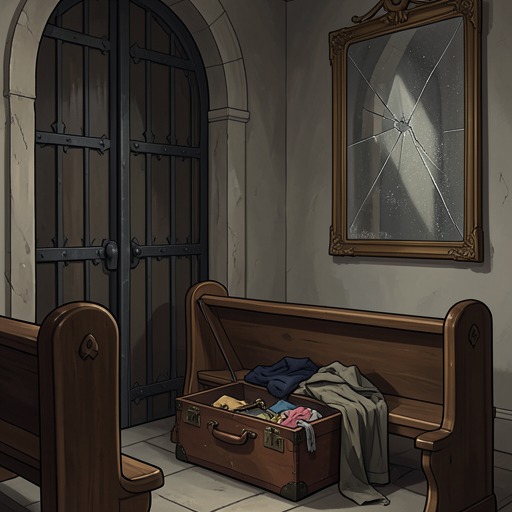
Xaloc did not speak. With Carlota’s grandmother weeping and her grandfather sunk in despair, he picked up his cap and left. He went to the church where he and Carlota had dreamed of marrying and gave the parish priest her twenty pearls. That night he walked through Santa Cruz; at dawn he departed on the first schooner to cast off. This time, no one saw him wave a handkerchief. The pearls remain the most tangible link between the lost marriage and the story’s later history: Macarena identifies them as Carlota’s tears and Xaloc’s testament.
The Last Spanish Privateer
Xaloc’s second departure carried him into the events of 1898. While he was sailing back, the Maine exploded in the port of Havana, and the Spanish government authorized privateering against the United States. Xaloc quickly obtained a commission. His fast armed yacht, the Manigua, had a crew recruited among the roughest men of the Antilles, and he used it to run the blockade. In June 1898 he attacked and sank two merchant vessels in the Gulf of Mexico; a night encounter with the gunboat Sheridan left both ships badly damaged.
Macarena takes evident pride in what followed, calling Xaloc the last Spanish corsair and the only one to operate during the Cuban War. He broke the blockade of Santiago harbor at night, carrying messages and supplies to Admiral Cervera. On July 3, as the Spanish squadron prepared to leave, Xaloc could have remained in port: he was a merchant sailor, not under the squadron’s orders, and the Spanish ships were old, poorly armed, and expected to be overwhelmed by American battleships and cruisers. He chose to sail with them.
Xaloc left last, after the other Spanish ships had been sunk or were burning. He made no attempt to escape. With the black pennant flying beside the Spanish flag, he drove the Manigua at full speed toward the enemy vessels and was still trying to ram the battleship Indiana when his yacht went down. There were no survivors. His final action gives his story a grim reversal: the sailor who once risked everything to return to Carlota ultimately steered toward a battle he could not expect to survive.
Narrative Significance
Xaloc’s life reaches Quart through Macarena’s recollection, not through a scene narrated from Xaloc’s own perspective. It is told as a family legend, but its details—ships, routes, dates, a privateering commission, and the final attack—give the romance the outline of a historical account. Macarena’s pride in him complicates the language of the sentimental tale she recognizes: Xaloc is not only the rejected lover of a melodrama but also a smuggler, a suspected pirate, and a combatant whose last decision is described with admiration.
The story’s recurring objects and departures hold together what the family’s actions have broken. The handkerchief first belongs to a farewell Carlota may only have imagined; at Xaloc’s final departure, no one sees it waved. The twenty pearls, brought back for a wedding that cannot take place, are left at the church instead. By calling them Carlota’s tears and Xaloc’s testament, Macarena turns a failed gift into a memorial. His legend is thus both an account of a sailor’s rise and death and a record of how inherited power separated two people so completely that, when they finally stood together, their shared past could no longer be recognized.