Manuel Xaloc's Twenty Pearls
La piel del tamborManuel Xaloc's Twenty Pearls are a bridal dowry transformed into a church offering: the necklace Manuel Xaloc had gathered for Carlota Bruner became the twenty pearls worn by the Virgin of Our Lady of Tears. Left in Seville when Xaloc returned to Havana to join the war, they preserve the trace of a marriage that never took place—and of Carlota's wish to be married in that church.
Origin and Intended Use
Before returning to Havana, Manuel Xaloc left in Seville the dowry he had brought for Carlota Bruner. The twenty pearls were intended for a necklace she would wear on their wedding day. The choice of gift tied a particular object to a future the couple expected to share: the pearls were not simply valuable adornment but part of a wedding that Carlota had imagined taking place at Our Lady of Tears.
From Dowry to Devotional Offering
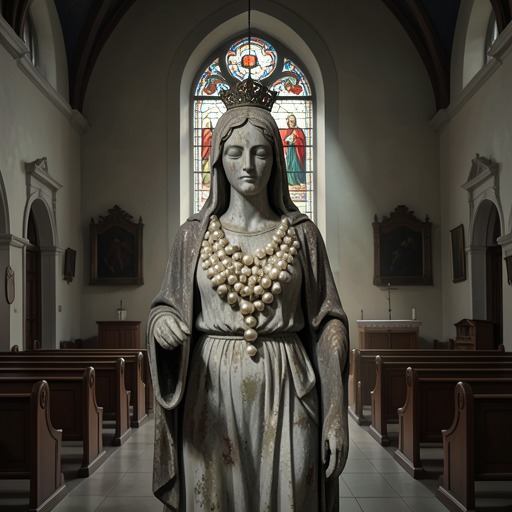
Instead of reaching Carlota as bridal jewelry, the pearls came to adorn the Virgin of Our Lady of Tears. When Gris Marsala led Lorenzo Quart from the crypt and illuminated the main altar so he could see the statue more clearly, the pearls shone across its face, among the crown of stars, and on the blue mantle. On the Virgin's breast was a heart pierced by seven daggers; the pearls thus appeared within a devotional image whose visible features were distinct from the necklace for which Xaloc had collected them.
Meaning and Narrative Significance
The pearls make Carlota's absent wedding materially present in the church she had chosen for it. Their transfer does not erase their original association with the couple: the bridal intention remains legible in the very object now serving a sacred image. The contrast between a promised wedding necklace and the Virgin's public adornment concentrates the story's movement from private love toward loss and memory, without turning the pearls into a fulfilled substitute for the marriage.
Their place on the statue also prompts Quart's next question. Thinking of a postcard with no postmark and of letters that had failed to arrive, he asks how Carlota and Manuel could have maintained correspondence during their years apart. The pearls therefore connect the church's visible image to the still-unresolved history of the lovers' separation and the missing letters.