Original Pearls from the Virgin Statue
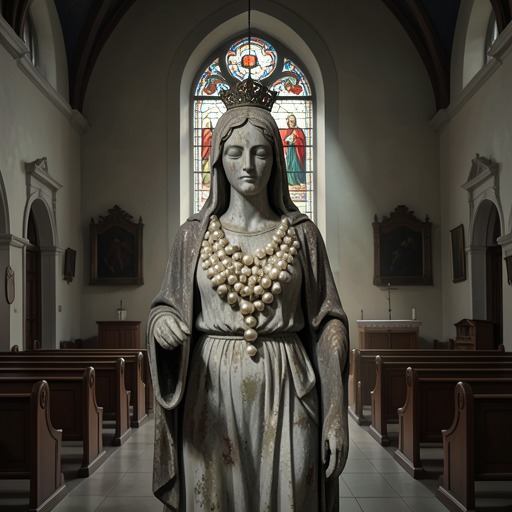
La piel del tamborThe Original Pearls from the Virgin Statue were twenty pearls set into the face, mantle, and crown of the Virgin image at Nuestra Señora de las Lágrimas. Months before their discovery, all twenty had been replaced by imitations. The substitution turns the pearls from devotional adornment into material evidence: their apparent absence helps explain how restoration work resumed, while a single pearl found on Honorato Bonafé connects the substitution to his death and to suspicion surrounding Father Príamo Ferro.
The pearls and the church
The pearls belonged to the statue at the center of a church already caught between conservation and demolition. Gris Marsala, the architect responsible for its restoration, described a building neglected for a century and a half but still structurally sound: the damage, she said, was chiefly to the plaster, and roof repairs had required nearly ten tons of material to be carried fifteen meters up. The contrast matters to the pearls’ later significance. The church’s survival depended on resources that its parish income could not provide, making the objects part of a story about both sacred inheritance and the practical cost of keeping the building standing.
The conflict also had a formal legal and ecclesiastical dimension. An alleged privilege granted in 1687 required a Thursday Mass for the soul of Gaspar Bruner de Lebrija, the church’s benefactor, as a condition of its continuing protected status. Macarena explained that a representative of the archbishop and a notary paid by Pencho Gavira watched the weekly service for any lapse that might remove this obstacle to demolition. The parish was financially desperate: its collection barely covered candle wax, and Father Ferro’s small salary could not account for substantial building expenses.
Substitution and the restoration funds
Police inquiries established that someone had exchanged all twenty original pearls for identical imitations months before Bonafé’s death. The trail led investigators toward Francisco Montegrifo, a Madrid art dealer who had previously been Father Ferro’s contact in the irregular sale of an altarpiece from Cillas de Ansó. Evidence also suggested that Montegrifo had circulated Captain Xaloc’s pearls; a police informant’s description of a batch of pearls in the hands of a Catalan jeweler was consistent with that lead. Investigators could not prove Montegrifo’s alleged intermediary role, but considered the indications substantial.
The timing gave the substitution a practical consequence. The informant’s date for the pearls’ circulation coincided with the resumption of work at the church, when masonry supplies were bought and machinery was rented. Suppliers told Subcommissioner Simeón Navajo’s men that the cost of deliveries exceeded what the parish priest’s salary and the church’s collection could support. The investigation therefore connected the missing originals, the sale of pearls, and otherwise unexplained restoration spending, without establishing that connection as conclusive proof of who arranged the exchange.
The pearl on Bonafé
A small nacreous object found in Bonafé’s jacket pocket gave the investigation its most immediate physical link to the statue. Navajo identified it as one of the twenty pearls and told Lorenzo Quart that it was an imitation, like the other nineteen. Bonafé had been on the scaffolding at the high altar when Father Ferro surprised him. The pearl thus placed an object from the substituted set on the dead journalist, while also suggesting he had discovered that the statue’s pearls were false.
Navajo reconstructed a possible sequence: Bonafé may have gone to the church, confirmed the substitution, and tried to blackmail Ferro—or Ferro may have caught him before he could do so. In this account, the priest might have killed Bonafé, locked the sacristy door, spent hours in the tower of Casa del Postigo, and then disappeared for a day. These were investigative conjectures, not a demonstrated account. Navajo stressed that Ferro had refused to explain his disappearance, and Quart supplied no clarification, leaving the pearl incriminating but not self-explanatory.
Significance and unresolved evidence
The originals matter because their replacement made a devotional object part of a chain of material and financial clues. The statue’s jewels were not merely background ornament: their exchange may have generated funds at a moment when the restoration was otherwise beyond the parish’s means, and their imitation counterparts made the theft harder to recognize until Bonafé examined them. At the same time, the evidence does not establish who ordered the substitution or prove that the sale proceeds financed the work.
The investigation ends this evidence sequence with competing meanings rather than a settled attribution. To the police, the imitation pearl in Bonafé’s pocket helps establish a possible motive and a route to Ferro; to the church, the restoration expenditure belongs to an effort to preserve a building threatened by demolition; and to Quart, the police account leaves a conspicuous silence around the priest’s disappearance. The originals are therefore significant both as lost sacred property and as the absent objects around which the novel’s suspicions gather.