Our Lady of Tears Parish
La piel del tamborOur Lady of Tears Parish is the small, impoverished community served by the aging Baroque church of Nuestra Señora de las Lágrimas in Seville’s Santa Cruz district. Its fragile hold on the building depends not only on worshippers and a priest’s persistence but on a 1687 privilege requiring Mass for its benefactor, Gaspar Bruner de Lebrija, every Thursday. As the church’s stalled restoration draws the attention of the archbishop, the city, and a bank-linked aristocratic family, the parish becomes a place where religious practice carries legal consequence and local devotion resists the conversion of inherited memory into disposable property.
Setting and Community
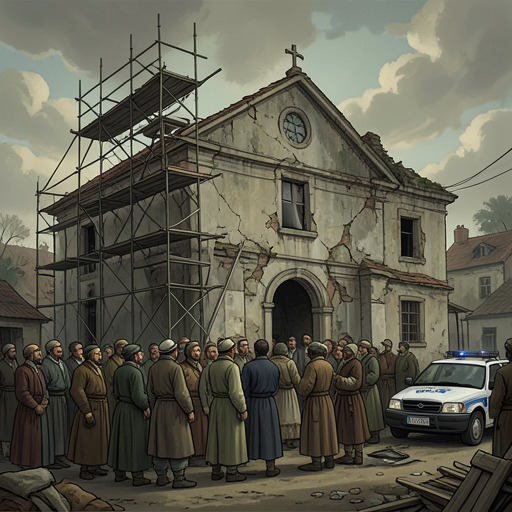
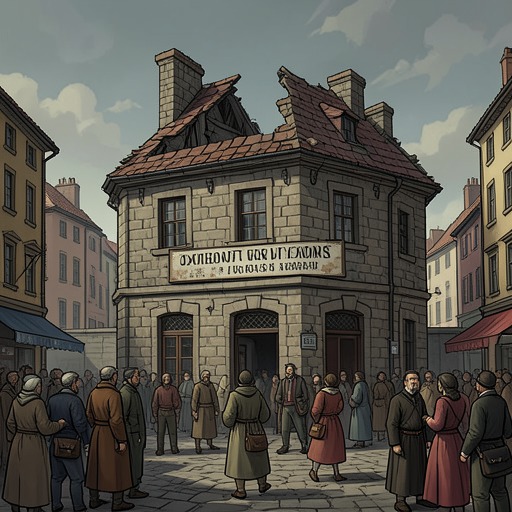
The church stands in Santa Cruz, the former Jewish quarter rebuilt in the early twentieth century, near Seville Cathedral and the Archbishop’s Palace. It is described as old, small, ruinous, and partly restored: work has stopped for lack of money, leaving the fabric of the building exposed to a threat of collapse and the prospect of demolition. The site’s location makes the deterioration more than a local maintenance problem. The municipality wants to expropriate it, while an aristocratic family connected to a bank invokes secular rights; the competing claims put the parish within a broader struggle over valuable historic land.
The congregation is modest, and its resources are correspondingly precarious. The parish priest’s salary is small, and Sunday collections do not cover even the cost of candles. Macarena Bruner tells Lorenzo Quart that she and the duchess have only enough for their own living expenses, while the church’s restoration remains unfinished. Her image of explorers under circling vultures gives the financial crisis a sense of siege: the parish is not simply waiting for repairs, but trying to remain present while more powerful institutions and interests watch for an opportunity to prevail.
The worshipping community is visible in the ordinary people who come through the church despite its condition. At an early-morning Mass, about twenty parishioners occupy half the nave, while unused pews and kneelers are stacked against the walls between scaffolding. The congregation includes older people, modestly dressed neighbors, workers about to begin the day, retirees, and homemakers with shopping baskets or carts; a few elderly women wear black, and one kneels beneath an old-fashioned Mass veil. Niña Puñales, who says she sometimes attends Mass there, is another sign that the church’s devotional life extends beyond the aristocratic family whose history is tied to its legal protections.
Worship and the Parish’s Claim to the Church
The church’s most consequential religious practice is the Thursday Mass established by the privilege granted in 1687. The building is to retain its special status while Mass is said for the soul of Gaspar Bruner de Lebrija, its benefactor, on the day of his death. The requirement is specific enough to be monitored: every Thursday at eight in the morning, an emissary of the archbishop and a notary paid by Pencho Gavira sit in the last row, watching for an irregularity or an omission that could undermine the church’s protection.
The condition is not merely archival. Father Príamo Ferro celebrates Mass daily at eight, except on Sundays and holy days, when he celebrates twice; his regular practice therefore exceeds the minimum required by the privilege. The archbishop acknowledges that Ferro says Mass every Thursday and describes the old grant as decisive while it remains in force. The ritual’s repeated hour and day give the parish a way to hold its ground, but they also make the service an object of surveillance: a liturgy performed for the dead is scrutinized by living officials and commercial agents because its proper observance affects the fate of the building.
Quart witnesses the particular character of Ferro’s worship during a morning service. Ferro reads the Gospel in white vestments, wearing an amice beneath his chasuble and stole, and an old guitar-shaped chasuble that had been displaced by a lighter, more convenient design. These vestments mark him as unusually traditional, a quality reflected in his broader ministry. His voice fills the small nave without microphones, steady and uninflected as he reads a text he has repeated throughout his life. In the half-used, scaffolded church, the Mass gives the parish a continuing public form: the building may be incomplete, but its central act has not stopped.
Authority, Discipline, and the Threat of Demolition
The parish’s survival is entangled with church governance as well as property law. The archbishop, Aquilino Corvo, says secularization of the building—a prerequisite for demolition—has become complicated because of the old privilege. At the same time, he presents Ferro as a disciplinary problem. The priest maintains personal positions and disregards the archbishop’s pastorals and calls to order; Corvo has asked Rome to suspend him ab officio, but says such proceedings take time. The local bishop’s authority is therefore neither absent nor unlimited: he can initiate a disciplinary process, yet cannot simply prevent a parish priest from celebrating Mass, and the privilege gives Ferro’s continued practice consequences beyond the normal parish routine.
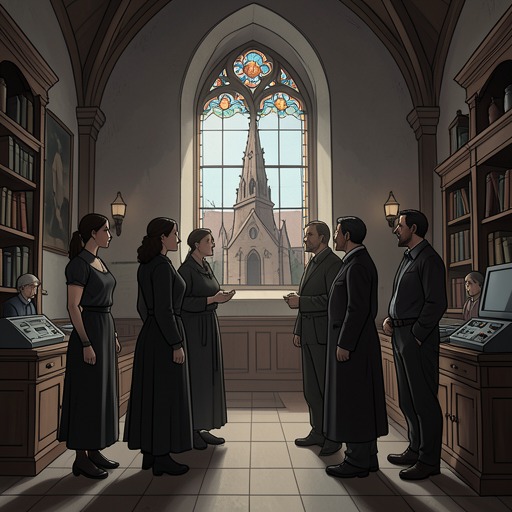
The dispute also becomes part of Quart’s assignment from the Institute for External Works. He is sent to Seville to identify the author of a letter, maintain discreet contact with the local ecclesiastical authorities, and handle the affair through reasonable channels. Corvo suggests that the Vatican’s response to Ferro may be waiting on Quart’s report, turning the investigator into a participant in a slow institutional process. The parish thus stands between overlapping jurisdictions: the local archbishop’s disciplinary concerns, Rome’s delayed procedure, the old grant’s religious and legal force, and secular plans for the land.
Corvo does not describe Ferro as wholly without support. Though he minimizes the size of the congregation, he admits that the priest is loved in the parish; neighbors greet him, and a group of women attends Mass. The archbishop has considered damaging Ferro’s standing among parishioners as a deterrent, but worries that this could do more harm than good. He calls the priest obstinate but sincere and recognizes an obligation to the people. That hesitation complicates any simple picture of the parish as a community controlled from above: even Corvo’s attempt to manage Ferro is checked by the prospect of injuring those whom the institution is meant to serve.
Memory and the Parish’s Stakes
For Macarena, the church’s future belongs to a personal battle against time and forgetting. She identifies herself with an aristocratic caste that is disappearing and says she is defending both the space she inhabits and the stories she loves. Among them is the history of Carlota Bruner, her great-aunt, and Manuel Xaloc, a sailor without fortune. When Xaloc emigrated to America, Carlota wrote to him almost weekly for years, but her father, Luis Bruner, bribed the city’s postal officials to intercept their correspondence. Neither lover received the letters. Xaloc returned to seek Carlota only after she had lost her reason; she spent her days looking toward the river and did not recognize him.
Carlota’s lost correspondence makes the parish’s threatened survival resonate beyond the mechanics of the 1687 grant. Macarena’s defense of Nuestra Señora de las Lágrimas is also an effort to preserve a setting bound to family memory, in a city and social order where inherited names and stories are losing their former force. The Thursday Mass keeps Gaspar Bruner’s name present through a repeated rite; the church itself shelters the material trace of the family’s history. Its preservation would not undo what happened to Carlota, but demolition would make the loss of place accompany the already irreparable loss of the people and correspondence attached to it.
Macarena’s concern is sharpened by the possibility that Father Óscar will be transferred away from the parish. She fears that, with the vicar removed, someone may try something against Ferro, whose Masses keep the privilege alive. The detail shows how the parish’s protection depends on particular people as well as written conditions: the old grant can be invoked only so long as its required ritual is actually performed. In this community, worship, memory, and the defense of a building are not separate causes. Their convergence makes the parish’s precarious existence one of the novel’s clearest tests of whether inherited obligations can still resist institutional convenience and commercial power.