Seville Archdiocese
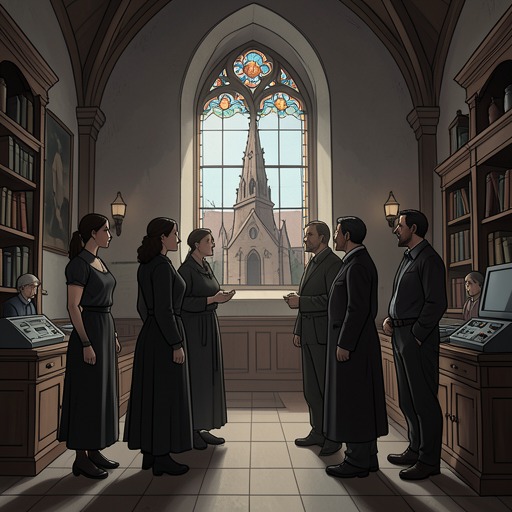
La piel del tamborThe Seville Archdiocese is the local church authority whose handling of Nuestra Señora de las Lágrimas places ecclesiastical jurisdiction in direct conflict with parish practice and commercial redevelopment. It can negotiate with Rome and discipline clergy, but its efforts to secularize the church are checked by a 1687 privilege requiring a Thursday Mass for Gaspar Bruner de Lebrija; as the crisis deepens, the archdiocese alternates between pressing its case and disclaiming responsibility for the consequences.
Authority and the Investigation
When the Holy Father seeks a formal inquiry into the anonymous Vatican intrusion, the Roman authorities assign the investigation to the Institute for External Works rather than immediately involving the Congregation for the Doctrine of the Faith. Lorenzo Quart is sent to Seville to identify the hacker and maintain discreet contact with the local church authority. The remit makes the archdiocese both a necessary local counterpart and a party whose interests the investigation may expose.
The distinction between Rome’s investigation and the archdiocese’s own authority becomes politically charged. Paolo Spada explains that the affair would ordinarily belong to the Archbishop of Seville and his relations with diocesan parish priests; papal attention, however, turns even a seemingly minor hacking incident into an opportunity in the Roman Curia’s internal struggle. Spada chooses Quart as his best investigator partly to produce a substantial report that will satisfy the Pope and help keep Cardinal Iwaszkiewicz in check.
The Church, the Privilege, and Redevelopment
Archbishop Aquilino Corvo tells Quart that secularizing Nuestra Señora de las Lágrimas, a necessary step before demolition, has become difficult because of an old privilege granted in 1687 with papal sanction. The condition is specific: Mass must be said in the church every Thursday for the soul of its benefactor, Gaspar Bruner de Lebrija. Corvo says Bruner died on a Thursday; later, Macarena Bruner identifies the date as 1709 and explains that the weekly service is held at eight in the morning.
Príamo Ferro does more than satisfy the condition: he celebrates Mass every day, at eight in the morning, and twice on Sundays and feast days. The privilege therefore gives the parish’s ritual calendar a practical legal consequence. On Thursdays, an emissary of the archbishop and a notary paid by Pencho Gavira watch from the last row, each alert to a lapse that could release the site for demolition. The service is at once an act of worship and the fragile condition on which the church’s protection depends.
The archdiocese is not merely opposed by an inflexible legal obstacle; its leadership also has a material stake in the proposed transaction. Corvo says Banco Cartujano has prepared a plan to use the site and offer the diocese generous compensation, despite its having no more than a moral claim to the land based on three centuries of worship. The bank also promises funding for a church in one of Seville’s poorest districts and a foundation supporting social work among the Roma community. Corvo presents those benefits against the parish’s financial hardship, while Quart recognizes that the arrangement would make demolition possible if Ferro’s Thursday observance could be stopped.
Discipline, Delay, and Disavowal
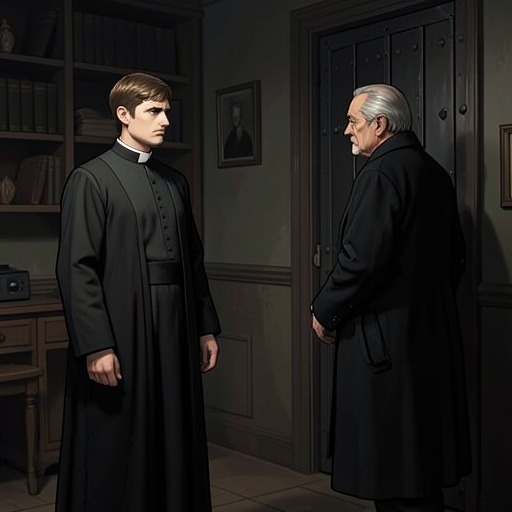
Corvo insists that his conflict with Ferro is not simply a question of episcopal authority: an archbishop cannot prevent a parish priest from saying Mass. He describes Ferro as personally defiant of pastoral instructions and disciplinary calls, and says he has requested the priest’s suspension from office in Rome. The procedure is slow, however, and Corvo suspects the Vatican intrusion has made Roman officials wait for Quart’s report before acting. Until then, the redevelopment remains suspended in uncertainty.
In his private conversation with Quart, Corvo portrays the archbishop’s office as a burden of managing incompatible demands. He describes himself as a temporary administrator of the Church’s accumulated thought and teaching, while also having to deal in practical financial values, negotiate with enemies, and sometimes condemn friends. He says Ferro’s case could have been resolved gradually, but that Rome’s intervention has changed the terms; invoking the maxim that Rome has spoken and the matter is settled, he says he will now observe rather than intervene and leaves the field to those he calls executioners.
The archdiocese’s withdrawal becomes explicit after the investigation turns toward the parish and its priest. Corvo tells Quart that the matter belongs to Rome and that he is washing his hands of it, while offering the formal support and prayers expected of his office. At the police station, Simeón Navajo reports that the archbishop called not to take part in the case but to distance himself and ask that journalists be kept away. The contrast is telling: the archdiocese’s institutional voice remains present, but its practical posture is one of carefully managed non-involvement.
Outcomes and Institutional Significance
The archdiocese’s position ultimately changes. Paolo Spada later tells Quart that the Nunciature in Madrid and the Seville Archdiocese have received instructions to preserve Nuestra Señora de las Lágrimas and appoint a new parish priest. Quart’s appeal to the symbolic value of the church—the fragment of sky that would disappear, and the old drum skin patched again and again—has helped persuade the authorities. Preservation thus comes not through the archdiocese’s original redevelopment arrangement, but through a higher-level reversal that keeps the church open while replacing its priest.
The epilogue shows the consequences without suggesting that every institutional conflict has been resolved. A letter from Óscar Lobato reports that Nuestra Señora de las Lágrimas remains open for worship and continues to function as a parish. Príamo Ferro, meanwhile, is convicted of involuntary homicide, spends time in a prison hospital, and is later confined to a diocesan residence for elderly priests, where his health is poor. The archdiocese preserves the parish, but the priest whose daily Mass sustained its claim is removed from it.
Through this arc, the Seville Archdiocese embodies the distance between formal jurisdiction and lived religious practice. Its authority is real but constrained by procedure, Roman oversight, and the parish priest’s repeated observance; its public rationale includes charitable benefits, while its conduct also reflects the financial and institutional stakes of redevelopment. The Thursday Mass makes that tension concrete: a repeated rite keeps the church from being treated as an available site, even as officials wait for a procedural opening to end the protection it provides.